DeKalb, IL – The U.S. Department of Energy (DOE) has awarded a $2.6 million grant to Northern Illinois University and the University of Illinois Chicago to provide classroom training and research opportunities in computational high energy physics (HEP).
The CERN Data Center. Photo credit: CERN.
Over the next five years, the award is intended to provide two dozen master’s-level students in physics and computer science with stipends, tuition reimbursement and opportunities to collaborate with scientists at the DOE’s Argonne National Laboratory and Fermi National Accelerator Laboratory.
“The great thing about this grant is that the overwhelming majority of the funding goes directly to students,” said NIU Professor Jahred Adelman, a particle physicist who is leading the grant project. It’s known as the Chicagoland Computational Traineeship in High Energy Particle Physics, or C2-the-P2, for short. NIU physics faculty members Vishnu Zutshi, Jerry Blazey and Mike Eads also are involved.
C2-the-P2 is one of three projects that were selected by competitive peer review under a DOE funding opportunity announcement. The total funding is $10 million for the three projects lasting up to five years in duration, with $1 million in Fiscal Year 2022 dollars and outyear funding contingent on congressional appropriations.
HEP relies on increasingly complex software and computing to deliver scientific discoveries. The DOE funding supports training of the next generation of scientists to develop and maintain U.S. competitiveness globally in these important areas.
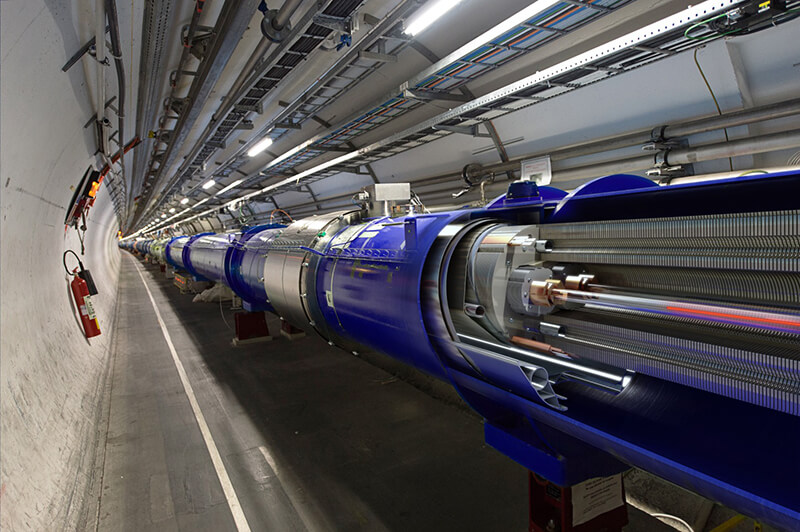
A cutaway of one of the dipole magnets that are used to steer proton beams around the Large Hadron Collider ring at CERN. Photo credit: CERN.
“Future high energy physics discoveries will require large accurate simulations and efficient collaborative software,” said Regina Rameika, DOE associate director of science for high energy physics. “These traineeships will educate the scientists and engineers necessary to design, develop, deploy and maintain the software and computing infrastructure essential for the future of high energy physics.”
Adelman and other particle physicists use particle accelerator experiments to understand how the smallest and most fundamental building blocks of the universe interact and talk to each other. Particle accelerators are devices that speed up the particles that make up all matter in the universe and collide them together or into a target. This allows scientists to study those particles and the forces that shape them.
One challenge at particle accelerator labs such as CERN in Europe, where Adelman conducts his research, and closer to home at Fermilab, is to develop new computational tools needed to parse and understand enormous amounts of data generated by particle accelerator experiments.
“There’s clearly a need for young scientists who are excited by particle physics and want to also learn software and computing skills,” Adelman said. “With this program, NIU and UIC are partnering with Fermilab and Argonne to train students who will develop expertise that really is needed for our field to succeed.”
HEP experiments at some of the world’s most advanced laboratories use software development that requires detailed knowledge and understanding of computing hardware systems. Traineeship students will work on and advance collaborative software environments that enable the sharing of tools and datasets in a coherent and efficient manner for hundreds or thousands of scientific users. Students will also develop software and algorithms that can take advantage of increasingly parallel computing platforms either synchronously or asynchronously
One student has already started in the traineeship at NIU. Both NIU and UIC are developing new courses for the program, and the institutions will jointly sponsor professional development opportunities and a computational seminar specifically for program participants.
Beyond skills acquired in the classroom, student theses will be devoted to computational HEP projects that are carried out with guidance from computational HEP experts. Projects will be in three target areas of need: hardware-software co-design, collaborative software infrastructure, and high-performance software and algorithms. Students will be able to graduate and move into the workforce or stay on to get their Ph.Ds. in HEP.
“Particle physics experiments provide incredible training opportunities for students,” Adelman said. “Students develop skills that are vital to our field and to all sorts of areas of the economy, such as data science, high-performance computing and optimization of new computing architectures. Some stay in academia, and others get great jobs that contribute enormously to our economy.”
Northern Illinois University is a student-centered, nationally recognized public research university, with expertise that benefits its region and spans the globe in a wide variety of fields, including the sciences, humanities, arts, business, engineering, education, health and law. Through its main campus in DeKalb, Illinois, and education centers for students and working professionals in Chicago, Naperville, Oregon and Rockford, NIU offers more than 100 areas of study while serving a diverse and international student body.
Date posted: November 15, 2022 | Author: Tom Parisi | Comments Off on $2.6M DOE award will support training in computational high energy physics
DeKalb, IL – A new study identifies the “circular economy” of seabirds linking land and sea and shows how invasive predators on an island can disrupt even what’s happening offshore beneath the waves.
What’s more, at the heart of it all is, well, bird poop.
Led by Professor Holly Jones of Northern Illinois University, the researchers studied four northern New Zealand islands in the same archipelago—two with histories of marauding invasive mammals such as rats, rabbits or cats and two that remain untouched by non-native predators.
Seabirds themselves are top hunters in the ocean, feeding on squid and fish. On the islands where they breed, the seabird guano, aka bird poop, is so rich in nitrogen and other nutrients that it’s sometimes called “white gold.” Along with the dead flesh of seabird prey, guano fertilizes island soil and runs off the islands into the sea, where it drives plant diversity and enriches nearshore aquatic ecosystems used by sea life as sources of habitat and protein.
The scientists hypothesized and demonstrated that the loss of island seabird populations would impact the composition and quality of nearshore seaweed, or macroalgae, which plays a vital role in fishery habitats, carbon sequestration and atmospheric oxygen production.
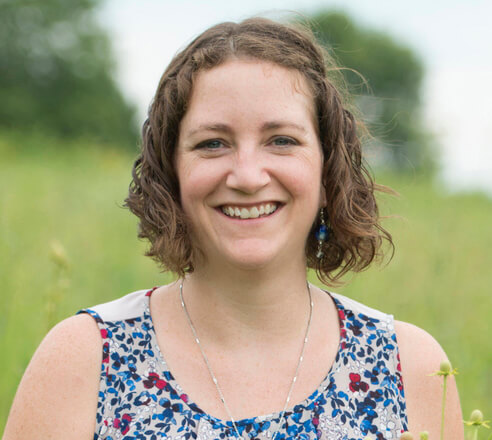
NIU Professor Holly Jones
“We found that nearly half of the variation in algae or seaweed-community composition in the nearshore ecosystem could actually be attributed to characteristics on the island—specifically seabird density, seabird-derived nutrients in soils and invasion history,” Jones said.
An island country, New Zealand’s only native mammals are bats, so invasive predators have particularly strong impacts. Globally, 31 percent of seabirds are threatened, the highest percentage of any bird group. Over the last four centuries, most species (including seabirds, mammals and reptiles) driven to extinction have been island species, with most of those extinctions caused by invasive predators.
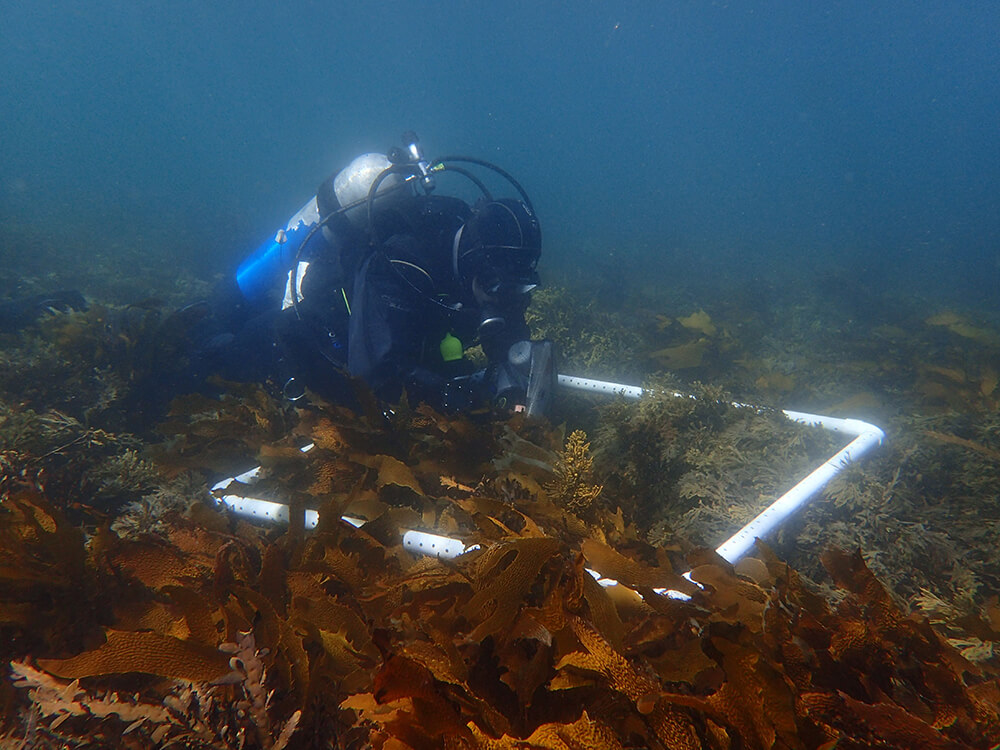
Lyndsay Rankin collects data on macroalgae community composition surrounding Korapuki, the Mercury Islands, Aotearoa, New Zealand. Photo credit: Evan Brown.
“By looking at the characteristics of certain seaweed communities, we could tell which islands had histories of invasive mammals, and the striking amount of variation confirms the importance of land-sea linkages that seabirds provide,” Jones said. “It was surprising to find that land variables are as important in driving the composition of seaweed communities as marine variables.”
Guano runoff from the islands fertilizes the nearshore ecosystem, impacting the abundance and types of seaweed species; it also enriches levels of nitrogen isotopes in the plants, making them more nutritious for sea creatures.
“Ocean herbivores need nutritious green stuff, and nutrient content in seaweed is passed up through trophic levels in the ocean,” Jones said.
“We found that nearshore ecosystem composition recovered more quickly than seaweed nutrient uptake,” she added. “On the island where invasive mammals were removed three decades ago, the composition of seaweed species was similar to the untouched islands. But nitrogen uptake levels in those species remained lower.”
Jones and her colleagues noted that some algae species are better indicators of seabird influence than others. On the two islands with predator invasion history, the researchers found four out of six species of seaweed studied showed depleted levels of seabird-derived nitrogen, indicating they had not fully recovered.
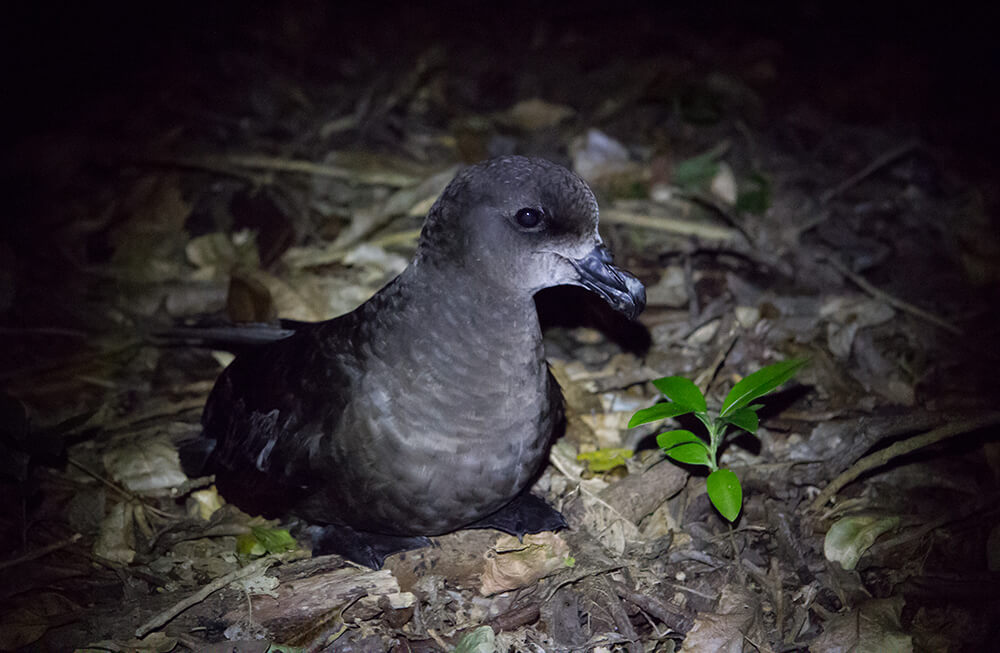
The studied islands are part of the Mercury Islands group, located eight kilometers off the east coast of the Coromandel, New Zealand. Burrowing seabirds that populate the islands include the fluttering shearwater, flesh-footed shearwater, little shearwater, Northern common diving petrel, Pycroft’s petrel, grey-faced petrel, white-faced storm petrel and little blue penguin.
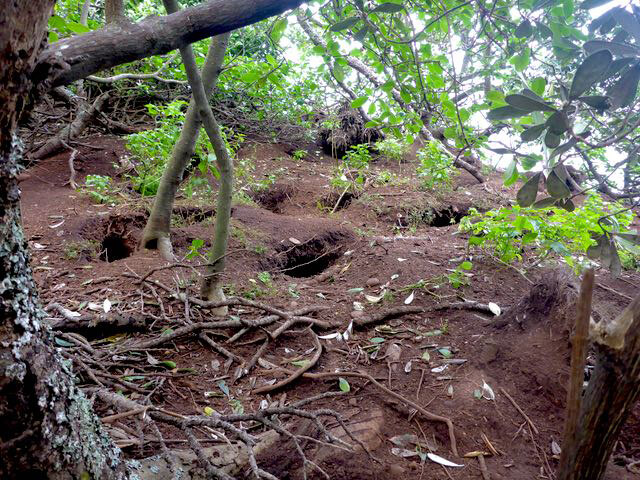
Among many variables studied, the scientists quantified burrow density on the islands. On the newly eradicated island of Ahuahu, only one apparently unoccupied burrow was discovered. The average seabird burrow density on the island of Korapuki, where predators were eradicated 30 years ago, was still only 14% of the burrow density on never invaded islands.
The researchers also calculated the density of the sea urchins offshore that feed off seaweed. Previous studies have noted the importance of herbivory in driving macroalgae community composition.
“Seabird burrow density, soil nutrients and invasion history together explained more variation in macroalgae than sea urchins, the predominant seaweed herbivore,” Jones said.
Predator eradication can lead to recovery of seabird colonization and is critical to restoring populations. But to better inform policy and restoration efforts, it is important to understand whether removing predators is enough to precipitate recovery of land-sea linkages.
“Our study findings suggest that seabirds take a long time to recover from mammal invasions, and their influence in terrestrial and marine food webs, also takes a long time,” Jones said. “This work is unique because most researchers study impacts of invasive mammals and island recovery either on land or at sea, but very rarely do they connect the two together.”
Northern Illinois University is a student-centered, nationally recognized public research university, with expertise that benefits its region and spans the globe in a wide variety of fields, including the sciences, humanities, arts, business, engineering, education, health and law. Through its main campus in DeKalb, Illinois, and education centers for students and working professionals in Chicago, Naperville, Oregon and Rockford, NIU offers more than 100 areas of study while serving a diverse and international student body.
Date posted: November 7, 2022 | Author: Tom Parisi | Comments Off on Oh, bird poop! Study shows invasive island predators can even disrupt life offshore
DeKalb, IL – NIU Chemistry Professor Tao Li has been awarded two new National Science Foundation (NSF) grants totaling $565,000 for energy-related research projects.
The work also promises to help hone research skills among as many as eight NIU graduate and undergraduate students.
Photo by Maksym Kaharlytskyi on Unsplash
The first project aims to develop an improved, cost effective and environmentally sound way to transform chemical compounds found in natural gas into other forms of petrochemical products.
The chemical compounds of interest are known as light alkanes, which are major components of fuels such as methane, propane, gasoline and diesel and are important raw materials in the chemical industry.
The low cost and increased supply of natural gas and natural gas liquids provides an opportunity to discover and develop new catalysts and processes to enable the direct conversion of natural gas and natural gas liquids into value-added chemicals with a lower carbon footprint, according to the National Academies of Sciences, Engineering and Medicine. Value-added chemicals would represent a higher-economic-value use of shale gas compared with its use as a fuel.
NIU Professor Tao Li
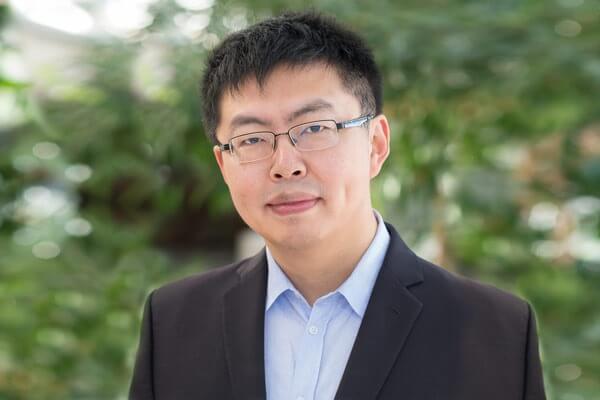
“The transformation of cheap and abundant light alkanes from natural gas could have far-reaching implications on the chemical and energy sectors,” said Li, who holds a joint appointment with the U.S. Department of Energy’s (DOE) Argonne National Laboratory.
Li’s project will investigate and elucidate the use of intermetallic compounds as transformation catalysts. “We’ve designed this catalyst to accomplish the same things as more costly high-temperature catalysts,” he said. “My focus is to try to understand what happens during the chemical reaction, and why this catalyst is superior to the one that’s commonly used.”
The research will be carried out through X-ray characterizations at Argonne’s Advanced Photon Source, one of the most powerful X-ray facilities in the world. Li will involve one NIU graduate student and two to three undergraduates in the project, with an emphasis on recruitment of students from underrepresented groups.
“I hope to have at least one Research Rookie involved,” said Li, who had four Research Rookies working with him last year.
The second NSF-supported project will work toward development of the high-energy density and low-cost sodium-sulfur battery technology. The work will yield new methods and chemistry understanding to enable the use of this battery system in applications requiring more durability and lower-cost, including electric vehicles and grid-scale energy storage for renewable energy generation.
One graduate student and two to three undergraduates will receive research and industry training through the project, with students from underrepresented groups to be recruited for participation. Li will collaborate with scientists at Argonne’s Advanced Photon Source for in situ X-ray characterization studies and hands-on student training.
Li was recognized earlier this year with an Emerging Researcher Award from the American Chemical Society and a Vebleo Fellowship. He now has a total of four concurrent research projects underway at NIU. Last year, NSF awarded Li with a grant of $271,000 over three years to characterize the transport property and microstructure of battery electrolytes. Li also is a co-principal investigator on a DOE grant to Argonne National Laboratory for the study of solid-state electrolytes in lithium batteries.
Northern Illinois University is a student-centered, nationally recognized public research university, with expertise that benefits its region and spans the globe in a wide variety of fields, including the sciences, humanities, arts, business, engineering, education, health and law. Through its main campus in DeKalb, Illinois, and education centers for students and working professionals in Chicago, Naperville, Oregon and Rockford, NIU offers more than 100 areas of study while serving a diverse and international student body.
Date posted: October 17, 2022 | Author: Tom Parisi | Comments Off on Prof Tao Li earns new NSF awards totaling $565K for energy research
DeKalb, IL – After a flurry of new election laws nationwide over the past two years, a new study identifies the U.S. states that are easing barriers for voters to get and stay registered to vote and cast a ballot on Election Day.
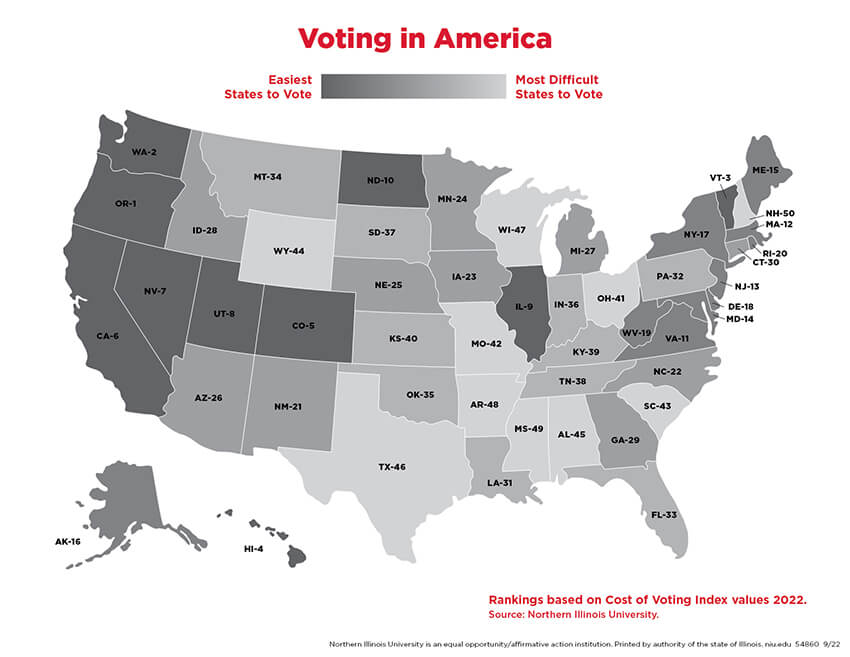
Not by chance, the eight states that take top honors in rank order for ease of vote—Oregon, Washington, Vermont, Hawaii, Colorado, California, Nevada and Utah—have institutionalized an all vote-by-mail process, according to the study, led by Northern Illinois University Professor Scot Schraufnagel.
The study, which ranks all 50 states, was recently published online ahead of print by the Election Law Journal.
Schraufnagel, and co-authors Michael J. Pomante II and Quan Li, political scientists who both previously worked in academia and now conduct private sector research, were prompted to update their 2020 Cost of Voting Index by the spate of new laws passed during the 2021-2022 legislative cycle. The index provides values for the rankings.
Election laws vary from one state to another. In 2021 alone, 19 states passed at least 33 new laws that add barriers to voting, while 25 states passed 62 laws that made it more accessible.
“Elections are at the heart of our democracy, and voting should be easy, accessible and inclusive,” Schraufnagel said.
NIU Political Science Professor Scot Schraufnagel
The authors’ updated Cost of Voting Index uses an assemblage of dozens of current election laws to rank each state according to the time and effort it takes to vote in U.S. elections. Both stages of the voting process—registering to vote and casting a ballot—are combined into a single index value.
“Our goal with this research is to make it simple to understand how the changes in voting laws at the state level impact overall access to the ballot box for voters and to identity which states are reducing the cost of voting for their constituents compared to other states,” Pomante said.
Illinois drops from the third easiest state for voting to ninth easiest—not because the state made it more challenging to vote but because other states passed laws that made voting even more accessible. (Note: Rankings from the Cost of Voting Index published in 2020 were later modified to account for data-collection errors. The new study uses the corrected 2020 rankings for comparison.)
States making substantial improvements in ease-of-vote rankings included Colorado (12th to 5th), Nevada (15th to 7th), Indiana (48th to 36th) and Vermont (23rd to 3rd), which made the most significant move toward a more inclusive electoral-institutional process. (Ranking comparisons do not consider temporary pandemic accommodations in 2020.) Vermont’s single most important change is the adoption of a statewide vote-by-mail process.
“The vote-by-mail process, which has existed in Oregon since 2000, makes voting very convenient,” Schraufnagel said. “Other research also has shown that vote-by-mail is arguably a barrier to voter fraud. That’s because there can be more careful bipartisan or nonpartisan deliberation of signature matches, ballot authenticity and other issues related to ballot integrity.”
Some states made voting easier by adopting changes initially made, in 2020, in response to the COVID-19 pandemic. “Because of the pandemic, most states made temporary accommodations that made it easier to vote in 2020,” Schraufnagel said. “Many realized those provisions made a lot of sense by saving money and/or making voting more accessible and secure.”
But with false claims of voter fraud being stoked by former President Trump, other states took a step backward by making voting more restrictive. Schraufnagel said many of the restrictions concern absentee voting.
“In the midst of the pandemic, states relaxed absentee voting—many states tweaked the process to make voting easier,” Schraufnagel said. “In the aftermath, states that liked the way the election unfolded codified those changes. Those that perhaps didn’t like how the vote went have not only gotten rid of the easing of constraints but invented new laws that make absentee voting more difficult.”
The most challenging states to vote in, according to the study, are New Hampshire (50th) and Mississippi (49th). “Their failure to move up in the rankings is largely due to failing to keep pace with reforms like online voter registration, automatic voter registration and no excuse absentee voting,” Schraufnagel said.
Wisconsin (38th to 47th), Florida (28th to 33rd), Georgia (25th to 29th) and Iowa (19th to 23rd) were among the states that fell in the study’s new rankings, compared to 2020.
Wisconsin requires proof of residency with their registration application and no longer sanctions special voter-registration deputies, who previously conducted voter registration drives. The state also strictly enforces its photo ID law and has no provision for pre-registration of young potential voters.
Neither Florida nor Iowa has adopted an automatic voter registration. Georgia maintains strict enforcement of a photo identification law for balloting and bans food and water distribution to people waiting in line to vote.
Iowa, Florida and Georgia eliminated ballot drop-off locations or the convenient drop boxes used during the 2020 election cycle and have laws restricting who can turn in an absentee ballot for someone else. Additionally, in the aftermath of the 2020 election, each of these states has codified that they will not allow state citizens permanent absentee voter status.
“In 2022, we found that the states that dropped the most in rankings since 2020 were states like Wisconsin and Arkansas (from 40th to 48th), where lawmakers passed laws that built in greater restrictions and added barriers, while refusing to pass other laws that make voters’ access to the polls easier,” Pomante said. “Meanwhile, states like Florida and Georgia are continuing to pass legislation that put up barriers for voters in the general election.”
Texas only drops one spot (from 45th to 46th), despite the passage of legislation that produced a myriad of election law changes. Specifically, the state banned practices that made it easier to vote in 2020 in response to the global pandemic, limiting the state’s ability to respond to another health crisis, the authors said.
The authors note that because election laws continue to change and evolve, their latest version of their Cost of Voting Index considers new variables not used in their previous rankings—including restrictions on absentee voting, excessive Election Day wait times and bans on food and water distribution to waiting voters.
“Over time, we see states develop new laws, or sets of laws, in a way that compromises a static approach to our index construction,” Li said. “What we would gain by consistency in measurement would come at the price of completeness.”
The 2022 Cost of Voting Index views and opinions are those of the authors and do not reflect the official policies or positions of their employers. The study authors have done their best to account for the most significant recent changes in election laws but also underscore the dynamic nature of their study area. Elections laws change, and will continue, to change.
Northern Illinois University is a student-centered, nationally recognized public research university, with expertise that benefits its region and spans the globe in a wide variety of fields, including the sciences, humanities, arts, business, engineering, education, health and law. Through its main campus in DeKalb, Illinois, and education centers for students and working professionals in Chicago, Naperville, Oregon and Rockford, NIU offers more than 100 areas of study while serving a diverse and international student body.
Date posted: October 5, 2022 | Author: Tom Parisi | Comments Off on Study: States with all vote-by-mail process make it easiest on voters
DeKalb, IL – Northern Illinois University saw its new freshman enrollment climb this fall by nearly 7% over the same time last year—the sixth straight year of increases in the size of the freshman class.
According to the official census on the 10th day of attendance, total freshman enrollment for fall 2022 increased to 2,440, up 155 students over last fall. It’s the largest freshman class since 2014. Additionally, the freshman Huskies arrive with an impressive average high school GPA of 3.42, the highest average for new freshmen on record.
Nearly 20% of incoming freshmen, or 472 students, had 4.0 high school GPAs (compared to 371 or 16% last fall), with each earning a merit scholarship of $7,000. Similarly, NIU continues to trend higher in new freshmen with a high school GPA of 3.7 or higher, now approaching nearly 40%.
Looking at other characteristics of the incoming class, 56% of the new freshmen are first-generation college students. NIU continues to have success recruiting students of color, with increases in the percentages of Asian and Latinx students, and strong representation among Black students. The new freshman class is the most diverse in university history.
“Guided by our multi-year planning efforts, we have removed barriers to a high-quality college education and are attracting robust numbers of talented freshmen who reflect the diversity of our region,” NIU President Dr. Lisa C. Freeman said. “Despite the challenges of the past two years, we continue to see very positive enrollment trends in other key areas, including enrollment increases among international students and in our University Honors Program. Additionally, more Huskies are choosing to live on campus, adding to our community’s vibrancy.”
The overall number of newly enrolled international students climbed from 246 students a year ago to 326 this fall. Similarly, total enrollment of international students grew by 30% to 966 students. The University Honors Program enrolled 283 freshmen—a 50% increase over last fall. NIU Housing and Residential Services reports an occupancy of 3,973 students, the highest occupancy figure since the fall of 2015.
Total NIU enrollment for fall 2022 is 15,649, a decrease of 3.6% from a year ago. Overall, both undergraduate and Graduate School enrollment decreased. The decline was anticipated in the wake of impacts of the prolonged pandemic, including steep declines in the pipeline of community college students, pandemic related stresses on students and a strong job market that might have enticed some students to delay their education.
“Nationwide, it became challenging during the pandemic for students to stay focused on their studies and engage with support networks designed to help them succeed,” Provost Beth Ingram said. “We have invested, and continue to invest, substantial resources aimed at supporting our Huskies. This fall, we’re already seeing heightened engagement among students at events such as Week of Welcome activities and the Involvement Fair.”
The university’s success in recruiting new freshmen is directly tied to a combination of innovative new admissions policies, which include the following.
Eliminating the use of standardized tests in merit scholarship eligibility served to make the process more equitable and diversify NIU’s pool of scholarship applicants and recipients. Of 1,910 freshman merit scholarship recipients this fall, 67% are students of color.
The Rockford Promise Program at NIU, now in its second year, guarantees that tuition and general fee costs will be met by gift aid such as grants and scholarships for up to four years at NIU. The university welcomed 133 new freshmen who qualified for the program, up from 96 last fall.
This year NIU and other state schools entered formal partnerships with Hope Chicago, an innovative scholarship program committed to investing $1 billion over the next decade in postsecondary scholarships to Chicago Public School (CPS) students and their parents. The university welcomed 61 Hope Scholars this fall.
NIU’s Huskie Pledge program, funded by the State of Illinois’ AIM HIGH Program, continues to ensure that qualifying Illinois students from lower-income households can attend college with no tuition or general fees for their first year and potentially beyond. This fall, 987 incoming freshmen were eligible and did not have to pay out-of-pocket expenses for tuition and general fees.
NIU also eliminated undergraduate application fees and joined the Common App in August 2020 to reduce barriers for students in their pursuit of higher education. The Common App gives students a way to apply to NIU and multiple other colleges with one online application. The university saw a 55% increase this fall in the total number of freshman applicants over 2020.
“In addition to removing barriers to higher education, we’re leveraging our strong academic programs,” said Sol Jensen, NIU vice president for Enrollment Management, Marketing and Communications. “Along the way, we’ve recruited a very diverse and strong freshman class of high achieving students.”
Northern Illinois University is a student-centered, nationally recognized public research university, with expertise that benefits its region and spans the globe in a wide variety of fields, including the sciences, humanities, arts, business, engineering, education, health and law. Through its main campus in DeKalb, Illinois, and education centers for students and working professionals in Chicago, Naperville, Oregon and Rockford, NIU offers more than 100 areas of study while serving a diverse and international student body.
Date posted: September 8, 2022 | Author: Tom Parisi | Comments Off on NIU’s freshman class grows again, shines academically
DeKalb, IL – NIU Professors Melissa Lenczewski and Ricela Feliciano have both recently won Fulbright U.S. Scholar Program awards.
NIU Professor Melissa Lenczewski
Fulbright Scholar Awards are prestigious and competitive fellowships that provide unique opportunities for scholars to teach and conduct research abroad. Fulbright scholars also play a critical role in U.S. public diplomacy, establishing long-term relationships between people and nations. Alumni include 61 Nobel Laureates, 89 Pulitzer Prize winners, 76 MacArthur Fellows and thousands of leaders and world-renowned experts.
The benefits of a Fulbright Scholar Award extend beyond the individual recipient, as Fulbright Scholars raise the profile of their home institutions as well.
Lenczewski, a professor in the Department of Earth, Atmosphere and the Environment, will conduct research in Cambodia and Thailand for four months beginning in February. She will be taking a Khmer language course at NIU this fall to provide her with basic skills in the language.
“Our Center for Southeast Asian Studies has numerous connections in this part of the world in fields such as political science, anthropology and language studies,” Lenczewski said. “I’m hoping to build research relationships in environmental studies, with one goal being to create collaborative processes and research opportunities for our students.”
Lenczewski, who formerly served as director of NIU’s Institute for the Study of Environment, Sustainability, and Energy (IESE), also will conduct research on the effect of urbanization on groundwater and water quality near the capital cities of Phnom Penh and Bangkok. Her collaborators will include faculty with the Royal University of Phnom Penh.
NIU Professor Ricela Feliciano
“I’m very excited,” she said. “Because I’ll be there for a significant time period, I’ll be able to develop stronger relationships and research ties and get to know the people better. Living in a culture makes a big difference.”
Feliciano, an assistant professor of mathematics, traveled to Colombia this month and will visit the South American country again from May 1 to June 30. She is conducting research on mathematical learning in rural Colombian secondary schools along the Caribbean Coast near Barranquilla.
“During my first visit, teachers are being offered free in-service sessions on designing culturally relevant mathematics curricula,” Feliciano said. “On my second visit, I will assess how teachers and students are progressing with the community-based pedagogy.
“The exchange will benefit underserved secondary school students and their teachers,” she added. “In the process, the project will advance my research agenda and build a link between NIU and the Universidad del Atlántico.”
Feliciano will collaborate on her research with NIU’s Kevin Palencia, an assistant professor of Mathematical Sciences; Mariana Ricklefs, an NIU assistant professor of Curriculum and Instruction; and a faculty member at Universidad del Atlántico.
Northern Illinois University is a student-centered, nationally recognized public research university, with expertise that benefits its region and spans the globe in a wide variety of fields, including the sciences, humanities, arts, business, engineering, education, health and law. Through its main campus in DeKalb, Illinois, and education centers for students and working professionals in Chicago, Naperville, Oregon and Rockford, NIU offers more than 100 areas of study while serving a diverse and international student body.
Date posted: August 18, 2022 | Author: Tom Parisi | Comments Off on Melissa Lenczewski, Ricela Feliciano named Fulbright Scholars
Batavia, Ill. – PIP-II, the state-of-the-art linear accelerator project at the U.S. Department of Energy’s Fermi National Accelerator Laboratory, received some help this year from undergraduate engineering students at Northern Illinois University.
NIU engineering students (from left) Marcus Mims, Caleb Denton and Perla Gaytan with their portable cleanroom at NIU’s Senior Design Day, May 6, 2022. The cleanroom will be used by PIP-II’s linac installation team. Photo: Kyle Kendziora, Fermilab
Every year, NIU’s Senior Design Program provides an opportunity for engineering students to apply the skills they learned in class to address challenges in the real world. At the beginning of the first semester, students form small teams and are presented with more than 100 projects proposed by professors, research organizations, companies and even individuals. Student teams rank their favorite projects and are matched via a lottery system.
The clients then give their teams some basic guidance and requirements. But from there, the students work mostly independently, starting with iterative design, safety discussions and paperwork in the first semester and finally ordering materials and building their designs in the second. The fruits of their labors are displayed at the annual Senior Design Demonstration Day at NIU.
This year, two student groups selected projects proposed by clients from PIP-II.
A customized cleanroom
NIU students Caleb Denton, Perla Gaytan and Marcus Mims spent their year working for Kyle Kendziora, a linac installation engineer, on a portable low-particulate cleanroom to be used for the installation of the linear accelerator.
When the superconducting cryomodules are installed, they will have to be connected to each other in a cleanroom to prevent any dust and debris from migrating into the beam tube and contaminating it.
Kendziora said they have used various iterations and styles of portable cleanrooms in several experiments before, but the space limitations for PIP-II’s installation are an added challenge this time. “Previous [cleanrooms] straddle the beam line and would roll along it, and we don’t have that luxury with the PIP-II linac,” said Kendziora.
To solve this, the student group designed a portable cleanroom that can slide in and be pulled away from the aisle side of the beam line without needing to be disassembled.
“For a senior design group with little-to-no experience in vacuum and accelerators and whatnot, they did a really good job,” said Kendziora. “The cleanrooms that the students built will get used for sure. They thought outside of the box a bit with the method of lighting it that I think will light up the work better than our previous portable cleanrooms.”
Mims, a mechanical engineering student, said he enjoyed working with Kendziora and having a chance to pick his brain and learn from a Fermilab engineer. “I definitely learned a lot,” said Mims. “It was something that every student needs to go through because it forces you to not just learn in the classroom but also apply what you learn to real applications.
“I actually enjoyed the process, and building it was the best part. … It takes a lot to build something that looks simple.”
A modular mockup
The other PIP-II project was a mockup of the HB650 cryomodule that will be used in the PIP-II Injector Test facility, also known as PIP2IT, a testbed for PIP-II technologies. The high-beta 650 MHz (HB650) elliptical cavity cryomodules will make up the final stage of the PIP-II linear accelerator; they accelerate the proton beam from roughly 500 MeV to its full energy of 800 MeV.
Curtis Baffes, a PIP-II installation engineer, commissioned the mockup so his team could prepare for installation before the actual cryomodules arrive at Fermilab. “Having something physical to work with allows you to have a much cleaner installation,” he said.
NIU students Caeden Keith, Svilen Batchkarov and Stefan Nyholm were matched with the cryomodule mockup project. Baffes began by showing them a CAD, or computer-aided design, model of the cryomodule they had to replicate.
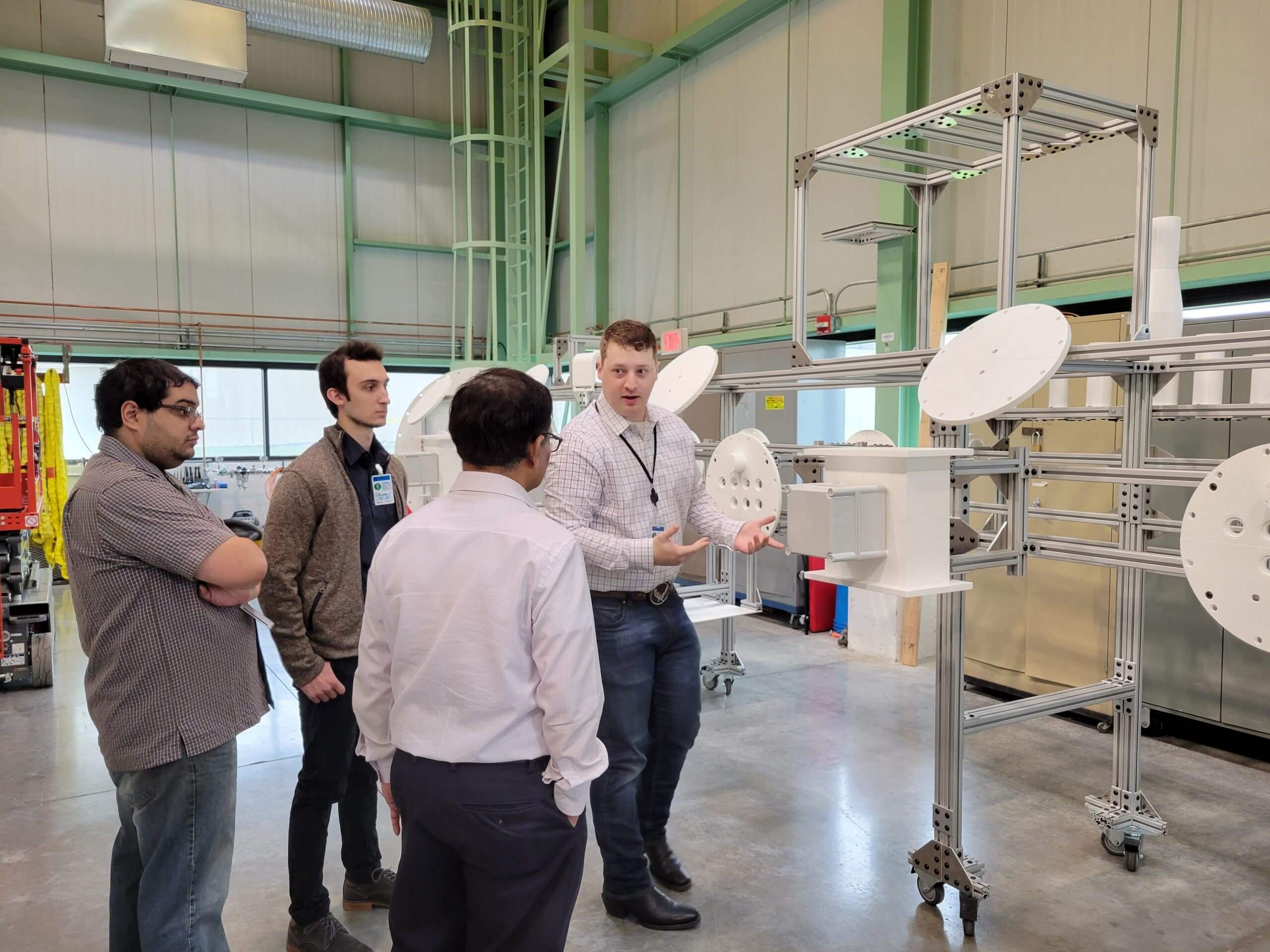
NIU engineering students (from left) Stefan Nyholm, Svilen Batchkarov and Caeden Keith explain their senior design project to their professor, Tariq Shamim (front, back turned) at Fermilab’s CMTF. The team built a full-scale mockup of PIP-II’s HB650 cryomodule that will be used for fit checking and preparing test stand and accelerator locations for the real cryomodule. Photo: Curtis Baffes, Fermilab
“Our first idea was trying to order a giant plastic tube, but we’re thinking there’s no way we’re going to get a 33-foot tube that will work out well,” said Nyholm, a mechatronics engineering student. “After that, a few other ideas came around and we thought to ourselves, Why do we need to have this as a tube?”
Thinking outside the tube led the group to decide on a modular solution made of an aluminum building system: metal framing that can be fastened together in various configurations, like an oversized erector set. The group 3D-printed accessories to represent the instrumentation ports on the outside of the cryomodule.
Baffes is excited by the mockup’s modularity; it represents the HB650 now but could be reconfigured in the future to match the interfaces of the LB650, SSR1 and SSR2 modules.
“The systems that were designed and built are great, and will find real-world application at Fermilab,” said Baffes. “We are already using the HB650 cryomodule mockup in the PIP2IT test stand for cable dressing. So this device has already been useful and will continue to be useful into the installation of the project.”
The students were also pleased with their final design. “It was a great sense of satisfaction and accomplishment to see the entire thing complete,” said Nyholm.
Keith, a mechatronics engineering student, said he was familiar with Fermilab from when he participated in Saturday Morning Physics. His favorite part of the senior design experience was the chance to contribute to PIP-II, “the next step in science.”
“When I did the Saturday Morning Physics program [at Fermilab], I got to learn ‘why does matter exist?’ and ‘how do we find particles?’ and ‘what is everything?’” he said. “So, being able to be a part of that next step is pretty cool, to say the least.”
Fermi National Accelerator Laboratory is supported by the Office of Science of the U.S. Department of Energy. The Office of Science is the single largest supporter of basic research in the physical sciences in the United States and is working to address some of the most pressing challenges of our time. For more information, please visit science.energy.gov.
Date posted: June 24, 2022 | Author: Tom Parisi | Comments Off on NIU students lend their engineering skills to PIP-II
The award, accompanied by a plaque and $1,000 prize, recognizes and encourages scientists who are early or midway into their careers and have made sustained and distinguished contributions to the field of fuel chemistry. It will be presented during the Spring ACS Meeting 2023.
“This award is well-deserved recognition of Professor Tao Li’s profound creativity, unparalleled work ethic, outstanding research program and service to the scientific community,” said Ralph Wheeler, chair of the Department of Chemistry and Biochemistry. “As an emerging researcher, he can look forward to many more years of spectacular research success at NIU.”
Li holds a joint appointment between NIU and Argonne National Laboratory. His research includes work that could lay the foundation for improvements to ubiquitous rechargeable batteries used in electronic devices, electric vehicles and grid energy storage.
Since arriving at NIU in 2018, Li has been attracted more than $2 million in external funding for his research from the likes of the National Science Foundation and U.S. Department of Energy. He also has authored or co-authored more than 150 papers.
Last year, NSF awarded Li with a grant of $271,000 over three years to characterize the transport property and microstructure of battery electrolytes. Crucial to battery performance, electrolytes are chemicals that allow an electrical charge to pass between two terminals. Li also is a co-principal investigator on a DOE grant to Argonne National Laboratory for the study of solid-state electrolytes in lithium batteries.
In addition to his battery research, Li received a $200,000 NSF grant in 2019 to investigate novel ways of converting greenhouse gases into useful fuels.
Li has been active in the ACS, having served as co-chair of several symposiums during organization meetings, and regularly involves students in his research. His research group currently has one post-doctoral staff member, six graduate students, and five former Research Rookies. Erik Sarnello, one of Li’s students, recently graduated with his Ph.D. and started a post-doctoral position at Argonne.
Northern Illinois University is a student-centered, nationally recognized public research university, with expertise that benefits its region and spans the globe in a wide variety of fields, including the sciences, humanities, arts, business, engineering, education, health and law. Through its main campus in DeKalb, Illinois, and education centers for students and working professionals in Chicago, Naperville, Oregon and Rockford, NIU offers more than 100 areas of study while serving a diverse and international student body.
Date posted: June 23, 2022 | Author: Tom Parisi | Comments Off on Professor Tao Li recognized with ACS Emerging Researcher Award
DeKalb, Ill. — Students from San Diego State University recently visited NIU as part of an exchange program that seeks to expose student groups that are underrepresented in the sciences to research projects, paths to graduate school and a network of supportive peers from other universities.
SDSU and NIU students learn about prairie ecology research from NIU Professor Holly Jones while visiting Nachusa Grasslands.
The three-day late May visit, which also included a trip to the Chicago campus of Northwestern University, was supported by a National Science Foundation grant to Professor Holly Jones and former NIU colleague Nicholas Barber, who’s now at SDSU. In turn, Jones will take a group of NIU students to San Diego next year.
Participants in the recent exchange—including five SDSU students, three NIU students and others from Northwestern—are all pursuing graduate or undergraduate degrees in the areas such as biochemistry, environmental studies, and environmental engineering. The SDSU and Northwestern students also are chapter members of the Society for the Advancement of Chicanos and Native Americans in STEM (SACNAS).
“NIU’s chapter went dormant, so part of the impetus for this exchange was for NIU students to learn more about what it takes to run a SACNAS chapter in hopes of revitalizing ours,” said Jones, who holds a joint appointment at NIU in biological sciences and environmental studies.
“More broadly, we want to create opportunities for students to talk to each other, especially encouraging conversations about careers and graduate school—what are the benefits, what’s it like, how to write a competitive application. Many of these students are the first in their families to go to college, so navigating academia is itself a learning experience. It helps to know other students on the same path and see people like yourself succeeding.”
Students visited Jones’ flowering prairie project on the western edge of NIU’s campus, the expansive restoration project at Nachusa Grasslands (complete with baby bison) and state-of-the-art biomedical facilities at Northwestern. They also picnicked, hiked, met in discussion groups and visited two Chicago landmarks famous for their beans—the four-story Starbucks Reserve Roastery and Millennium Park, with its iconic Bean (Cloud Gate) sculpture.
According to the 2020 NSF Science & Engineering Indicators, members of underrepresented minorities represented about 15% of the U.S. science and engineering workforce and more than 28 percent of the adult U.S. population. NSF Director Sethuraman Panchanathan has said addressing the “missing millions”—people who are capable of succeeding as scientists and engineers but do not have access to pathways that lead into those careers—is a key step toward enabling the American STEM enterprise to thrive in the coming decades.
A San Diego native, Regina Mae Francia is now pursuing her Ph.D. in ecology from NIU. She jumped at the chance to volunteer to be part of the exchange and meet fellow San Diegans. Francia said the exchange provided a unique experience for students to share their passion for research and their diverse experiences.
“This program brings science and culture together with students who are on similar academic or career paths,” Francia added. “And this really helps us not feel alone, that there are other people from similar backgrounds and experiences that also fell in love with science and decided to pursue it.”
Northern Illinois University is a student-centered, nationally recognized public research university, with expertise that benefits its region and spans the globe in a wide variety of fields, including the sciences, humanities, arts, business, engineering, education, health and law. Through its main campus in DeKalb, Illinois, and education centers for students and working professionals in Chicago, Naperville, Oregon and Rockford, NIU offers more than 100 areas of study while serving a diverse and international student body.
Date posted: June 17, 2022 | Author: Tom Parisi | Comments Off on NIU hosts NSF-supported exchange with San Diego State University
DeKalb, Ill. — Scientists at Northern Illinois University continue to hone extended-range weather forecasting, identifying patterns halfway around the globe that will heighten the probability weeks later for hail- and tornado-producing storms in the United States.
Credit: Victor Gensini, Northern Illinois University
New research identifies three specific orientations of atmospheric phenomena occurring near the equator over the Maritime continent that increase the probability of severe U.S. weather events three to four weeks later. Using such information to create extended-range forecasts would provide more time to raise awareness of severe weather, and potentially save lives and property.
Combing through data from 1979–2019, the scientists found 100 instances of significant fluctuations that had occurred in the Madden-Julian Oscillation (MJO)—a major eastward moving disturbance of winds, rain and pressure—and looked for correlations to U.S. severe weather weeks later.
As an MJO moves eastward along the equator, it can weaken or strengthen as it crosses the islands of the Maritime Continent, which include Indonesia and the Philippines. Of the 100 identified MJO fluctuations, 53 of these storm clusters gained strength as they crossed the Maritime Continent and entered the Pacific Ocean, causing ripples in the atmosphere and eventually changing circulation patterns over North America.
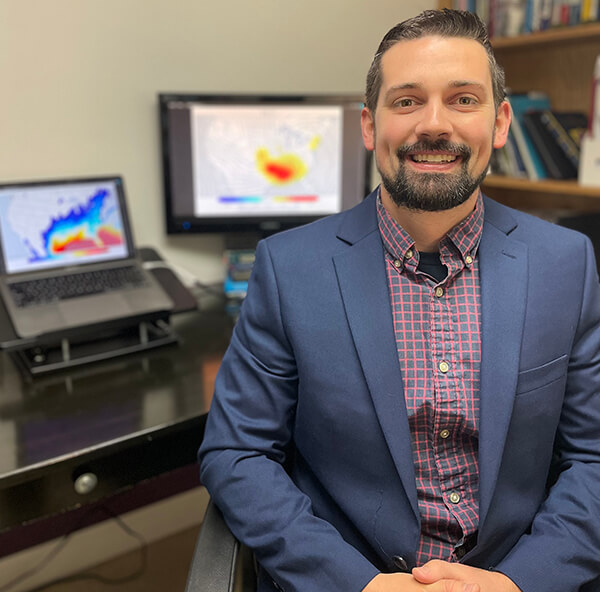
NIU post-doctoral researcher Douglas E. Miller
“These 53 events showcased the largest probabilities for increasing U.S. tornado and hail activity in the following three to four weeks,” said the study’s lead author, Douglas E. Miller, an NIU post-doctoral researcher. “Different MJO characteristics led to different timing and changes in severe weather activity.”
The study—coauthored with NIU Meteorology Professor Victor Gensini and Bradford Barrett of the U.S. Air Force Office of Scientific Research—is published in the Nature Publishing Group journal Climate and Atmospheric Science.
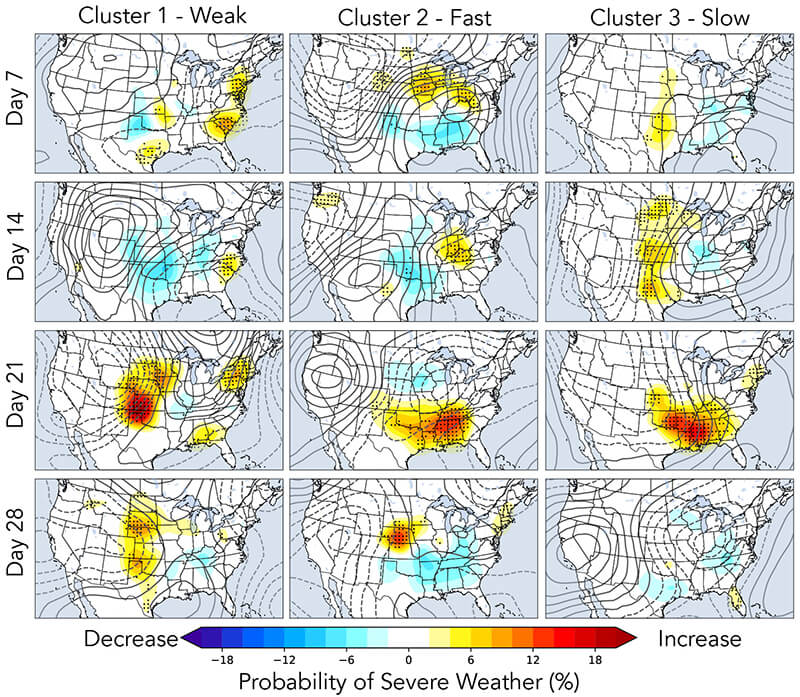
The researchers used machine learning to separate characteristics of the 53 storm clusters according to location, strength and propagation speed. Composites of the clusters were then categorized as one of three “flavors”—weak, slow or fast.
A graphical depiction of probabilities for severe U.S. weather by storm cluster type following significant Madden-Julian Oscillation fluctuations that have moved into the Pacific Ocean. Credit: Douglas E. Miller, Northern Illinois University
All three types heightened probabilities of increased U.S. tornado and hail events, but different flavors took different paths, Miller said, with the slowly propagating MJO clusters providing the best “forecast of opportunity” for severe convective storms in the United States.
“Our work highlights pathways forward for better prediction and understanding of how the Madden-Julian Oscillation clusters influence U.S tornado and hail frequency,” Miller said. “While not part of this study, we saw two bursts of maximum convection this spring. Each time we verified increases in severe U.S. weather three to four weeks later.”
Past research by NIU’s Gensini, who has pioneered extended-range forecasting, had identified MJO disturbances as an influencer on severe weather in the United States. In 2019, he led a team of scientists who reported that they accurately predicted the nation’s extensive tornado outbreak in May of that year—nearly four weeks before it began. During a 13-day stretch that month, 374 tornadoes occurred, more than triple the average.
Gensini said recurring MJO modes like those identified in the new study present “forecasts of opportunity,” providing enhanced predictability of the potential for severe weather frequency. Such opportunities do not always exist because often there is no recognizable pattern.
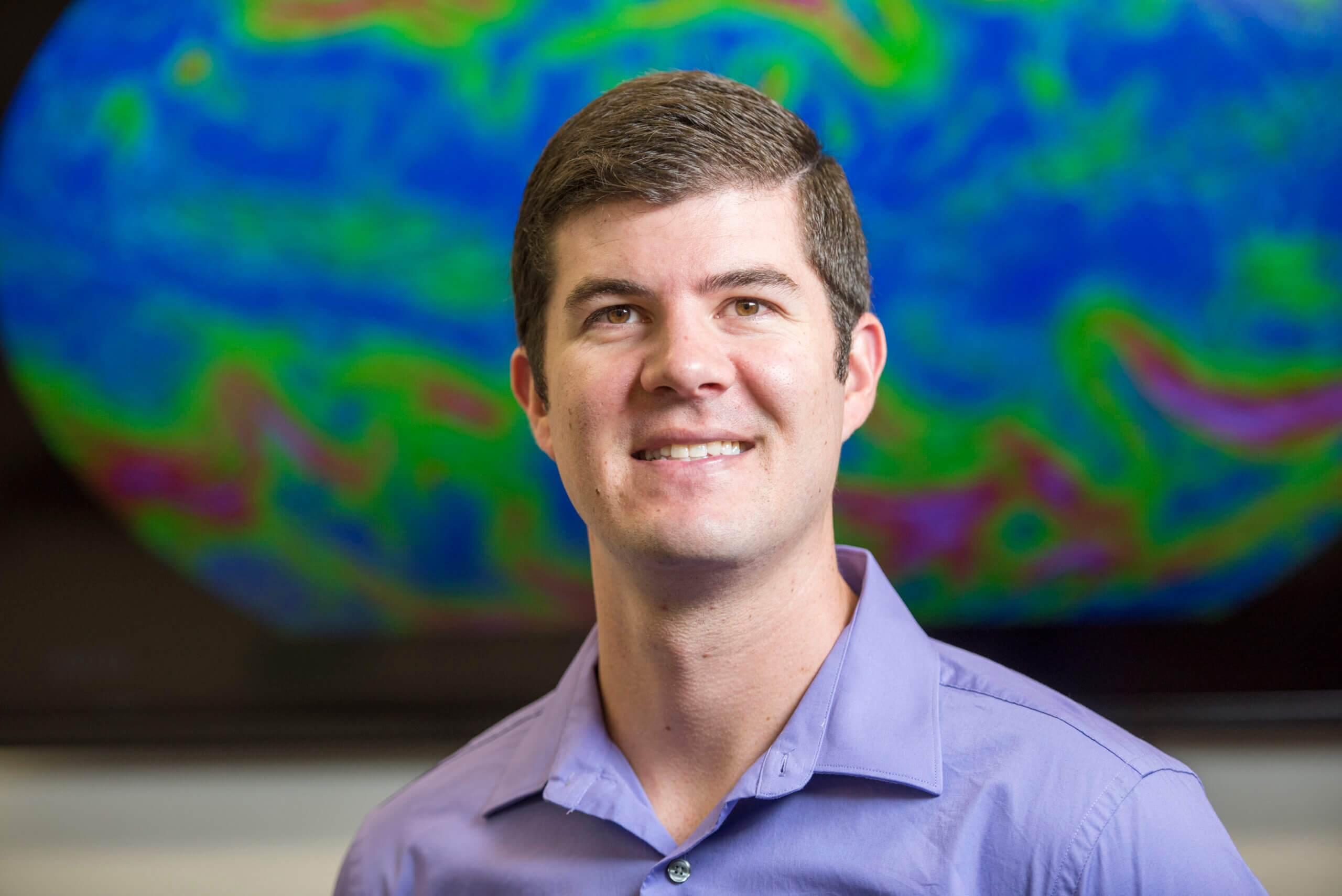
NIU Professor Victor Gensini
“This new work helps us catalogue weather patterns that present these forecasts of opportunity,” Gensini said. “We’re learning that there are quite a few different flavors this convection has in terms of modulating how the overall weather pattern sets up across the United States.”
MJO disturbances only happen once or twice each spring, so the sample size for the new study was limited, the authors said.
“The main caveat associated with this analysis is sample size,” Gensini said. “We are limited by the number of years in the study and the temporal frequency at which MJO events cycle in the North American springtime. If MJO events were examined over thousands of years, it would be likely that more than three clusters would emerge. Future work may focus on the issue of sample size by utilizing climate model simulations, allowing for more robust results.”
Northern Illinois University is a student-centered, nationally recognized public research university, with expertise that benefits its region and spans the globe in a wide variety of fields, including the sciences, humanities, arts, business, engineering, education, health and law. Through its main campus in DeKalb, Illinois, and education centers for students and working professionals in Chicago, Naperville, Oregon and Rockford, NIU offers more than 100 areas of study while serving a diverse and international student body.
Date posted: May 17, 2022 | Author: Tom Parisi | Comments Off on Scientists hone long-range forecasting of U.S. tornadoes, hail