
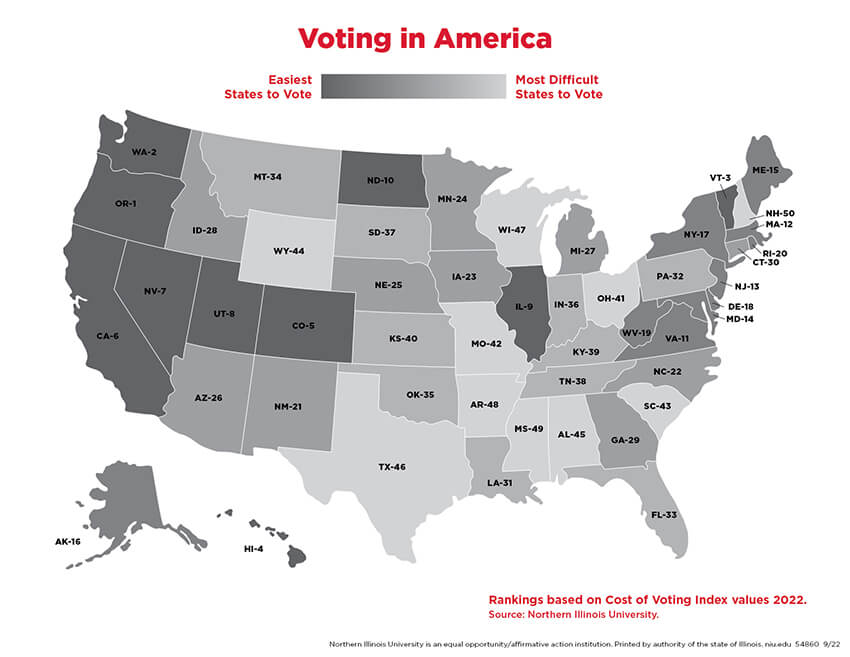
 DeKalb, IL – After a flurry of new election laws nationwide over the past two years, a new study identifies the U.S. states that are easing barriers for voters to get and stay registered to vote and cast a ballot on Election Day.
Not by chance, the eight states that take top honors in rank order for ease of vote—Oregon, Washington, Vermont, Hawaii, Colorado, California, Nevada and Utah—have institutionalized an all vote-by-mail process, according to the study, led by Northern Illinois University Professor Scot Schraufnagel.
The study, which ranks all 50 states, was recently published online ahead of print by the Election Law Journal.
Schraufnagel, and co-authors Michael J. Pomante II and Quan Li, political scientists who both previously worked in academia and now conduct private sector research, were prompted to update their 2020 Cost of Voting Index by the spate of new laws passed during the 2021-2022 legislative cycle. The index provides values for the rankings.
Election laws vary from one state to another. In 2021 alone, 19 states passed at least 33 new laws that add barriers to voting, while 25 states passed 62 laws that made it more accessible.
“Elections are at the heart of our democracy, and voting should be easy, accessible and inclusive,” Schraufnagel said.

NIU Political Science Professor Scot Schraufnagel
The authors’ updated Cost of Voting Index uses an assemblage of dozens of current election laws to rank each state according to the time and effort it takes to vote in U.S. elections. Both stages of the voting process—registering to vote and casting a ballot—are combined into a single index value.
“Our goal with this research is to make it simple to understand how the changes in voting laws at the state level impact overall access to the ballot box for voters and to identity which states are reducing the cost of voting for their constituents compared to other states,” Pomante said.
Illinois drops from the third easiest state for voting to ninth easiest—not because the state made it more challenging to vote but because other states passed laws that made voting even more accessible. (Note: Rankings from the Cost of Voting Index published in 2020 were later modified to account for data-collection errors. The new study uses the corrected 2020 rankings for comparison.)
States making substantial improvements in ease-of-vote rankings included Colorado (12th to 5th), Nevada (15th to 7th), Indiana (48th to 36th) and Vermont (23rd to 3rd), which made the most significant move toward a more inclusive electoral-institutional process. (Ranking comparisons do not consider temporary pandemic accommodations in 2020.) Vermont’s single most important change is the adoption of a statewide vote-by-mail process.
“The vote-by-mail process, which has existed in Oregon since 2000, makes voting very convenient,” Schraufnagel said. “Other research also has shown that vote-by-mail is arguably a barrier to voter fraud. That’s because there can be more careful bipartisan or nonpartisan deliberation of signature matches, ballot authenticity and other issues related to ballot integrity.”
Some states made voting easier by adopting changes initially made, in 2020, in response to the COVID-19 pandemic. “Because of the pandemic, most states made temporary accommodations that made it easier to vote in 2020,” Schraufnagel said. “Many realized those provisions made a lot of sense by saving money and/or making voting more accessible and secure.”
But with false claims of voter fraud being stoked by former President Trump, other states took a step backward by making voting more restrictive. Schraufnagel said many of the restrictions concern absentee voting.
“In the midst of the pandemic, states relaxed absentee voting—many states tweaked the process to make voting easier,” Schraufnagel said. “In the aftermath, states that liked the way the election unfolded codified those changes. Those that perhaps didn’t like how the vote went have not only gotten rid of the easing of constraints but invented new laws that make absentee voting more difficult.”
The most challenging states to vote in, according to the study, are New Hampshire (50th) and Mississippi (49th). “Their failure to move up in the rankings is largely due to failing to keep pace with reforms like online voter registration, automatic voter registration and no excuse absentee voting,” Schraufnagel said.
Wisconsin (38th to 47th), Florida (28th to 33rd), Georgia (25th to 29th) and Iowa (19th to 23rd) were among the states that fell in the study’s new rankings, compared to 2020.
Wisconsin requires proof of residency with their registration application and no longer sanctions special voter-registration deputies, who previously conducted voter registration drives. The state also strictly enforces its photo ID law and has no provision for pre-registration of young potential voters.
Neither Florida nor Iowa has adopted an automatic voter registration. Georgia maintains strict enforcement of a photo identification law for balloting and bans food and water distribution to people waiting in line to vote.
Iowa, Florida and Georgia eliminated ballot drop-off locations or the convenient drop boxes used during the 2020 election cycle and have laws restricting who can turn in an absentee ballot for someone else. Additionally, in the aftermath of the 2020 election, each of these states has codified that they will not allow state citizens permanent absentee voter status.
“In 2022, we found that the states that dropped the most in rankings since 2020 were states like Wisconsin and Arkansas (from 40th to 48th), where lawmakers passed laws that built in greater restrictions and added barriers, while refusing to pass other laws that make voters’ access to the polls easier,” Pomante said. “Meanwhile, states like Florida and Georgia are continuing to pass legislation that put up barriers for voters in the general election.”
Texas only drops one spot (from 45th to 46th), despite the passage of legislation that produced a myriad of election law changes. Specifically, the state banned practices that made it easier to vote in 2020 in response to the global pandemic, limiting the state’s ability to respond to another health crisis, the authors said.
The authors note that because election laws continue to change and evolve, their latest version of their Cost of Voting Index considers new variables not used in their previous rankings—including restrictions on absentee voting, excessive Election Day wait times and bans on food and water distribution to waiting voters.
“Over time, we see states develop new laws, or sets of laws, in a way that compromises a static approach to our index construction,” Li said. “What we would gain by consistency in measurement would come at the price of completeness.”
The 2022 Cost of Voting Index views and opinions are those of the authors and do not reflect the official policies or positions of their employers. The study authors have done their best to account for the most significant recent changes in election laws but also underscore the dynamic nature of their study area. Elections laws change, and will continue, to change.
Media Contact: Tom Parisi
About NIU
Northern Illinois University is a student-centered, nationally recognized public research university, with expertise that benefits its region and spans the globe in a wide variety of fields, including the sciences, humanities, arts, business, engineering, education, health and law. Through its main campus in DeKalb, Illinois, and education centers for students and working professionals in Chicago, Naperville, Oregon and Rockford, NIU offers more than 100 areas of study while serving a diverse and international student body.
