DeKalb, IL – In the 1970s, a small North American diving duck known as the little bluebill or broadbill had an estimated population of 7 million. While other waterfowl species have grown in number, the little bluebills have declined by nearly half—to about 3.8 million today.
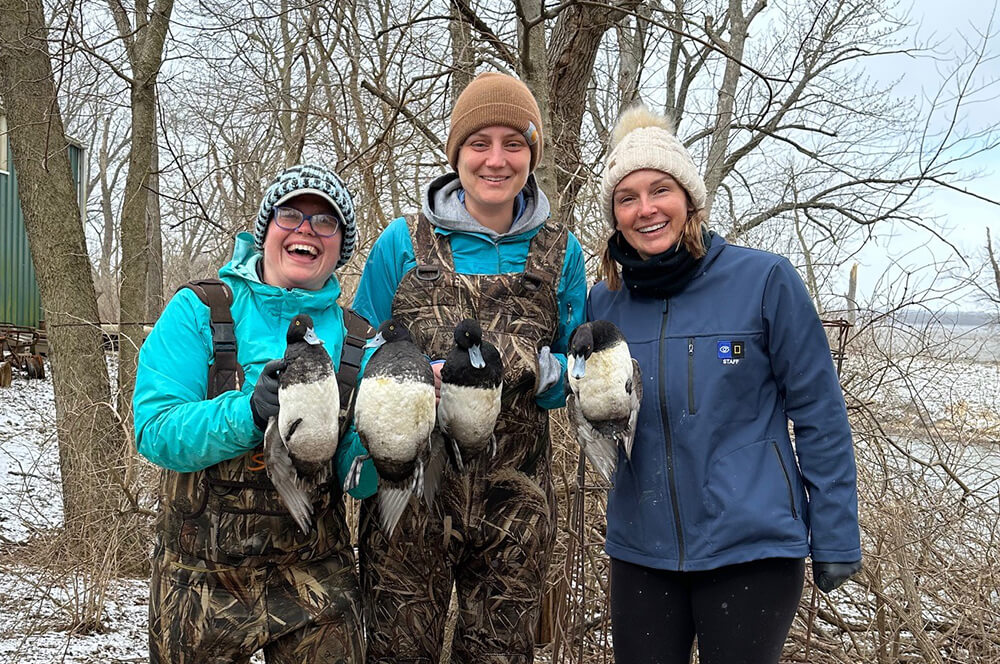
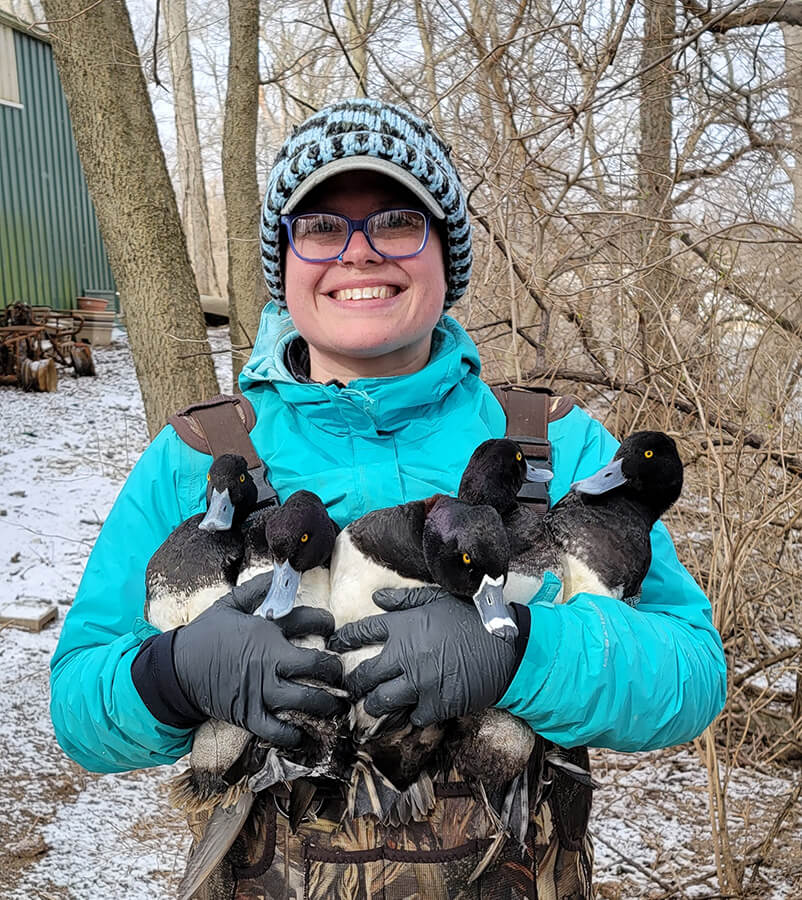
Cheyenne Beach (left), Dr. Auriel Fournier (middle), and Dr. Jennifer Koop (right) prepare to release Lesser scaup back into the wild at the Forbes Biological Station near Havana, IL. These birds were captured and banded (fitted with an individual marker tag) as part of ongoing research on their ecology and migration.
That trend has made their formal name, Lesser scaup, all too fitting—and has inspired Cheyenne Beach, a doctoral student in the NIU biological sciences department, to try to unearth the root of their propagation problem.
With funding support from the Illinois Department of Natural Resources (IDNR), Beach will test a theory behind the issue. Based on prior research that others have conducted, Beach is exploring the impact of trematodiasis—a disease caused by an intestinal parasite—on scaup migration and breeding efforts.
Part of her working hypothesis is that a decline in spring food availability for the ducks as they migrate along the Mississippi Flyway through the Upper Midwest—they make an annual journey as far south as Central America—may be diminishing their physical ability to reproduce. The food they do find, such as aquatic snails, can harbor intestinal parasites that may further reduce the ability of the ducks to migrate and nest successfully.
The effort flows from Beach’s love for nature, which she developed during her formative years as a child in upstate New York.
“Waterfowl are amazing; I love wetlands, and I love waterfowl,” Beach said. “Everything that wetlands do for us – people need to appreciate them for all that they offer. They are nature’s sponges and filter out all that we throw at them – agricultural runoff, industrial runoff, heavy metals, pesticides and herbicides. You name it, wetlands help filter and clean our water resources.”
Beach is beginning the field portion of this study this spring and will continue it through spring 2026.
The groundwork for the study occurred over a three-month span in 2022. At Pinola Aviary, a private aviary near Shreveport, Louisiana, Beach oversaw the implanting of transmitters in 10 birds—there were seven others in a control group—to show that birds behaved normally and could lay eggs despite the implanted transmitters.
NIU graduate student Cheyenne Beach.
The field portion of the project entails safely capturing more female ducks, testing them for trematodes (the worm that causes trematodiasis) via their fecal matter, and having a veterinarian implant a transmitter to track their movements and breeding behavior following release. In all, 100 female birds will be tracked, 50 each spring.
The transmitters are surgically implanted in the bird’s abdominal area, with GPS pings twice a day indicating its movements. Researchers can track a duck’s migration pathway and duration. They can also tell if a duck has begun nesting if she returns to the same location daily for about 30 consecutive days. Lesser scaup typically lay eight to 10 eggs in each nest.
By evaluating the difference between infected and uninfected ducks, Beach hopes to better understand how these parasites might be limiting the ability of these birds to migrate and breed. Beach will also assess the current range of an invasive snail species that is known to carry these parasites. That information will help waterfowl managers better evaluate trouble spots along the ducks’ migration pathway.
The continued survival of Lesser scaup, and waterfowl in general, is important for a number of reasons.
“Hunters want to see this species at an optimal level where they can harvest the ducks,” Beach said. “If the population gets below a certain level, then managers may need to consider closing the season on scaup to help conserve the birds.”
Others with a vested interest in seeing them thrive are bird watchers and anyone seeking the continued health of the habitat.
“If these birds are struggling from a concert of things—such as degradation of habitat and loss of wetlands—then other parts of this ecosystem are also struggling,” Beach said. “Finding out where and why they are struggling is very important.”
Securing the $250,000 IDNR grant were Beach’s advisors: Jennifer Koop, an associate professor in the NIU Department of Biological Sciences, and Auriel Fournier, director of the Forbes Biological Station, a part of the Illinois Natural History Survey, University of Illinois Urbana-Champaign.
Koop described Beach as “a wonderful graduate student, the kind you always hope for as an advisor.”
“Cheyenne is smart and passionate and has designed an experiment that will advance our scientific understanding of how parasites can affect their hosts and provide meaningful information to wildlife managers,” Koop said. “Her experience and drive uniquely equip her to take on a project as intense and involved as this one.”
A broader benefit of this type of work is that many of the same ideas can be applied to understand diseases in other animal systems, including humans, Koop said.
“It’s often hard to study those species that are dealing with something catastrophic,” Koop said. “These snails and ducks have a lot to teach us about the ways in which diseases affect populations.”
Northern Illinois University is a student-centered, nationally recognized public research university, with expertise that benefits its region and spans the globe in a wide variety of fields, including the sciences, humanities, arts, business, engineering, education, health and law. Through its main campus in DeKalb, Illinois, and education centers for students and working professionals in Chicago, Naperville, Oregon and Rockford, NIU offers more than 100 areas of study while serving a diverse and international student body.
Date posted: February 29, 2024 | Author: Tom Parisi | Comments Off on NIU graduate student seeks to solve mystery of duck population’s decline
DeKalb, IL – Northern Illinois University is among Carnegie-classified R2 universities for high research activity. This year, the Office of Student Engagement and Experiential Learning (OSEEL) and the University Honors Program are taking the celebration of research to the next level, with the debut of Research Month in April.
This month-long celebration will highlight research accomplishments and provide engaging new opportunities for students, departments and colleges to get involved. You can get involved by sharing OSEEL content on your social media pages and helping spread the word about Research Month.
“Research is a key component of what we offer as part of an education at NIU, and this priority is reflected in our university goals,” said Andrea Radasanu, assistant vice provost for Student Enhancement. “Research Month is a great way to showcase the talents of our students and the dedication of our faculty mentors, while bringing the campus community together.”
Undergraduate students involved in research are encouraged to share gratitude posts to show how research impacted their undergraduate experience and thank those who supported them. Faculty mentors are encouraged to share research story highlights featuring undergraduate researchers who made a positive impact. These gratitude posts and research highlights will be shared on NIU’s social media pages, and you are encouraged to share these posts to help recognize these accomplishments.
To kick off Undergraduate Research Month, faculty mentors and their undergraduate researchers from various colleges will share their stories and the impact undergraduate research has had on them, followed by networking. This event is co-sponsored by Founder’s Memorial Library and will be held from 3 to 4 p.m. Thursday, April 4, in the staff lounge located in the basement of the library. Staff, faculty and undergraduate students are invited to attend.
Research Month will culminate Tuesday, April 30, with the Conference on Undergraduate Research and Engagement (CURE). This annual event returns to the Duke Ellington Ballroom for the first time since the pandemic. CURE gives NIU students the opportunity to present faculty-mentored undergraduate research, artistry and engagement projects.
Registration for CURE is open until noon Wednesday, April 3. Students, faculty, staff, alumni and community members are encouraged to attend. Students presenting at CURE can find information and guidance on the student resources page for the event, including a CURE workshop series to learn best practices for writing an abstract, developing an academic poster and communicating research by developing an elevator pitch.
“CURE gives student researchers a platform for sharing their work with others, while building confidence and getting valuable exposure for their hard work,” said Emily Reilly, OSEEL associate director. “We encourage all undergraduate students to participate, whether by presenting or attending, and look forward to seeing what these talented individuals have accomplished with their research.”
Students receiving high rankings on their presentation in their respective categories will receive a monetary award and the opportunity to have their poster published in Huskie Commons, thanks to the Dr. Arnold Hampel and Dr. Denise Kennedy CURE Award Fund.
New this year, NIU Career Services staff and volunteer alumni will be hosting a Career Corner. This will help students learn how to communicate skills gained during their research journey to future employers or graduate schools.
“Come join us for a look at some compelling research,” Radasanu said. “We hope you will leave with an added appreciation for the work being done by students and faculty mentors, and we hope you will have fun joining others as we celebrate research at NIU.”
Northern Illinois University is a student-centered, nationally recognized public research university, with expertise that benefits its region and spans the globe in a wide variety of fields, including the sciences, humanities, arts, business, engineering, education, health and law. Through its main campus in DeKalb, Illinois, and education centers for students and working professionals in Chicago, Naperville, Oregon and Rockford, NIU offers more than 100 areas of study while serving a diverse and international student body.
Date posted: February 28, 2024 | Author: Tom Parisi | Comments Off on Undergraduate Research Month to debut at NIU
DeKalb, IL – About five years ago, NIU Psychology Professor Brad Sagarin’s passion for playing Pokémon Go sparked a research project that sought to answer this central question: What effect does the augmented reality game have on players’ sense of belonging?
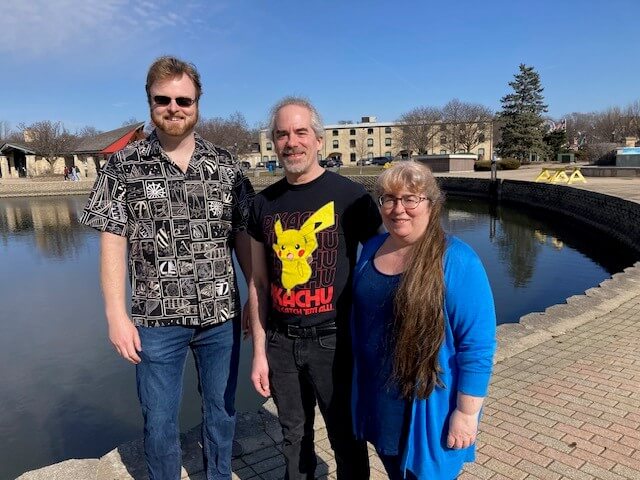
Andrew Pederson (left) with Professors Brad Sagarin and Kimberly Lawler-Sagarin at the Batavia Riverwalk, a hot spot for Pokémon Go enthusiasts.
Along with his Pokémon Go-playing wife, Elmhurst University Chemistry Professor Kimberly Lawler-Sagarin, and then-NIU student Andrew Pederson, Sagarin’s yearlong inquiry netted a resounding answer—the game strengthens that feeling of belonging among players.
Since its debut in 2016 – there were over 230 million users globally at its peak — Pokémon Go has been a popular out-and-about endeavor that defies video games’ longstanding reputation as a refuge for couch potatoes. Building on the Pokémon card craze that went global in the late 1990s, the game’s players catch fictitious creatures they see and interact with through a smartphone.
Among other findings, the survey of 449 players between August 2018 and September 2019 found that 88% reported meeting someone playing the game, 78% reported visiting a new location, and 35% reported patronizing a new business. The results were derived from a 16-question survey; data indicated that the more someone played, the greater the chance they’d develop a stronger sense of belonging to the community where they play.
Previously, other researchers had found the phone-based game encourages physical exercise and social interaction.
Building on those findings, the authors stated that their research holds multiple implications, including “that areas such as town centers or college campuses could benefit from welcoming augmented reality games as these games have the potential to increase community engagement.”
The results affirm what the Sagarins have experienced. Residents of Batavia since 2001, “what really highlighted things for us is we discovered the Batavia Riverwalk through playing Pokémon Go,” Sagarin recalled. “We said, ‘What are all these Pokéstops over here? This is gorgeous. How did we not know about this?’ ”
Along the way, through their game play, “we would see this incredible diversity of people show up for events—kids on bikes, older couples walking up,” Sagarin added. “It’s really a wonderful way of seeing a group of people come together that probably would not have converged for other reasons.”
As a student majoring in psychology, Pederson met Sagarin in late 2017, a meeting that would perfectly foreshadow their research. At the recommendation of other psychology professors, Pederson signed up for Sagarin’s office hours to explore possibilities at the school.
After signing up, Pederson went outside to play Pokémon Go nearby with about 15 other players all engaged in one of the in-game group activities. After the activity wrapped up, Pederson announced he was “off to meet Sagarin.”
Much to everyone’s surprise, the man to his right looked up from his phone and asked “Oh, you’re my 1 o’clock?” It was Dr. Sagarin.
In the ensuing conversation, Pederson agreed to join Sagarin’s independent study group. The next semester, Sagarin invited Pederson, a 2019 NIU graduate with a degree in psychology, to be part of the Pokémon Go research project.
At Elmhurst University, in addition to being a chemistry professor, Lawler-Sagarin is associate dean of the faculty. In that latter role, she is studying factors that increase belonging and the role of belonging in student and faculty retention in higher education.
“There is an increasing body of evidence in the literature that shows a student’s sense of belonging enhances retention and persistence, especially in STEM,” Lawler-Sagarin explained. “Our experience with Pokémon Go highlighted the power of sense of belonging. We met so many different people in Batavia through playing Pokémon Go, the possibility that the game might increase a player’s sense of belonging to their community was something we were excited to explore.”
Computer gaming, historically, has tended to be “a solo kind of thing,” said Sagarin, who hopes the research will highlight the ability of some augmented reality games to provide a more social outlet.
“A lot of computer gaming can feel very isolating,” Sagarin said. “It’s cool the way Pokémon Go has gotten people out and about. It’s a nice way to change the narrative.”
Northern Illinois University is a student-centered, nationally recognized public research university, with expertise that benefits its region and spans the globe in a wide variety of fields, including the sciences, humanities, arts, business, engineering, education, health and law. Through its main campus in DeKalb, Illinois, and education centers for students and working professionals in Chicago, Naperville, Oregon and Rockford, NIU offers more than 100 areas of study while serving a diverse and international student body.
Date posted: February 27, 2024 | Author: Tom Parisi | Comments Off on More than a game: NIU psychology professor measures Pokémon Go’s impact on belonging
DeKalb, IL – The Central Midwest Water Science Center (CMWSC) of the U.S. Geological Survey (USGS) will open a branch office later this semester on the campus of Northern Illinois University, a move that is expected to stimulate collaborative education and research efforts in an array of academic disciplines.
NIU photo by Wade Duerkes
The CMWSC conducts research and investigations to provide the scientific knowledge that engineers, planners and managers can use to make informed decisions related to water quality; water availability and use; extreme events; ecosystem interactions and monitoring; streamflow, groundwater and lakes; and advanced technologies and modeling.
The center currently has three offices in Illinois, including a Peace Road location in DeKalb. That office will be relocated to the former NIU Department of Information Technology print shop on the western portion of the university’s campus.
“We would like to thank NIU for our longstanding relationship in water resource research. This new co-location partnership will significantly advance the USGS mission as a leader in the water resources community; and NIU’s reputation as a world-class research institution,” said Kelly Warner, Acting Director of the USGS Central Midwest Water Science Center. “USGS is excited to continue our success with NIU and continue to provide important data and research for our state and nation.”
Renovation to reconfigure the 11,700 square feet of space in the former print shop is underway, with an estimated cost of $500,000 that will be funded by the USGS via grant reimbursement to NIU. The USGS center is expected to move onto campus in late April.
“We’re excited to be welcoming the USGS into their new NIU home,” said Yvonne Harris, vice president of NIU’s Division of Research and Innovation Partnerships (RIPS). “This will only strengthen our already productive relationship, which has resulted in partnerships centered around education, research and student experiences, and employment opportunities.”
The new cooperative agreement will support and promote a joint program of earth sciences research, education and outreach. The focus on transdisciplinary research involving water will advance university goals and the mission of the Northern Illinois Center for Community Sustainability (NICCS).
The $23 million NICCS facility—which will conduct research on water resources, environmental change, and food systems—was greenlighted by the State of Illinois a year ago. NICCS also will be located on the west side of campus, a short distance from the USGS offices, with construction expected to begin in 2025.
The CMWSC conducts unbiased, scientific hydrologic investigations and research projects to effectively manage the region and nation’s water resources through joint efforts with its partners.
“Historically, the collaboration between the USGS and NIU has resulted in students and graduates transitioning to long-term USGS scientists and employee positions,” said Karinne Bredberg, director of the NIU Office of Innovation. Bredberg noted that the USGS currently employs more than a dozen NIU graduates.
Barrie Bode, interim associate vice president of RIPS, said the campus presence of the USGS center will have a ripple effect.
“We expect the presence of the water science center on campus to lead to collaborative research with faculty and students, co-sponsorship of scientific meetings, joint research and education proposals, teaching collaborations and joint publishing of academic articles,” Bode said. “It will help bolster NIU’s reputation in water research.”
As natural resource management and geoenvironmental hazard responses become more complex, the science required to support them is becoming increasingly transdisciplinary. Collaborative research could focus on such areas as emerging water contaminants such as microplastics, stable-isotope ratio studies that can unlock stories about ecological processes, and science engagement within the communities regarding these science issues.
Studies could involve NIU faculty and students from such departments as Earth, Atmosphere, and Environment; Environmental Studies; Chemistry and Biochemistry; Communication; Engineering Technology; Mechanical Engineering; Biological Sciences; and Computer Sciences.
“NIU is known for its water research, and ESE helped lay the foundation for the NICCS,” Lenczewski added. “This collaboration could be a big focal point for NICCS.”
Northern Illinois University is a student-centered, nationally recognized public research university, with expertise that benefits its region and spans the globe in a wide variety of fields, including the sciences, humanities, arts, business, engineering, education, health and law. Through its main campus in DeKalb, Illinois, and education centers for students and working professionals in Chicago, Naperville, Oregon and Rockford, NIU offers more than 100 areas of study while serving a diverse and international student body.
Date posted: February 7, 2024 | Author: Tom Parisi | Comments Off on U.S. Geological Survey to open office on NIU campus
DeKalb, IL – Further demonstrating its commitment to access and affordability, Northern Illinois University is now expanding the eligibility requirements for its popular AIM HIGH Huskie Pledge program.
NIU’s AIM HIGH Huskie Pledge is supported by the State of Illinois’ AIM HIGH Program. At NIU, qualifying Illinois high school seniors who graduate with an overall GPA of 3.0 or above could pay no tuition costs or general fees for their first year at NIU — and potentially beyond.
In the past, program eligibility requirements included a family adjusted gross income at or below $75,000. The university has now raised the ceiling of that threshold to $100,000—a move that will allow many more students to qualify for the program.
The new threshold is effective immediately for students enrolling as full-time freshmen this coming fall.
“At NIU, we’re committed to reducing barriers, creating opportunities and investing where we can make a difference,” said Sol Jensen, NIU vice president for Enrollment Management, Marketing and Communications. “We’re excited to announce that we’ve expanded our AIM HIGH Huskie Pledge program to make NIU an affordable choice for even more students.”
Here’s how the program works. For eligible students, the Huskie Pledge guarantees that tuition and general fee costs will be met by grants and/or scholarships for their first year at NIU and potentially beyond. A Huskie Pledge Grant covers tuition and general fee expenses that aren’t met by other financial aid. Students who continue to meet renewal eligibility criteria can receive the same Huskie Pledge Grant amount for up to four more years.
Since the program was started in 2020, nearly 3,500 full-time students have qualified and enrolled at NIU. Those students had an average high school GPA of 3.55, and nearly three-quarters of them reported being first-generation college students.
Significant changes were made to the FAFSA application this year, and the planned date for the U.S. Department of Education to send financial aid information to universities has been delayed until at least mid-March. To ease any student concerns, NIU has moved its AIM HIGH Huskie Pledge priority deadline back two months, to April 1.
State Representatives Lance Yednock and Jeff Keicher are strong supporters of the state-funded AIM HIGH Huskie Pledge.
Yednock said: “NIU extending the AIM HIGH Huskie Pledge to incomes at or below $100k will open access to the university for so many more students, proving once again NIU is one of the most forward thinking and accessible universities in our state—way to go NIU!”
“As a proud alum, who is a first-generation college graduate, I am able to say NIU changed the course of my life,” Keicher added. “I am consistently impressed at the opportunity provided by the NIU AIM HIGH Huskie Pledge to students who were just like me. NIU offers today’s students the same ability to succeed in achieving dreams today as it did for me 25 years ago.”
Learn more about NIU’s AIM HIGH Huskie Pledge at the program website.
Northern Illinois University is a student-centered, nationally recognized public research university, with expertise that benefits its region and spans the globe in a wide variety of fields, including the sciences, humanities, arts, business, engineering, education, health and law. Through its main campus in DeKalb, Illinois, and education centers for students and working professionals in Chicago, Naperville, Oregon and Rockford, NIU offers more than 100 areas of study while serving a diverse and international student body.
Date posted: February 6, 2024 | Author: Tom Parisi | Comments Off on No tuition or fees? NIU expands AIM HIGH Huskie Pledge program
DeKalb, IL – In the battle for mental health wellness among our nation’s youth, NIU’s role on the frontlines is growing.
Photo credit: Bruno Nascimento, Unsplash
Recently, along with the University of Missouri, NIU received a five-year grant for $2.5 million to help nurture the next generation of professionals providing mental and behavioral support services to students.
The funding is devoted to training 10 graduate students, five through the NIU Department of Psychology School Psychology Program and five at the University of Missouri Special Education Doctoral Program. The grant is funded by the Office of Special Education Programs (OSEP), part of the U.S. Department of Education.
NIU Psychology Professor Julia Ogg is director of the project, known as SMART-MBH (Scholars in Multi-Tiered Approaches to Research and Training in Mental and Behavioral Health).
About 20% of elementary school students and high school students need mental health support and, “with COVID-19, a lot of those numbers were higher,” Ogg said. “This highlights the need to address mental health issues in schools where all students spend a significant amount of time.”
Missouri’s special education doctoral program’s involvement stems in part from historical data revealing that students with disabilities experience mental health challenges at a higher rate than their peers without disabilities.
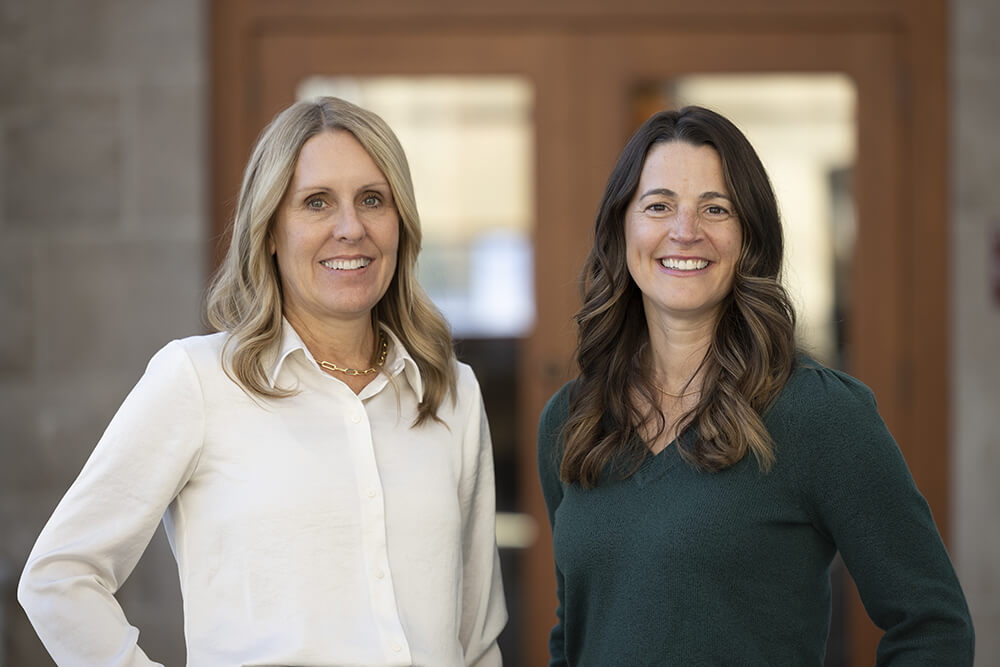
NIU Professors Michelle Demaray and Julia Ogg.
“Most kids who get those kinds of supports get them in school,” Ogg added. “There are some outstanding programs that work effectively in schools to address anxiety, depression and other issues. The need is more pressing than ever.”
The grant’s focus, she said, is “training leaders with research expertise in addressing the mental and behavioral health of students in schools.”
“This funding will enable grad students to be successful in pursuing academic positions and become faculty themselves, and to drive the field of psychology forward as these scholars will have specialized training opportunities in research and teaching,” Ogg said.
At NIU, Ogg and Psychology Professor Michelle Demaray will train students in school psychology; at Missouri, Chad Rose and Aaron Campbell will be at the helm of guiding students pursuing doctorates in special education.
NIU students will be supported via tuition, stipends, health insurance and other resources to support their training and scholarship. Also, the funding covers technology—such as computers or statistical software—and travel expenses to present research findings at conferences, Ogg said.
There is also a “stats camp” and a summer research institute for both NIU and Missouri students. These opportunities will allow students to gain additional expertise needed for complex research, as well as opportunities to network with other scholars in the field.
NIU had applied for the grant at least three other times in recent years, so securing the funding represents a significant win for the university, Ogg said. “This is such a good opportunity for students,” Ogg noted. “We are excited to carry this out and excited about the ripple effect it will have on so many students in need of these services.”
Prospective students in the program will be interviewed early this semester, with offers made later in the semester, Ogg said. Students will enroll in the Fall 2024 semester.
Northern Illinois University is a student-centered, nationally recognized public research university, with expertise that benefits its region and spans the globe in a wide variety of fields, including the sciences, humanities, arts, business, engineering, education, health and law. Through its main campus in DeKalb, Illinois, and education centers for students and working professionals in Chicago, Naperville, Oregon and Rockford, NIU offers more than 100 areas of study while serving a diverse and international student body.
Date posted: February 5, 2024 | Author: Tom Parisi | Comments Off on NIU partners with U of Missouri to develop mental health leaders
The highly competitive award is given to students who have the potential to make important contributions to the mission of the DOE Office of Science.
A 31-year-old native of Waterloo, Indiana, Kelham is one of 60 students from across the United States to receive the 2023 award. Each student is focused on projects addressing critical energy, environmental and nuclear challenges at the national and international levels.
The award stipend covers travel expenses and $3,600 per month in general living expenses for a one-year period starting in January. At that time, Kelham will begin work at Argonne National Laboratory (ANL) in Lemont on a full-time basis. He will be supervised by NIU Physics Professor Philippe Piot, who holds a joint appointment with the university and ANL.
At Argonne, Kelham will use electro-optic-based diagnostic tools to analyze particle beams. The goal of this work is to develop a working system for measuring and recording electron bunch shape, as well as arrival time. These quantities are important for characterizing and optimizing the electron bunch in accelerator applications.
“Over the next year, thanks to the support from the Department of Energy, the diagnostics that Spencer will develop is expected to be critical to understanding the intricate dynamics of charged-particle beams in large light-source storage rings but also in future high-energy particle accelerators,” Piot said. “The research will be performed at ANL in collaboration with staff at the Advanced Photon Source and the Argonne Wakefield Accelerator.”
Kelham, whose anticipated Ph.D. date is spring 2025, expressed gratitude for Piot. “I really appreciate the opportunities I’ve been given under his guidance,” Kelham said. “I’ve learned a lot under him.”
Kelham earned his bachelor’s degree in physics from Purdue University Fort Wayne in 2019. He enrolled at NIU in 2020 to study beam physics and has been researching optics-based beam diagnostics.
“As long as I could remember, I always wanted to do research in the sciences,” Kelham said. “As early as high school, physics really became an area of interest for me. That interest focused on the study of optics as an undergraduate, and more so as a graduate student.”
One of his first professors at NIU was Piot, who became a valued mentor during Kelham’s development in DeKalb.
“He celebrates with you when you make major accomplishments and has been a great professor to work under,” Kelham said. “He also really cares about the wellbeing of his students.”
Kelham becomes the fifth NIU physics student since 2016 to win the prestigious DOE award, which aims to spur on emerging professionals to help the DOE’s effort to discover and innovate. Another of Professor Piot’s students won the award in 2021.
NIU is home to one of the best university accelerator physics programs in the nation. The program benefits from the proximity of major accelerator research facilities at Argonne and Fermi National Accelerator Laboratory. Faculty members associated with the program collaborate with these laboratories and colleagues from around the world in high-priority accelerator projects and experiments. They also teach accelerator and beam physics courses at NIU.
Northern Illinois University is a student-centered, nationally recognized public research university, with expertise that benefits its region and spans the globe in a wide variety of fields, including the sciences, humanities, arts, business, engineering, education, health and law. Through its main campus in DeKalb, Illinois, and education centers for students and working professionals in Chicago, Naperville, Oregon and Rockford, NIU offers more than 100 areas of study while serving a diverse and international student body.
Date posted: December 15, 2023 | Author: Tom Parisi | Comments Off on Physics student Spencer Kelham wins prestigious DOE award
DeKalb, IL – Back in the spring, NIU biological sciences associate professor Jennifer Koop burst in on her faculty mentor’s conference with a graduate student.
Professor Jennifer Koop
To the untrained eye, her behavior might have resembled that of the invasive species that Koop has studied for many years. However, not only was she speedily forgiven, but the student and mentor—Professor Holly Jones—joined in celebration of the remarkable news: Koop had just learned she would receive a Faculty Early Career Development Program (CAREER) grant of $1.2 million over five years from the National Science Foundation (NSF).
“I was shocked,” Koop recalled. “It was surreal. It’s really an amazing vote of confidence from a national institution, and you just don’t get that very often in your career.”
Jones recalled the scene, noting she was “absolutely thrilled to hear the news but, unlike Dr. Koop, I was not at all surprised she successfully garnered this funding.”
“Her research is compelling,” Jones added. “It helps us understand invasive species evolution, and she also devised an engaging program for local middle school students to learn about ecology–the perfect recipe for a successful grant.”
The NSF funding period began on July 1, 2023 and supports Koop’s efforts to investigate why some species, specifically parasitic trematodes (worms) have invaded new habitats. Finding answers could be crucial in developing management practices aimed at reducing the negative impact of those invasive species on the environment.
The grant also has a large outreach component that involves NIU graduate students, undergraduate students and 7th grade STEM students at Clinton Rosette Middle School in DeKalb who are mentored by NIU students. The grant will enable Koop to hire six to eight NIU undergraduate students, two or three graduate students, and a post-doc for varying lengths of time.
“It’s a massive amount of work, and it will take a lot of people to get it done,” Koop explained. “It is going to help explain why some parasites and pathogens are really good at spreading in new spaces and infecting new groups of organisms.”
The middle-school students are collaborating to design and implement their own experiments that seek to understand how various environmental factors affect animal dispersal. For example, do snails (and their parasitic worms) move faster in warm water than in cold water? Do snails stop moving if they sense a predator is near (such as when students place a fake snake in the pool)?
Already, 35 Clinton Rosette students, along with seven NIU student mentors, have begun and “are learning to partake in scientific inquiry,” including ecological and evolutionary research methods, teaching methods and science communication, Koop said.
Eventually, the goal is for over 60 seventh-graders at Clinton Rosette and Genoa-Kingston middle schools to participate annually.
“We know very little about what evolutionary processes have to happen for a particular parasite or pathogen to succeed, and what ecological conditions need to be there for it to succeed,” Koop said. “Invasive species are a major threat to today’s biodiversity. Invasive parasites and pathogens are making themselves known and require our attention as scientists.”
The CAREER grant is NSF’s highest honor in support of junior faculty who exemplify the role of teacher-scholars through outstanding research, excellent education and the integration of education and research. It is only the latest in a string of successes for Koop, who is in her fifth year at NIU as a newly tenured professor of biological sciences.
When she was an assistant professor at UMass-Dartmouth, she received a grant from the National Oceanic and Atmospheric Administration with an unusual “research set-aside” twist: She was allocated 53,000 pounds of Atlantic sea scallops, for which she hired fishermen to collect. At $12 per pound, she earned the equivalent of $600,000 for two years of research focusing on an invasive parasite that was affecting sea scallop meat quality.
That funding approach is “a cool way of doing research,” Koop noted. “Fishermen and scientists decide together which grants to fund. That means that the research with the most relevant information is prioritized and helps in a direct way.”
One outgrowth of that research came in early 2022, when Koop appeared on Good Morning America as part of a two-week excursion in the Galápagos Islands. On that occasion, she and a graduate student were studying the invasion pathway of a parasitic nest fly – the avian vampire fly—affecting Darwin’s finches in the exotic area.
“I’m grateful that I was able to help showcase the beauty and treasure that is the Galapagos,” Koop said. “But if I had to choose between GMA and getting this grant, I’d choose the grant without hesitation. Five years of funding to pursue the research and outreach that is most interesting to me is a dream come true.”
About NIU
Northern Illinois University is a student-centered, nationally recognized public research university, with expertise that benefits its region and spans the globe in a wide variety of fields, including the sciences, humanities, arts, business, engineering, education, health and law. Through its main campus in DeKalb, Illinois, and education centers for students and working professionals in Chicago, Naperville, Oregon and Rockford, NIU offers more than 100 areas of study while serving a diverse and international student body.
Date posted: October 30, 2023 | Author: Tom Parisi | Comments Off on NIU biological sciences professor awarded $1.2 million NSF grant to study invasive species
DeKalb, IL – To kick off Northern Illinois University’s Edible Campus initiative this past spring, NIU students and faculty planted nearly 100 garden beds across campus, plus a one-third acre market garden near Anderson Hall—and now they’re reaping a plentiful harvest.
In this brief accompanying video, you can learn (and see) more about NIU’s expansive Edible Campus, a living laboratory that, well, also tastes delicious.
Since May 1, the Anderson Market Garden has produced over 2,000 pounds of produce with more than 20 different plants and herbs. Harvested produce is being used in dining halls, in educational settings, at the Huskie Food Pantry and in meal-prep sessions for the Huskie community.
Northern Illinois University is a student-centered, nationally recognized public research university, with expertise that benefits its region and spans the globe in a wide variety of fields, including the sciences, humanities, arts, business, engineering, education, health and law. Through its main campus in DeKalb, Illinois, and education centers for students and working professionals in Chicago, Naperville, Oregon and Rockford, NIU offers more than 100 areas of study while serving a diverse and international student body.
Date posted: October 25, 2023 | Author: Tom Parisi | Comments Off on Video: NIU’s Edible Campus reaps food, knowledge, tomorrow’s sustainability leaders
DeKalb, IL – The research of NIU Chemistry Professor Tao Li continues to attract attention from national research funders.
NIU Chemistry Professor Tao Li
After earning research grants totaling more than $880,000 over the last two years, Professor Li this fall has received three new federal awards for his scientific studies, this time totaling $1.85 million. All of the new projects will incorporate student researchers.
Earlier this month, it was announced that Li will be a member of a new center at the U.S. Department of Energy’s Argonne National Laboratory that is making a major research push toward the decarbonization of steelmaking. As a center researcher, NIU’s Li will receive $850,000 in DOE funding for a four-year study on the solvation behavior of iron electrolytes. He’ll hire one postdoctoral student and one Ph.D. student to assist with the study.
Li also has a five concurrent National Science Foundation research projects underway at NIU, including two that are newly funded this fall.
Undergraduate student Rena Gonzalez is a member of Professor Li’s research group.
Under its Designing Materials to Revolutionize and Engineer our Future (DMREF) program, NSF is awarding $1.9 million for work on the battery project over four years, with $760,000 going to NIU.
“Rechargeable batteries have become one of the most popular energy storage devices for electric vehicles, electronics and grid energy storage,” Li says. “But developing novel electrolytes for the next generation of rechargeable batteries requires more understanding of transport properties, microstructures, and the impact of microstructure on transport property.”
NSF recently announced a $72.5 million investment in its DMREF program, with research teams working to create novel materials to address grand societal challenges and develop the scientific and engineering workforce of tomorrow. DMREF is NSF’s primary response to the federal Materials Genome Initiative. Its mission is to discover, develop and deploy new materials twice as fast and at a fraction of the cost of traditional research methods.
Li’s project is one of 37 projects to be funded through the program, and he is the only researcher from a Carnegie Classified R2 research university to lead one of the teams. The others are being led by large R1 research institutions.
Professor Li working in his lab with Ph.D. student Xingyi Lyu.
“This was a very competitive grant program, and I’m excited about the research and about the opportunities it will provide to NIU students,” Li said, adding that the research will be conducted at NIU and the U.S. Department of Energy’s Argonne National Laboratory.
Li will employ a postdoc and a Ph.D. student to work on the project, as well as undergraduate interns who will be part of NIU’s summer Research Experiences for Undergraduates program. The students will learn skills related to the characterization of materials and machine learning.
On another research topic, NSF will provide Li with $240,000 to help investigate the creation of next generation microchips or semiconductors for electronic devices. Li serves as a principal investigator on the multiyear project, being led by the University of Cincinnati. It is supported by the NSF Future of Semiconductors (FuSe) program through a public-private partnership.
The outcome of this project is expected to be information on how to manufacture a highly efficient spintronic device. Spintronics technology is an emerging field that uses the spin of an electron along with its charge to reduce power consumption and to increase memory and processing capabilities.
Li said one NIU graduate student will be involved in the project, but the researchers additionally will work to create a blueprint for the launch of a micro-credential in technology communication. The team will also conduct outreach to undergraduate and K-12 audiences to raise awareness of jobs in the semiconductor industry.
Li was recognized last year with an Emerging Researcher Award from the American Chemical Society and selected to be in the class of 2022 Illinois Science & Technology Coalition Researchers to Know in the field of energy technology.
About NIU
Northern Illinois University is a student-centered, nationally recognized public research university, with expertise that benefits its region and spans the globe in a wide variety of fields, including the sciences, humanities, arts, business, engineering, education, health and law. Through its main campus in DeKalb, Illinois, and education centers for students and working professionals in Chicago, Naperville, Oregon and Rockford, NIU offers more than 100 areas of study while serving a diverse and international student body.
Date posted: October 25, 2023 | Author: Tom Parisi | Comments Off on Chemistry Professor Tao Li’s research attracting lots of attention
 DeKalb, IL – Northern Illinois University is among Carnegie-classified R2 universities for high research activity. This year, the Office of Student Engagement and Experiential Learning (OSEEL) and the University Honors Program are taking the celebration of research to the next level, with the debut of Research Month in April.
 Research Month will culminate Tuesday, April 30, with the Conference on Undergraduate Research and Engagement (CURE). This annual event returns to the Duke Ellington Ballroom for the first time since the pandemic. CURE gives NIU students the opportunity to present faculty-mentored undergraduate research, artistry and engagement projects.