
DeKalb, IL – Back in the spring, NIU biological sciences associate professor Jennifer Koop burst in on her faculty mentor’s conference with a graduate student.
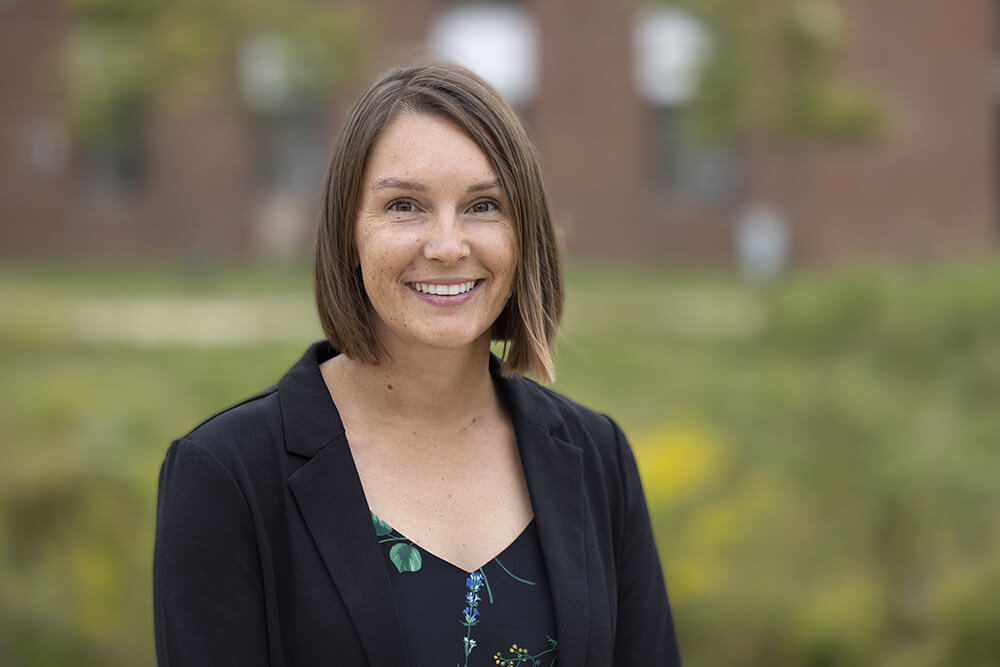
Professor Jennifer Koop
To the untrained eye, her behavior might have resembled that of the invasive species that Koop has studied for many years. However, not only was she speedily forgiven, but the student and mentor—Professor Holly Jones—joined in celebration of the remarkable news: Koop had just learned she would receive a Faculty Early Career Development Program (CAREER) grant of $1.2 million over five years from the National Science Foundation (NSF).
“I was shocked,” Koop recalled. “It was surreal. It’s really an amazing vote of confidence from a national institution, and you just don’t get that very often in your career.”
Jones recalled the scene, noting she was “absolutely thrilled to hear the news but, unlike Dr. Koop, I was not at all surprised she successfully garnered this funding.”
“Her research is compelling,” Jones added. “It helps us understand invasive species evolution, and she also devised an engaging program for local middle school students to learn about ecology–the perfect recipe for a successful grant.”
The NSF funding period began on July 1, 2023 and supports Koop’s efforts to investigate why some species, specifically parasitic trematodes (worms) have invaded new habitats. Finding answers could be crucial in developing management practices aimed at reducing the negative impact of those invasive species on the environment.
The grant also has a large outreach component that involves NIU graduate students, undergraduate students and 7th grade STEM students at Clinton Rosette Middle School in DeKalb who are mentored by NIU students. The grant will enable Koop to hire six to eight NIU undergraduate students, two or three graduate students, and a post-doc for varying lengths of time.
“It’s a massive amount of work, and it will take a lot of people to get it done,” Koop explained. “It is going to help explain why some parasites and pathogens are really good at spreading in new spaces and infecting new groups of organisms.”
The middle-school students are collaborating to design and implement their own experiments that seek to understand how various environmental factors affect animal dispersal. For example, do snails (and their parasitic worms) move faster in warm water than in cold water? Do snails stop moving if they sense a predator is near (such as when students place a fake snake in the pool)?
Already, 35 Clinton Rosette students, along with seven NIU student mentors, have begun and “are learning to partake in scientific inquiry,” including ecological and evolutionary research methods, teaching methods and science communication, Koop said.
Eventually, the goal is for over 60 seventh-graders at Clinton Rosette and Genoa-Kingston middle schools to participate annually.
“We know very little about what evolutionary processes have to happen for a particular parasite or pathogen to succeed, and what ecological conditions need to be there for it to succeed,” Koop said. “Invasive species are a major threat to today’s biodiversity. Invasive parasites and pathogens are making themselves known and require our attention as scientists.”
The CAREER grant is NSF’s highest honor in support of junior faculty who exemplify the role of teacher-scholars through outstanding research, excellent education and the integration of education and research. It is only the latest in a string of successes for Koop, who is in her fifth year at NIU as a newly tenured professor of biological sciences.
When she was an assistant professor at UMass-Dartmouth, she received a grant from the National Oceanic and Atmospheric Administration with an unusual “research set-aside” twist: She was allocated 53,000 pounds of Atlantic sea scallops, for which she hired fishermen to collect. At $12 per pound, she earned the equivalent of $600,000 for two years of research focusing on an invasive parasite that was affecting sea scallop meat quality.
That funding approach is “a cool way of doing research,” Koop noted. “Fishermen and scientists decide together which grants to fund. That means that the research with the most relevant information is prioritized and helps in a direct way.”
In 2016, during her four-year stint at UMass-Dartmouth, she received a grant from the National Geographic Research and Exploration Committee for work on reconstructing the invasion route of a parasitic nest fly to the Galápagos Islands.
One outgrowth of that research came in early 2022, when Koop appeared on Good Morning America as part of a two-week excursion in the Galápagos Islands. On that occasion, she and a graduate student were studying the invasion pathway of a parasitic nest fly – the avian vampire fly—affecting Darwin’s finches in the exotic area.
“I’m grateful that I was able to help showcase the beauty and treasure that is the Galapagos,” Koop said. “But if I had to choose between GMA and getting this grant, I’d choose the grant without hesitation. Five years of funding to pursue the research and outreach that is most interesting to me is a dream come true.”
About NIU
Northern Illinois University is a student-centered, nationally recognized public research university, with expertise that benefits its region and spans the globe in a wide variety of fields, including the sciences, humanities, arts, business, engineering, education, health and law. Through its main campus in DeKalb, Illinois, and education centers for students and working professionals in Chicago, Naperville, Oregon and Rockford, NIU offers more than 100 areas of study while serving a diverse and international student body.
