You might have heard of the famous “marshmallow test.” The study, and follow-ups that extended over decades, found that children who could delay gratification—and consequently get two marshmallows instead of one—tended to have better life outcomes.
But a 2018 study challenged those results. And many other widely accepted findings from high-profile studies of the past have faced new scrutiny over the last decade. Since the nature of science is one study building upon another, what has come to be known as the reproducibility crisis (or replication crisis) has cast a shadow on some important discoveries of the past, particularly in the fields of psychology, economics and medicine.
Now two NIU computer scientists, working with a colleague at Northwestern University, are hoping to make headway in addressing the reproducibility crisis by taking the first steps toward developing software akin to a spell checker for research—a program that would help scholars gauge the likelihood of their study results being successfully reproduced or replicated.
The National Science Foundation (NSF) has awarded $300,000 in grant funding for the project to NIU Computer Science Professors Hamed Alhoori and David Koop, along with colleague Brian Uzzi of Northwestern’s Kellogg School of Management. Their project will make use of “explainable AI,” or artificial intelligence technology that finds solutions that can be understood by people.
Across the globe, millions of research papers are published by scholars annually.
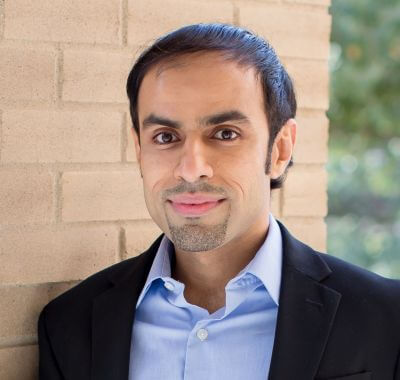
NIU Computer Science Professor Hamed Alhoori
“Each year, more than $2 trillion is spent on research and development worldwide, so findings that don’t hold up represent an enormous waste of time and money,” said Alhoori, the lead researcher on the project. He also points to a 2016 survey by the prestigious journal Nature finding that more than 70% of researchers have tried and failed to reproduce another scientist’s experiments, and more than half have failed to reproduce their own experiments.
“If we can’t validate published findings, it’s clearly a problem,” Alhoori said. “When scientists see research published in a reputable journal, we think we can build on the work.”
There’s also public trust to consider, Koop added.
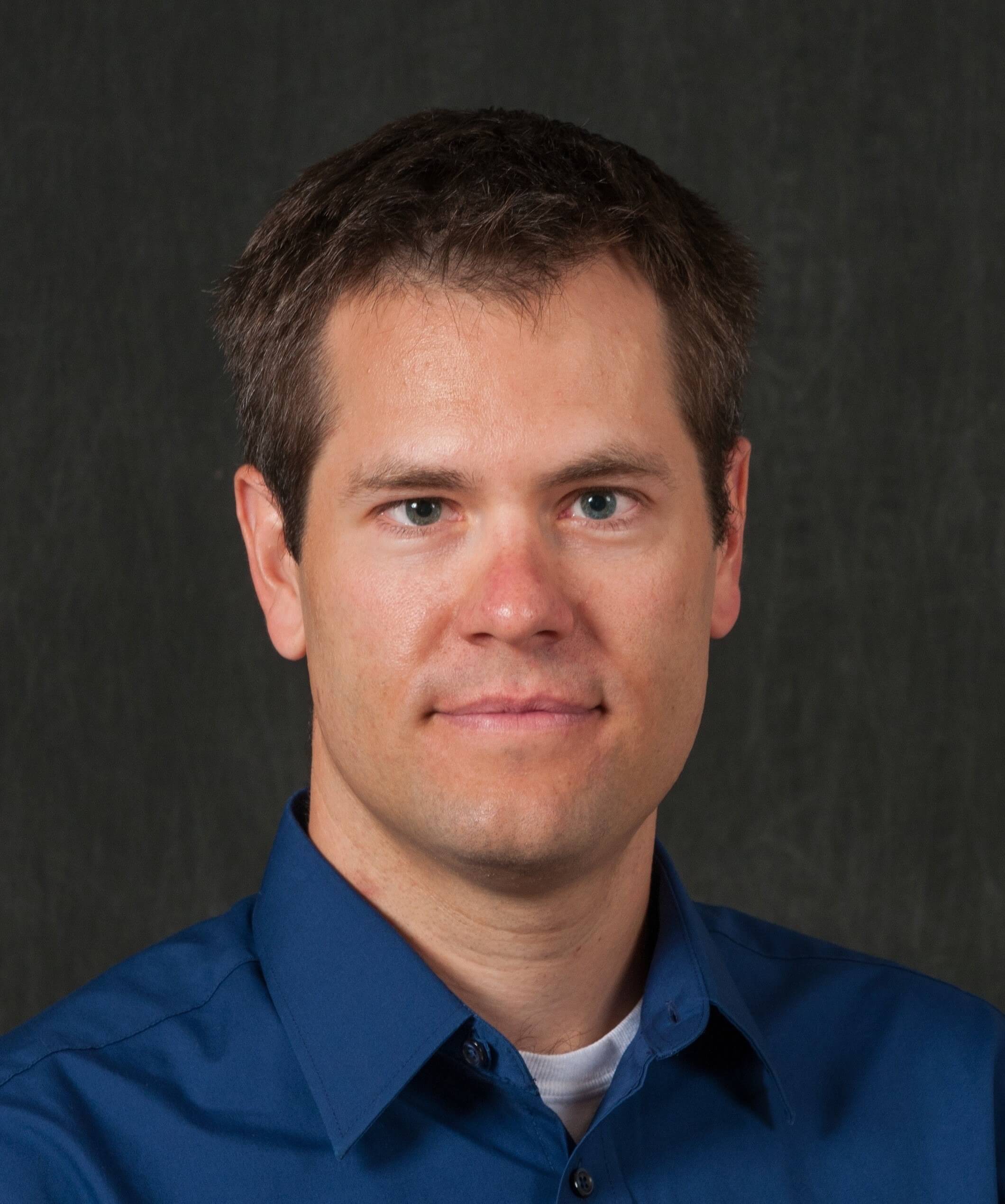
NIU Computer Science Professor David Koop
“People hear about retractions (of scientific studies) and assume they can’t trust science,” he says. “It’s important to minimize those events as much as possible.”
Over the next two years, the researchers plan to begin developing metrics and tools to help make reproduction of existing work more efficient. They also want to help scientists, scholars and technologists self-evaluate their work before publishing it.
“One of our major goals is to quantify the level of confidence that a work is likely to be reproducible by leveraging both human and machine intelligence,” Alhoori said. “Ideally, researchers would have something like spell check.”
The terms “reproducibility” and “replicability” are often used interchangeably. However, the former more specifically refers to computational reproducibility, or repeating an experiment using the same data and methods to obtain consistent results. Replicability aims to answer the same scientific question with new data. The thrust of the new research could aid either process but is focused on reproducibility—analyzing the data originally captured and the computer code used to produce models and/or results.
The scientists plan to assemble new datasets covering the success and failure of hundreds of scientific papers and identifying the common threads among research that holds up to scrutiny versus studies that unravel when being reproduced. A range of metrics will be analyzed from the scholarly text, images, tables, methods, computer code, computational notebooks and results.
“There are signals that could provide clues as to whether a work is reproducible,” Koop said.
The research team is aiming to develop interpretable machine learning and deep learning models that will estimate a confidence level in a work’s reproducibility. However, Koop notes that tools that work in one type of discipline might not be appropriate for another. “The tools we develop will probably need to be different depending on the type of publication,” he said.
So, is a spell checker for research imminent? Not yet, Alhoori said, but he and his colleagues hope to make strides in that direction.
Northern Illinois University is a student-centered, nationally recognized public research university, with expertise that benefits its region and spans the globe in a wide variety of fields, including the sciences, humanities, arts, business, engineering, education, health and law. Through its main campus in DeKalb, Illinois, and education centers for students and working professionals in Chicago, Hoffman Estates, Naperville, Oregon and Rockford, NIU offers more than 100 areas of study while serving a diverse and international student body.
Date posted: January 19, 2021 | Author: Tom Parisi | Comments Off on Spell check for research? Confronting the reproducibility crisis with explainable AI
In his new book, NIU anthropologist Mark Schuller tackles a frightening prospect that seems all too relevant in these turbulent times: Is the human species headed toward extinction?
Set for publication Friday (Jan. 15), “Humanity’s Last Stand: Confronting Global Catastrophe” dares to ask this and other provocative questions, exploring the interconnections between climate change, global capitalism, xenophobia and white supremacy.
A virtual book launch will be held from 2 to 3:30 p.m. Friday, featuring Schuller and five leading NIU scholars. (The book is accompanied by a website, with instructional resources.)
“Humanity’s Last Stand” is a call “to elevate our thinking to the species level,” writes former Congresswoman Cynthia McKinney in the book’s foreword.
Schuller’s work surveys the struggles of disenfranchised peoples across the globe, from frontline communities affected by climate change, to #BlackLivesMatter activists, to Indigenous water protectors, to migrant communities facing increasing hostility. Across all these spectrums, he argues that we must develop radical empathy, requiring that we move beyond simply identifying ourselves as “allies” in movements for the betterment of our planet and start acting as “accomplices.”
Bringing together the insights of anthropologists and activists from many cultures, the NIU professor’s timely study ultimately points to establishing a more inclusive vision of humanity before it’s too late.
In advance of the publication, Schuller, who holds a joint appointment at NIU in anthropology and nonprofit and NGO studies, participated in a Q&A with the NIU Newsroom about the new book.
The title of your book, “Humanity’s Last Stand,” creates an apocalyptic image. Is humanity truly headed toward extinction?
Seen from an anthropological view, as a species, the warning signs are clear. This is the mandate of the Anthropocene: Ever more species are becoming extinct, including our closest relatives, primates. As the creators of this catastrophe, we can turn this around but only by taking deadly seriously the existential threats of climate change, proliferating warfare, xenophobia and racism.
What are the biggest threats to humanity, in your opinion?
We cannot continue to treat the planet as something to consume. Increasingly deadly droughts, wildfires and hurricanes are violent warnings that our global economic system is unsustainable. Over the course of our species’ history, humanity survived climate change and major catastrophes by migration—so putting up barriers only hastens our demise. White supremacy and racism, as products of capitalism built on plantation slavery and Indigenous genocide, keep us divided.
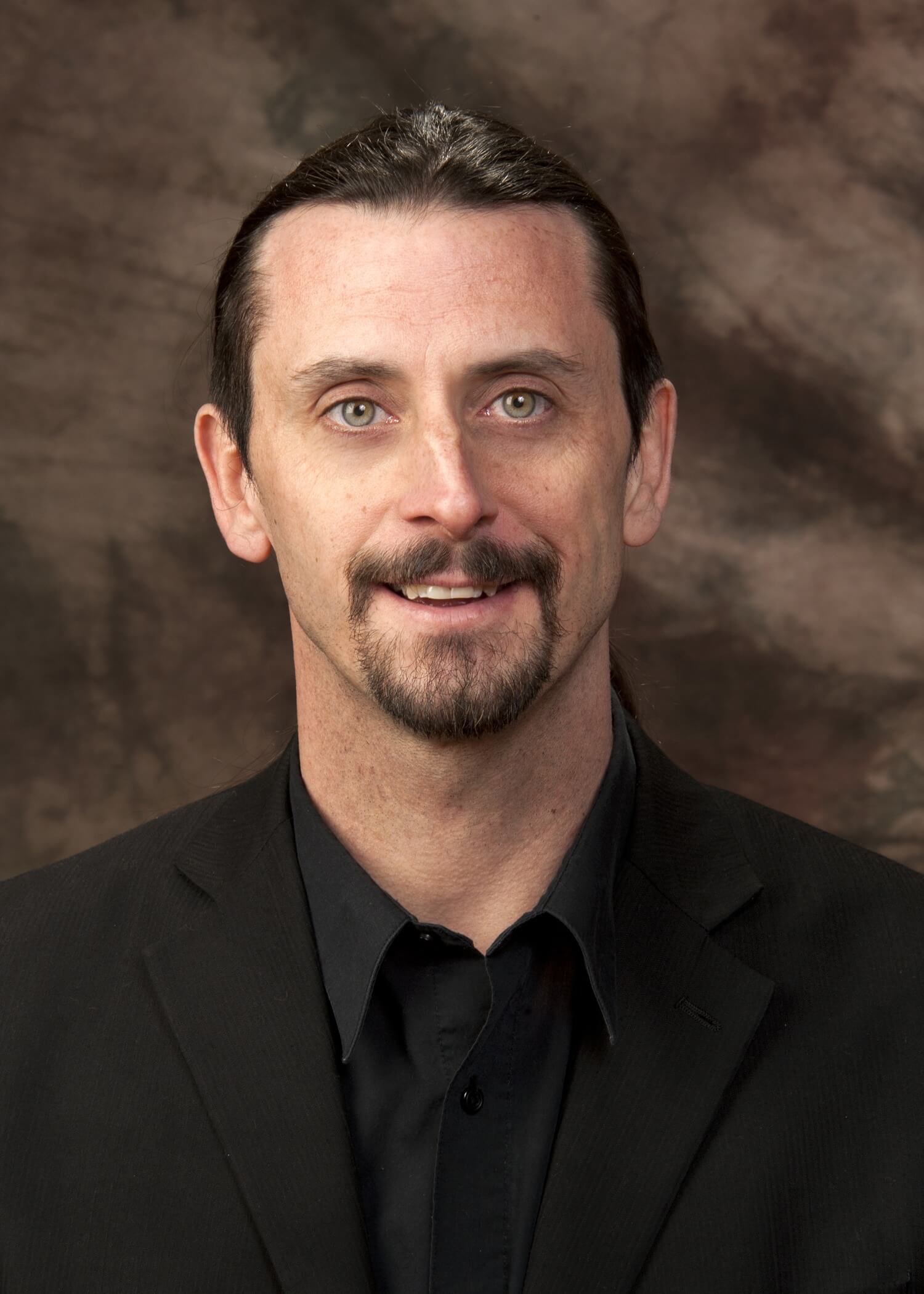
NIU Anthropology Professor Mark Schuller
What prompted you to write this book?
In a single year, 2017, we saw four deadly Category 4 hurricanes following terrifying and proto-Fascist attacks on immigrants in the U.S. and the rise of alt-right white nationalists, out in the open and emboldened. I saw my students, colleagues and friends increasingly terrorized, and “allies” spinning our wheels playing “whack-a-mole” and being demoralized and ineffective.
The book explores interconnections between disparate topics such as climate change, global capitalism, xenophobia and white supremacy. How and why do you make these connections?
Capitalism was founded on plantation slavery, following Indigenous genocide. Capitalism requires growth at all costs; global capitalism entails colonial expropriation. Resources are taken from colonized peoples to enrich an increasingly small group, which builds literal walls, as well as walls of racism and nationalism, protecting its privilege. After abolition, fossil fuels replaced enslaved people’s blood, heating up the planet.
Your book unearths how capitalism was born from plantation slavery and the slaughter of Indigenous people. Can you briefly summarize here?
Following Columbus’s voyage, Western European powers fought over the “New World,” declared “terra nullius” (empty land) by the pope in 1493, after the Church’s 1452 blessing of slavery. Within a generation of contact, Indigenous people were literally decimated. As Eric Williams demonstrated 80 years ago, African slavery in the Caribbean provided the infusion of capital to fuel the industrial revolution.
You argue that we must develop “radical empathy.” What is that?
Radical empathy is moving beyond individuals, seeing the connections between people woven together by our global economic system. It is seeing how our own way of life may be out of step with humanity, possibly contributing to others’ oppression, and therefore may need to change. Seeing these connections forces us to move beyond identifying as “allies” into being “accomplices.”
2020 alone saw a global pandemic, escalating tensions among races and nations, and terrible U.S. storms and wildfires. Is there hope for humanity?
Yes, if we act. Now. We must learn and apply urgent lessons. In humanity’s ugliest hours, we have demonstrated our capacity for love, solidarity and justice, whether harboring enslaved people fleeing to freedom, Jews facing extermination, or undocumented people facing deportation. Following revolutionary BIPOC movements rooted in self-help, collectivism and linking activism with production, we can build alternatives.
How is it helpful to cultivate an “anthropological imagination”?
Cultivating an anthropological imagination shows us that struggles for justice “here” are already connected to struggles “there.” It highlights the connections we already have, despite the fog of ideology that keeps us feeling isolated. It provides a platform for a solidarity politics, finding appropriate ways to unravel the threads of inhumanity from where we are, acknowledging and then dismantling privilege.
At the individual level, what can we do to save our species?
Have an anthropological imagination, see us as connected. We need to see the human beings behind our food, shelter, electricity and consumer goods. That’s the first step in building a bottom-up platform for making necessary global changes. We will never muster the courage or will while we continue to dehumanize other people and their problems and ignore the consequences of our unsustainable consumption.
Northern Illinois University is a student-centered, nationally recognized public research university, with expertise that benefits its region and spans the globe in a wide variety of fields, including the sciences, humanities, arts, business, engineering, education, health and law. Through its main campus in DeKalb, Illinois, and education centers for students and working professionals in Chicago, Hoffman Estates, Naperville, Oregon and Rockford, NIU offers more than 100 areas of study while serving a diverse and international student body.
Date posted: January 13, 2021 | Author: Tom Parisi | Comments Off on Mark Schuller confronts question of extinction—of human species
DeKalb, Ill. — A research team, led by the U.S. Department of Energy’s (DOE) Argonne National Laboratory in collaboration with Northern Illinois University, has discovered a new electrocatalyst that converts carbon dioxide (CO2) and water into ethanol with very high energy efficiency, high selectivity for the desired final product and low cost.
Ethanol is a particularly desirable commodity because it is an ingredient in nearly all U.S. gasoline and is widely used as an intermediate product in the chemical, pharmaceutical and cosmetics industries.
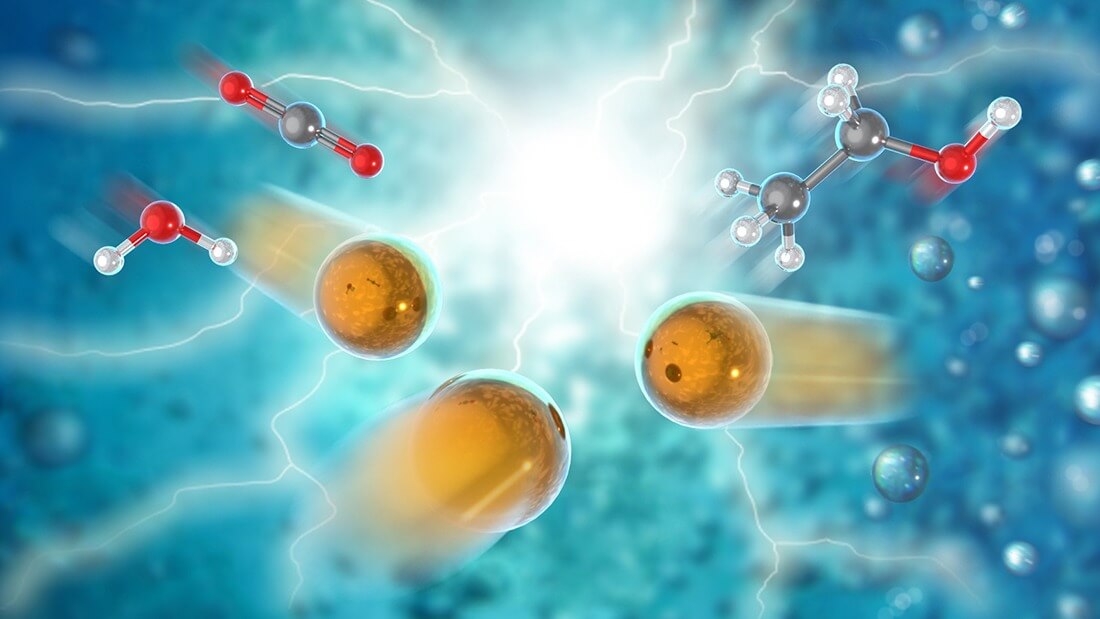
Artistic rendering of electrocatalytic process for conversion of carbon dioxide and water into ethanol. (Image by Argonne National Laboratory.)
The report on the discovery, first made in an NIU laboratory and studied in detail at Argonne, is published in the July 27 issue of the prestigious scientific journal, Nature Energy.
The team includes four NIU scientists. It was led by NIU’s Tao Xu, a professor of chemistry specializing in nanotechnology, and Di-Jia Liu, a senior chemist in Argonne’s Chemical Sciences and Engineering division and a UChicago CASE scientist in the Pritzker School of Molecular Engineering, University of Chicago.
“With this research, we’ve discovered a new catalytic mechanism for converting carbon dioxide and water into ethanol,” Xu said. “The unique synthetic method for production of electrocatalysts developed in our NIU lab enables a crucial dynamic interaction between the catalytic metal atoms and the carbon substrate that can efficiently orientate the electrochemical reaction to produce a range of desired organic fuels.”
Catalysts speed up chemical reactions and form the backbone of many industrial processes. For example, they are essential in transforming heavy oil into gasoline or jet fuel. Today, catalysts are involved in over 80 percent of all manufactured products.
The team’s catalyst consists of atomically dispersed copper on a carbon-powder support. By an electrochemical reaction, this catalyst breaks down CO2 and water molecules and selectively reassembles the broken molecules into ethanol under an external electric field. The electrocatalytic selectivity, or “Faradaic efficiency,” of the process is over 90 percent, much higher than any other reported process. What is more, the catalyst operates stably over extended operatio
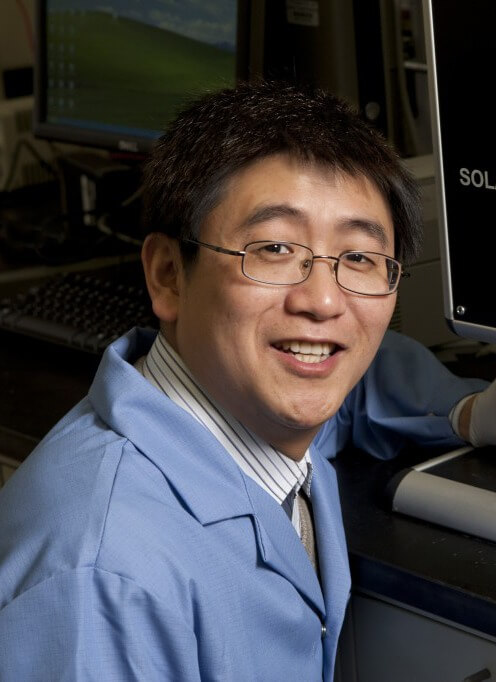
NIU Professor Tao Xu.
n at low voltage.
“The process resulting from our catalyst would contribute to the circular carbon economy, which entails the reuse of carbon dioxide,” co-author Liu said. This process would do so by electrochemically converting the CO2 emitted from industrial processes, such as fossil fuel power plants or alcohol fermentation plants, into valuable commodities at reasonable cost.
Because CO2 is a stable molecule, transforming it into a different molecule is normally energy intensive and costly. However, according to Liu, “We could couple the electrochemical process of CO2-to-ethanol conversion using our catalyst to the electric grid and take advantage of the low-cost electricity available from renewable sources like solar and wind during off-peak hours.” Because the process runs at low temperature and pressure, it can start and stop rapidly in response to the intermittent supply of the renewable electricity.
The team’s research benefited from two DOE Office of Science User Facilities at Argonne — the Advanced Photon Source (APS) and Center for Nanoscale Materials (CNM) — as well as Argonne’s Laboratory Computing Resource Center (LCRC).
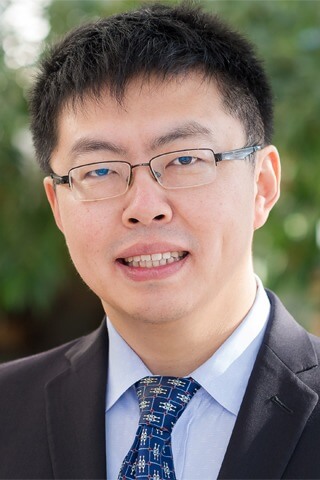
NIU Professor Tao Li.
“Thanks to the high photon flux of the X-ray beams at the APS, we have captured the structural changes of the catalyst during the electrochemical reaction,’’ said co-author Tao Li, an assistant professor in the Department of Chemistry and Biochemistry at NIU and an assistant scientist in Argonne’s X-ray Science division.
These data along with high-resolution electron microscopy at CNM and computational modeling using the LCRC revealed a reversible transformation from atomically dispersed copper to clusters of three copper atoms each on application of a low voltage. The CO2-to-ethanol catalysis occurs on these tiny copper clusters. This finding is shedding light on ways to further improve the catalyst through rational design.
“We have prepared several new catalysts using this approach and found that they are all highly efficient in converting CO2 to other hydrocarbons,” Liu said. “We plan to continue this research in collaboration with industry to advance this promising technology.”
Support for the research came from Argonne’s Laboratory Directed Research and Development (LDRD) fund provided by the DOE Office of Science and from the DOE Office of Basic Energy Sciences. Other authors on the research publication include Haiping Xu and Dominic Rebollar, who both earned Ph.D.s from NIU in May, along with Haiying He, Lina Chong, Yuzi Liu, Cong Liu, Cheng-Jun Sun, John V. Muntean and Randall E. Winans.
Northern Illinois University is a student-centered, nationally recognized public research university, with expertise that benefits its region and spans the globe in a wide variety of fields, including the sciences, humanities, arts, business, engineering, education, health and law. Through its main campus in DeKalb, Illinois, and education centers for students and working professionals in Chicago, Hoffman Estates, Naperville, Oregon and Rockford, NIU offers more than 100 areas of study while serving a diverse and international student body.
Date posted: August 10, 2020 | Author: Tom Parisi | Comments Off on NIU, Argonne scientists turn carbon dioxide into liquid fuel
Tao Xu is on a mission to harness the sun, and he plans to have NIU students give him a hand.
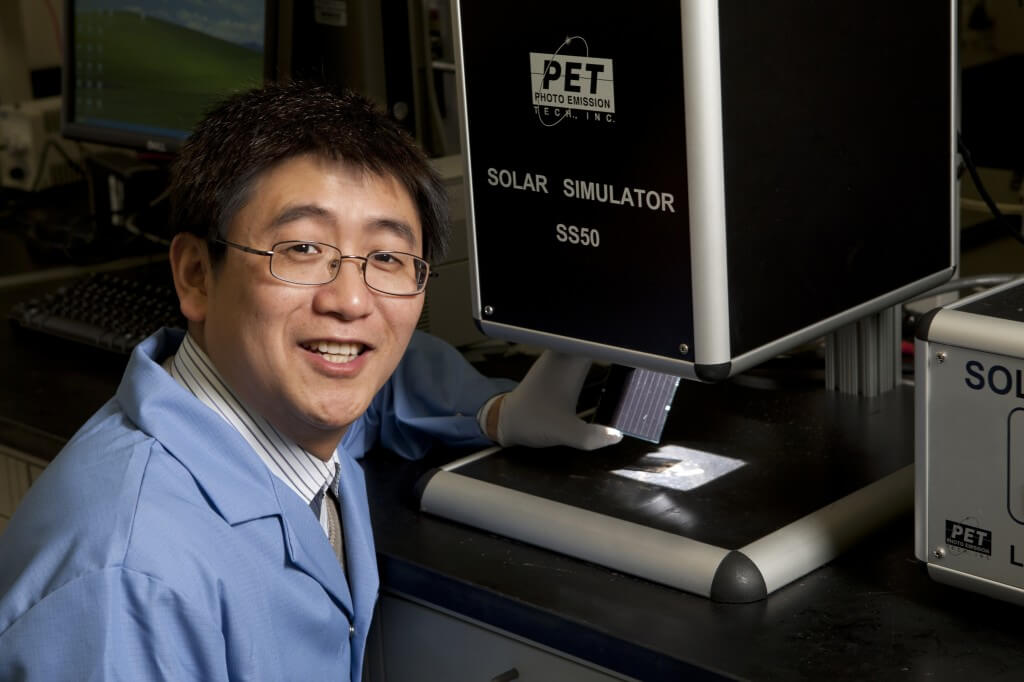
Tao Xu
The NIU chemistry and biochemistry professor has been working for years to further develop perovskite solar cells, and his efforts continue to gain momentum. Perovskite solar cells are not yet used commercially but are considered rising stars in the field of photovoltaics, which explores the conversion of light into electricity.
The National Science Foundation recently awarded Xu with a grant of more than $300,000 over three years to support his efforts. Additionally, Xu and his Ph.D. student, Jue Gong, were part of a team of scientists reporting new developments in their research last month in the prestigious Proceedings of the National Academy of Sciences.
Perovskite solar cells are so named because they use a crystal structure similar to that found in the mineral known as perovskite. When compared to traditional solar cells made of silicon, perovskite cells are greener and more cost efficient to produce. They have been the subject of intense interest among materials scientists, who have been successfully working in recent years to increase their efficiency for converting sunlight to electricity.
Xu and his research team have been working on clean and effective ways to push perovskite photovoltaic materials toward their best performance. Organic-inorganic hybrid perovskites materials have exhibited stunning photovoltaic efficiency. But before these hybrid materials can be commercialized, researchers must overcome some key challenges, including chemical instability and the use of toxic lead in current state-of-the-art hybrid perovskite materials.
The new project, which will include collaboration with scientists at Argonne National Laboratory, aims to minimize toxicity and learn how the introduction of small amounts of impurities could help regulate chemical instability at the atomic level.
Xu’s team currently includes several graduate students, and he will recruit two to three undergraduates each year to be involved in the research.
“This NSF-funded project will enable NIU students to explore innovative ways that can drastically stabilize the perovskite materials and minimize the use of toxic lead,” Xu says. “The research skill set, the problem-solving methodology and the teamwork will provide students with invaluable experiences that will benefit their future career development.”
And, as an added bonus, the work could ultimately benefit the world’s environment.
###
About NIU
Northern Illinois University is a student-centered, nationally recognized public research university, with expertise that benefits its region and spans the globe in a wide variety of fields, including the sciences, humanities, arts, business, engineering, education, health and law. Through its main campus in DeKalb, Illinois, and education centers for students and working professionals in Chicago, Hoffman Estates, Naperville, Oregon and Rockford, NIU offers more than 100 courses of study while serving a diverse and international student body.
Date posted: August 23, 2018 | Author: Tom Parisi | Comments Off on NSF awards more than 300k to NIU’s Tao Xu for research on making a better solar cell

 But a 2018 study challenged those results. And many other widely accepted findings from high-profile studies of the past have faced new scrutiny over the last decade. Since the nature of science is one study building upon another, what has come to be known as the reproducibility crisis (or replication crisis) has cast a shadow on some important discoveries of the past, particularly in the fields of psychology, economics and medicine.