
DEKALB, IL – Northern Illinois University, in partnership with the University of Wisconsin-Madison, is launching a new public-private Center for Interdisciplinary Research on Convective Storms (CIRCS), to be headed by NIU Atmospheric Science Professor Victor Gensini.
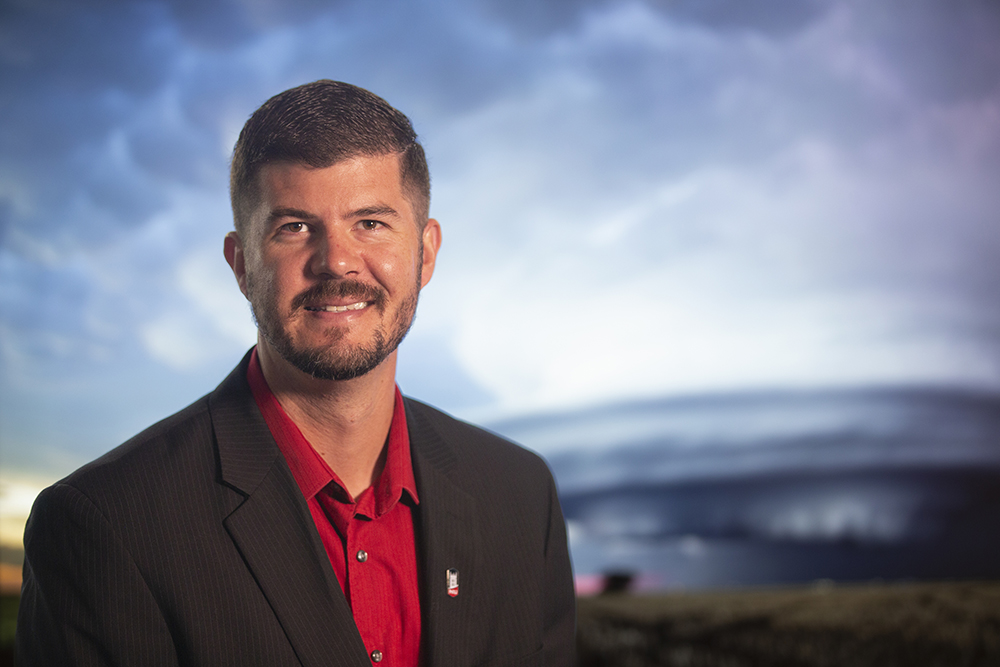
NIU Professor Victor Gensini serves as director of the Center for Interdisciplinary Research on Convective Storms.
CIRCS will conduct research that aims to make society more resilient and better able to withstand the impacts of convective storms—from tornadoes and hail to extreme rainfall and floods. The collaborative center includes nearly two dozen scientists from the fields of atmospheric science, engineering, geography, physics, computer science, actuarial science, and risk and insurance.
The U.S. National Science Foundation (NSF) is providing $1.5 million in funds over five years to establish the center, which will be further supported by about a dozen private companies, with each paying an annual membership fee and in return helping to direct the focus of CIRCS research.
“This particular award comes under a unique Industry-University Cooperative Research Center (IUCRC) model within NSF, which is supplying funds that will help administer the center,” said Gensini, who will serve as CIRCS director. “The other path of funding for research, students and lab equipment, that’s all coming from private industry. The center’s members are mostly insurance and reinsurance companies interested in research on convective storms.”
Damage from severe convective storms has been on the rise in recent decades, driven by changing weather patterns and shifting geographical populations.
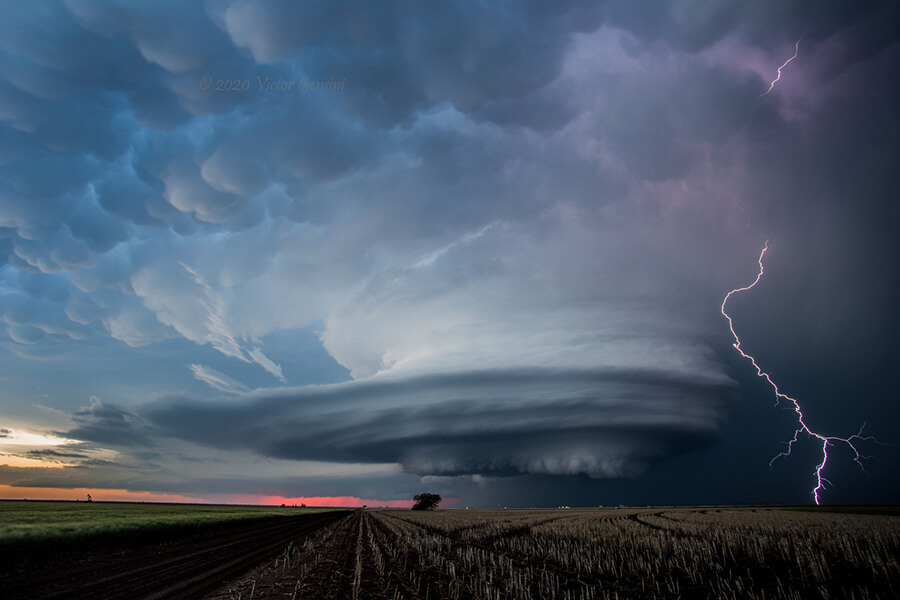
Photo Credit: Victor Gensini, Northern Illinois University
According to the NOAA’s National Centers for Environmental Information, the United States was buffeted by 190 separate billion-dollar weather and climate disasters from 2015 through 2024. These events, which are often driven by convective storms, killed more than 6,300 people and caused roughly $1.4 trillion in damage. CIRCS research thrusts will focus on convective storm risk, prediction, societal impacts, changing weather patterns and data science modeling.
NIU faculty serving as the center’s principal investigators include Walker Ashley and Alex Haberlie (Earth, Atmosphere and Environment); Lei Hua (Statistics and Actuarial Science); Christine Nguyen (Industrial and Systems Engineering); Sahar Vahabzadeh (Mechanical Engineering); and Hamad Alhoori, Reva Freedman, Nicholas Karonis, David Koop and Maoyuan Sun (Computer Science).
Gensini said the UW-Madison, which also has about a dozen faculty members associated with the new center, will play a large role.
“We have to approach this specific peril from multiple directions,” Gensini said. “When dealing with insurance and reinsurance, you also better have actuaries at the table. So getting our statistics departments involved from both universities was very important.”
The UW-Madison site director is Daniel Wright, the university’s Arno Lenz Memorial Associate Professor of Water Resources Engineering.
“There are synergies with people in atmospheric sciences who do field observations or use satellites for observations, while we create models,” Wright said. “The idea with this center is that it will bring all of these people together with expertise from across different disciplines to make the research bigger than it would otherwise be.”
Gensini and Wright are in discussions with representatives from NASA and the Federal Emergency Management Agency for potential involvement with the center as well.
At NIU, the idea for CIRCS first occurred during a car ride Gensini took three years ago with former NIU vice president for research Jerry Blazey and Professor Ashley.
“We were driving to Madison to meet with an insurance company,” Gensini said. “We’ve had longstanding relationship with the insurance and reinsurance industry because our research has direct applicability to their businesses. We thought we had developed enough relationships over the years that this particular model would work. When you’re consulting for many companies, and they all want similar information, it makes sense to advance the needle in a collective fashion.”
In the spring of 2023, NOAA announced a new agreement it had with NSF to support the creation of an IUCRC focused on modeling catastrophic impacts and risk assessment of climate change to help better support the needs of the insurance sector.
“We responded to the call and were awarded the initial planning grant,” Gensini said. “We received a significant amount of positive feedback and then moved to responding to a full phase I center proposal.”
IUCRCs are consortia developed by NSF where university faculty and students work with members of industry to accelerate the impact of research focused on the collective needs of a sector of the U.S. economy. IUCRCs connect corporate partners, government agencies and academia through mutual interest, creating spaces that build partnerships and usher in science and technology breakthroughs in their respective fields.
“The IUCRC model is unique and powerful, as it is a collaborative funding effort between the federal government and industry,” said Richard Mocarski, NIU Vice President for Research and Innovation Partnerships. “Due to the unique nature of the mechanism, the National Science Foundation only funds one IUCRC per area of expertise, making the awarding a significant honor for the team and NIU.”
CIRCS will be located on the first floor of Davis Hall on the NIU campus. A kickoff meeting will be held in mid-November to construct bylaws for the organization and pitch potential research projects.
“It’s kind of like Shark Tank,” Gensini said. “Researchers will pitch projects, and industry members will vote on projects for the fiscal year.”
Any NIU faculty member who is interested in pitching a research project can contact Gensini at vgensini@niu.edu.
Media Contact: Tom Parisi
About NIU
Northern Illinois University is a student-centered, nationally recognized public research university, with expertise that benefits its region and spans the globe in a wide variety of fields, including the sciences, humanities, arts, business, engineering, education, health and law. The Wall Street Journal and CollegeNET recognize NIU as a leading institution for social mobility, or helping its students climb the socioeconomic ladder. Through its main campus in DeKalb, Illinois, and education centers for students and working professionals in Chicago, Naperville and Rockford, NIU offers more than 100 areas of study while serving a diverse and international student body.
