
DeKalb, IL – If you’ve encountered golf ball-size hail in recent years, well, you might have glimpsed the future.
Under current human-driven climate-warming trajectories, hailstorms will more frequently produce larger hailstones by mid-to-late century—as in the kind of ice orbs that can damage aircraft, shatter windshields, leave divots in your roof shingles and pose serious safety risks.
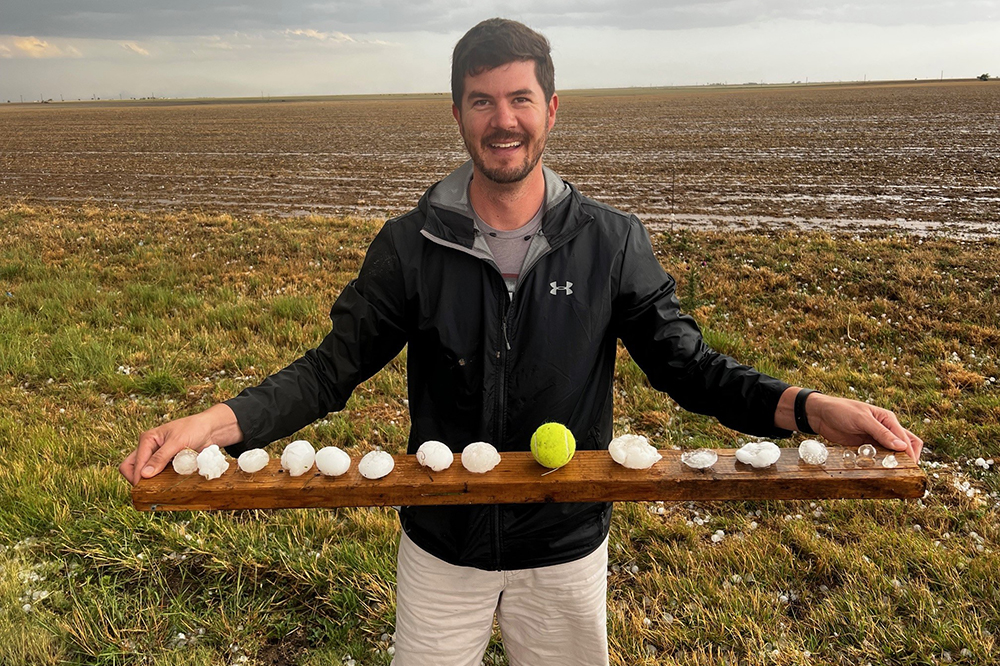
Victor Gensini holds a flight of severe hailstones in a field near Tulia, TX on May 31, 2022. Photo courtesy of Walker Ashley, NIU
That’s the conclusion of a study from the Weather, Climate and Society Research Group at Northern Illinois University. The group’s new study on hail is published in the Nature journal npj Climate and Atmospheric Science.
The NIU scientists tracked future hail-producing storms using supercomputer-powered simulations of climate under two greenhouse gas concentration trajectories, one considered “intermediate” and the other “pessimistic.” They compared simulated late-20th-century hailstorm populations (similar to actual populations) with mid- to late-21st-century counterparts.
“Our study suggests golf ball-size hail or larger will become more common because of more atmospheric instability, which leads to stronger thunderstorm updrafts,” said NIU Atmospheric Science Professor Victor Gensini, lead author of the study.
“Strong updrafts are a key ingredient for the formation of larger hailstones,” he added. “In our study, the largest hailstones are found to increase by 15% to 75%, dependent on greenhouse gas emissions.”
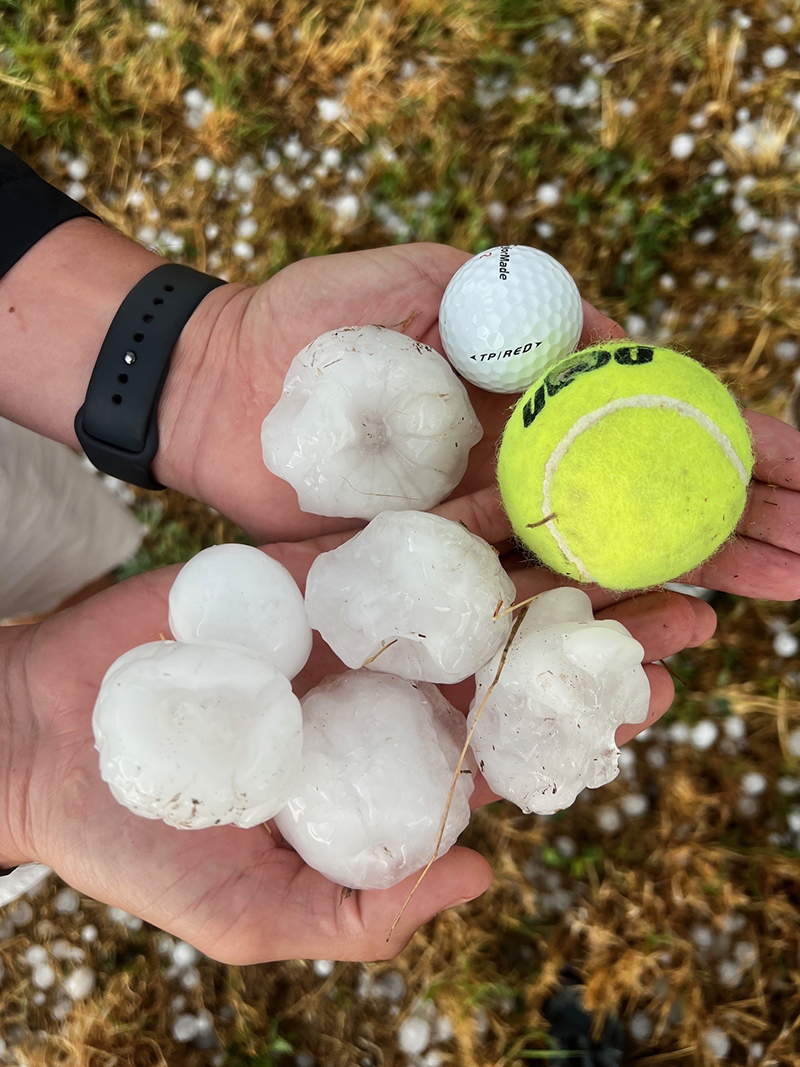
According to scientist Victor Gensini, a warmer climate leads to increased water vapor, which serves as energy for thunderstorms and creates stronger updrafts on average—and more large hailstones aloft. Photo courtesy of Laura Hedien
Hailstones form when small soft ice pellets known as graupel (think Dippin’ Dots) are carried upward by thunderstorm updrafts. When they reach extremely cold atmospheric layers, supercooled water (below 32 degrees Fahrenheit) freezes onto the graupel, forming hailstones. Hailstones fall when the thunderstorm’s updraft can no longer support their weight.
A warmer climate leads to increased water vapor, which serves as energy for thunderstorms and creates stronger updrafts on average—and more large hailstones aloft. As hailstones begin their downward trajectory, they encounter a melting level height that is expected to increase in the future due to warming. These processes ultimately result in fewer small hailstones (less than golf ball-size) reaching the surface, with a favored distribution toward larger hail sizes, the study suggests.
“Warming temperatures near the surface will promote more melting of smaller hailstones as they fall,” Gensini said. “Melting has a disproportionate impact on smaller hailstones due to their mass and fall speed.”
By mid- and late-century periods, the number of days with severe hailstorms producing large hailstones in the atmosphere is projected to robustly increase in most locations outside of the southern Plains, a distribution that closely mimics previous projections of thunderstorm days, according to the study.
The simulations found the most significant increases in large aloft hail during future storms in the Midwest, Ohio Valley and Northeast. The changes are most pronounced under the pessimistic greenhouse gas concentration trajectories.
In addition to Gensini, study authors include NIU Atmospheric Scientists Walker Ashley, Allison Michaelis and Alex Haberlie, along with former NIU graduate student Jillian Goodin and former NIU postdoctoral fellow Brendan Wallace.
Hail is an important topic for study. Nationally, damaging hail occurs 158 days per year on average, which translates to roughly $10 billion of insured losses annually before accounting for agricultural losses. Losses due to hail and other severe convective storms have quintupled nationally since 2008, raising questions from scientists, industry and members of the public about the roles of a warming climate and changing socioeconomic exposure.
“Tornadoes are fascinating, but when you talk about impact on society, hail does more damage by an order of magnitude,” Gensini said.
Co-author Ashley adds that urban sprawl also plays an outsize role in projecting future impacts from hail.
“While the risk and character of hail may change in the future, the primary driver of losses will remain the increasing assets in the path of these storms,” Ashley said. “This expanding bull’s-eye effect reveals that impacts from perils such as hail are enlarging as populations grow and spread across the landscape. With increasing risk and societal exposure, the potential for hail disasters will continue to increase in the future.”
Funding for the study was provided by the National Science Foundation and National Oceanic and Atmospheric Administration.
Climate simulations were conducted at the NCAR-Wyoming Supercomputing Center. The intermediate greenhouse gas concentration trajectory (Representative Concentration Pathway 4.5) used end-of-the century global-climate-warming projections of 2 degrees to 5 degrees Fahrenheit, while the more pessimistic trajectory (RCP 8.5) factored in a warming of 5 degrees to 9 degrees Fahrenheit.
Media Contact: Tom Parisi
About NIU
Northern Illinois University is a student-centered, nationally recognized public research university, with expertise that benefits its region and spans the globe in a wide variety of fields, including the sciences, humanities, arts, business, engineering, education, health and law. Through its main campus in DeKalb, Illinois, and education centers for students and working professionals in Chicago, Naperville, Oregon and Rockford, NIU offers more than 100 areas of study while serving a diverse and international student body.
