
DeKalb, IL – Scientists are using new tools that provide a window into the ancient past to better understand how the Grand Canyon’s oldest rocks formed, creating the foundation for one of the seven natural wonders of the world.
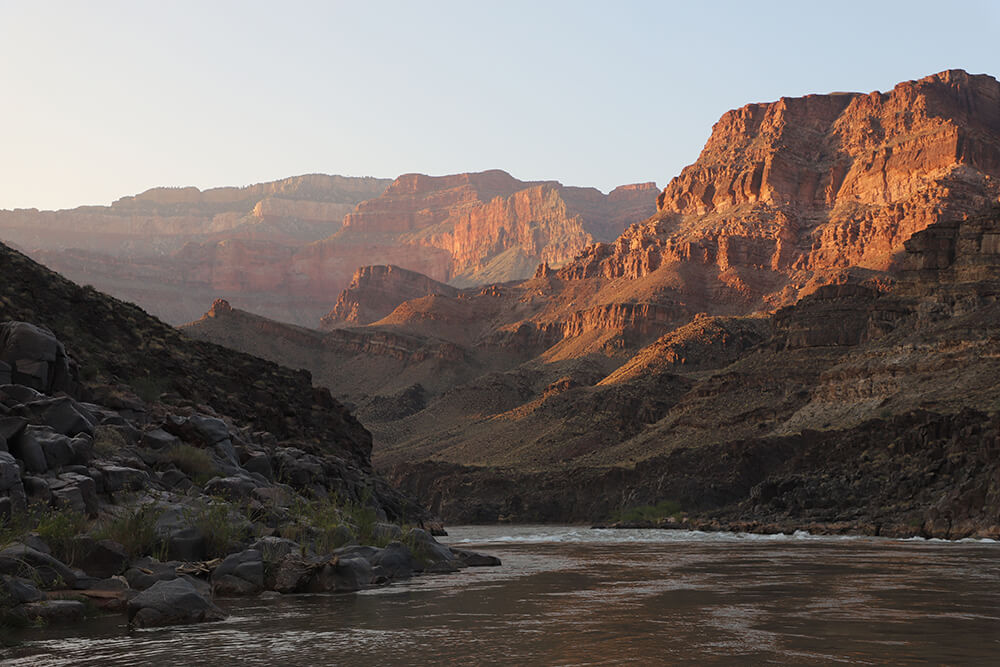
Feature photo: The Colorado River meanders along a bend in the depths of the Grand Canyon. Photo credit: Dr. Laura Crossey, University of New Mexico.
The findings from a new examination of the 1.7-billion-year-old rocks, published recently in the journal Geology, revise what was previously known about the formation of the Grand Canyon Precambrian basement.
“Our work produced new high-resolution data that gave insights into how the rocks at the base of the Grand Canyon formed,” said Suzanne Autrey-Mulligan, an assistant professor of geology at Northern Illinois University and lead author on the paper.
“We were able to reconstruct the burial and uplift paths that these rocks took through the earth’s crust while they were forming,” she said. “The new understanding of the depths at which these rocks formed has led to a reevaluation of the tectonic history of the Grand Canyon Precambrian basement rock.”
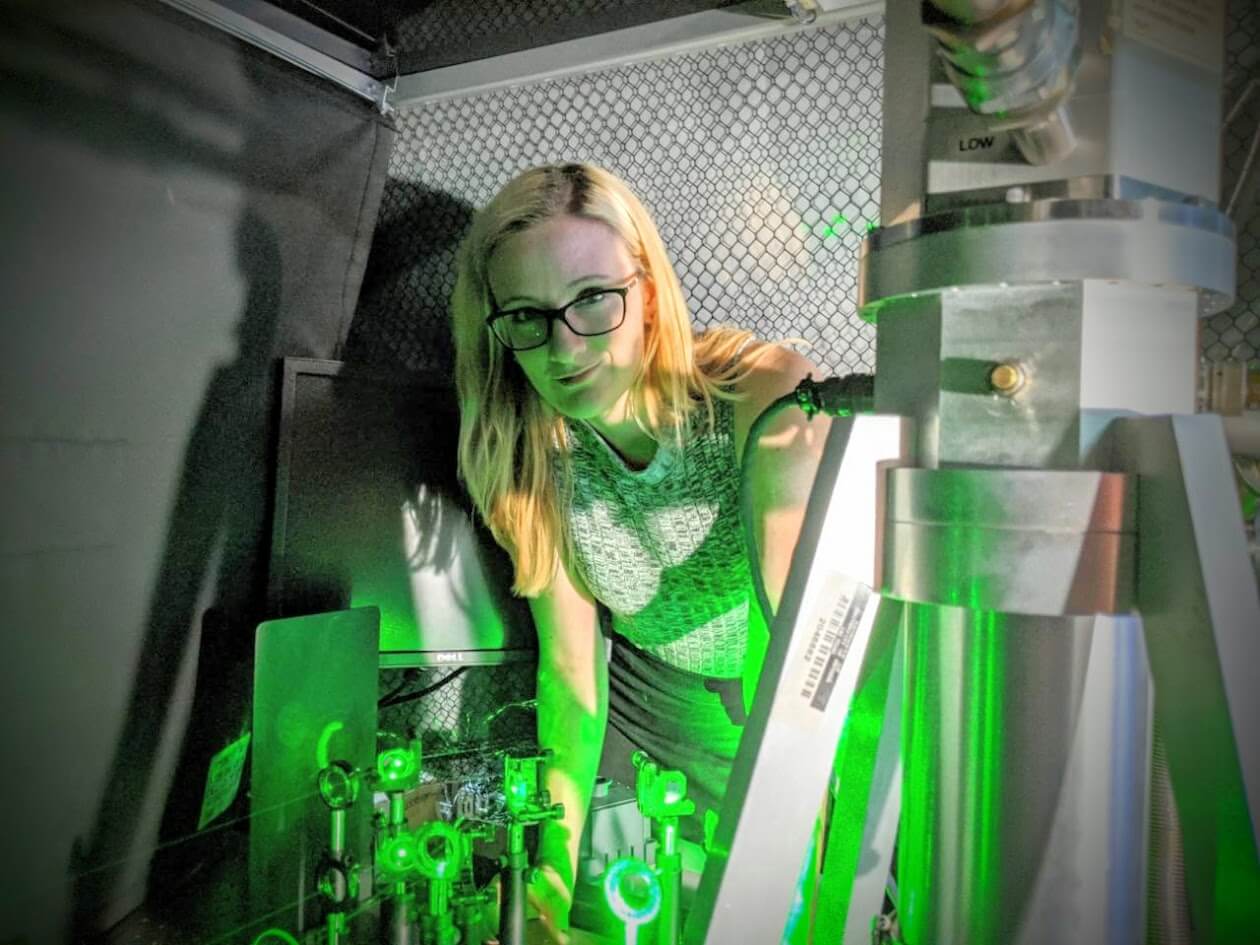
NIU Geology Professor Suzanne Autrey-Mulligan in a Raman spectroscopy laboratory. Photo credit: Suzanne Autrey-Mulligan, NIU.
The types of rocks studied by Autrey-Mulligan and her research team are 1.7-billion-year-old metamorphic schists and gneisses. Making up part of what is called the “crystalline basement” of the Grand Canyon and the greater Mojave region, the rocks in this study comprise the deepest section of the Grand Canyon along the Colorado River in the Upper Granite Gorge of Grand Canyon National Park.
“Previously, it was thought that the 43-mile exposed basement section in the Upper Granite Gorge was a block of the middle crust that was buried and exhumed together as one package,” Autrey-Mulligan said.
“Our work suggests that we need to rethink this. We now know that the blocks reached different depths within the earth and had to be later placed together, potentially by folding and faulting of the rocks or vertical shuffling during collapse of over-thickened crust. Ongoing work is needed to decipher the mechanism that resulted in the juxtaposition of these blocks of rock from different crustal depths.”
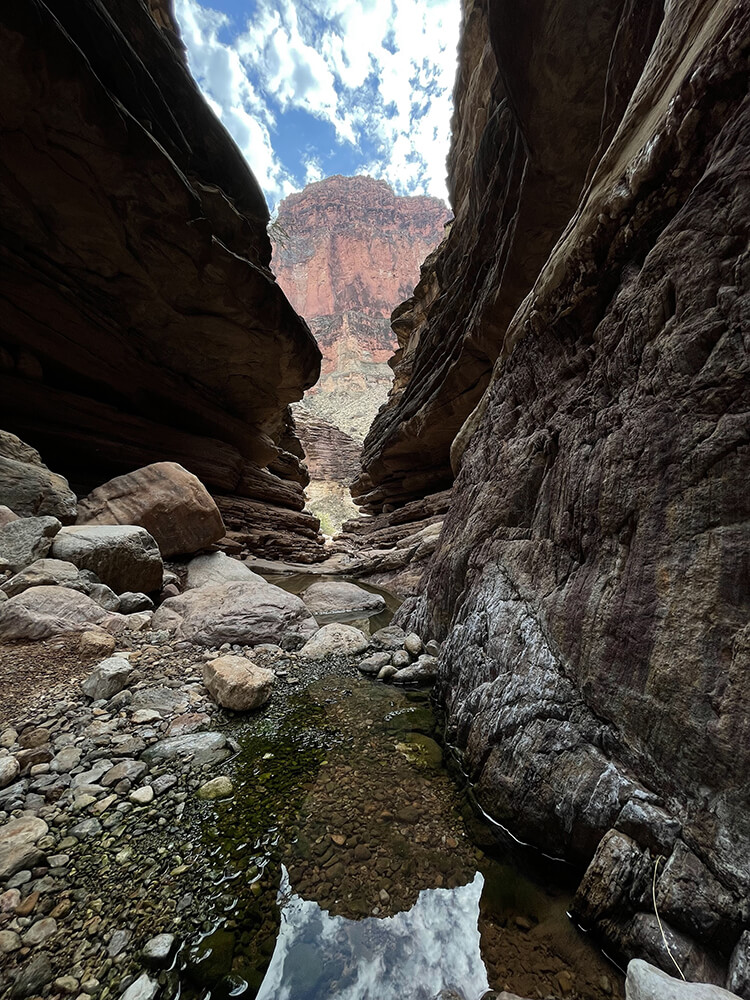
In this view down Blacktail Canyon toward the Colorado River, near-vertical foliation of 1.7-billion-year-old metamorphic Brahma Schist is visible in the right lower half of the image. Photo credit: Dr. Laura Crossey, University of New Mexico.
The research team also included Chloe Bonamici of the University of Wisconsin-Madison; Michael L. Williams of the University of Massachusetts Amherst; Karl Karlstrom of the University of New Mexico; and Cailey B. Condit of the University of Washington.
In the Upper Granite Gorge, it is clear to any petrologist that the different blocks of rocks were metamorphosed (or altered by pressure, temperature and deformation) to different degrees when they were in the middle crust. The high-grade or high-temperature blocks have minerals and textures that indicate they were cooked at higher temperatures and/or greater depths. Other “cold blocks” have minerals and textures that indicate that they never reached as high of temperatures or were never buried as deeply during their geologic history.
The scientists used a Raman spectrometer that focuses a laser beam onto tiny mineral grains entrapped within garnet crystals and extracts information about stress and strain recorded within them. That information was fed into an elastic modeling program, which can determine the pressures or depths when the minerals were formed.
“Earlier studies were not able to obtain pressure or depth constraints because the tools they had available could not access this information with the required resolution,” Autrey-Mulligan said. “This affected the interpretations. Without a technique capable of resolving these depth differences, the earlier interpretations relied primarily on temperature changes to explain the differences that we see in the rocks in the Upper Granite Gorge.”
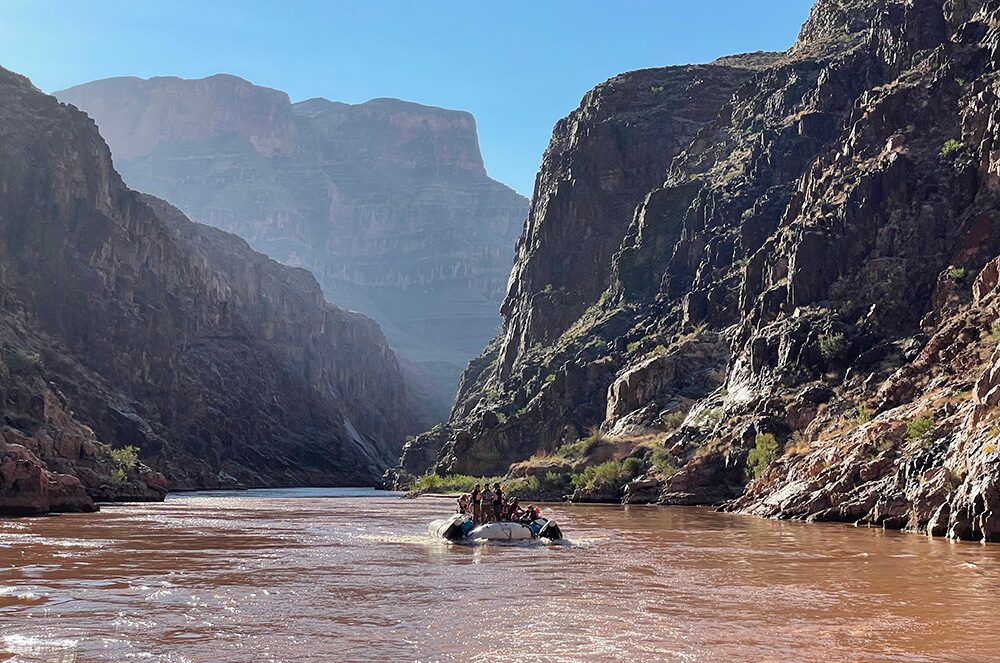
The scientists took two multi-week raft trips down the Colorado River to collect rock samples in the Upper Granite Gorge and other field sites. Photo credit: Dr. Laura Crossey, University of New Mexico.
Autrey-Mulligan sees the Grand Canyon and other natural wonders as ancient history books waiting to be decoded.
“Just like we have museums for understanding human history, I like to think of the national parks as our best public access to Earth’s history—especially somewhere like the Grand Canyon, where millions of visitors and nature enthusiasts love to come and visit each year,” Autrey-Mulligan said. “This is where visitors become exposed to geology and science, and it’s critical that we understand these rocks so that we can share that information with the public—and hopefully plant the seed for some future scientists.”
Autrey-Mulligan plans to continue working in rocks from the middle-crust of the earth, and her current project is in the desert Southwest. Next month she and at least one NIU graduate student will travel to Death Valley National Park to study ancient mid-crustal rocks exposed in metamorphic core complexes in the Funeral Mountains and Panamint Mountains.
Media Contact: Tom Parisi
About NIU
Northern Illinois University is a student-centered, nationally recognized public research university, with expertise that benefits its region and spans the globe in a wide variety of fields, including the sciences, humanities, arts, business, engineering, education, health and law. Through its main campus in DeKalb, Illinois, and education centers for students and working professionals in Chicago, Naperville, Oregon and Rockford, NIU offers more than 100 areas of study while serving a diverse and international student body.
