
DEKALB, IL — NIU Physics Professor Roland Winkler presented a talk and was interviewed on a new kind of magnetism early this month at the Annual Meeting of the American Association for the Advancement of Science (AAAS), one of the world’s most prestigious scientific organizations.
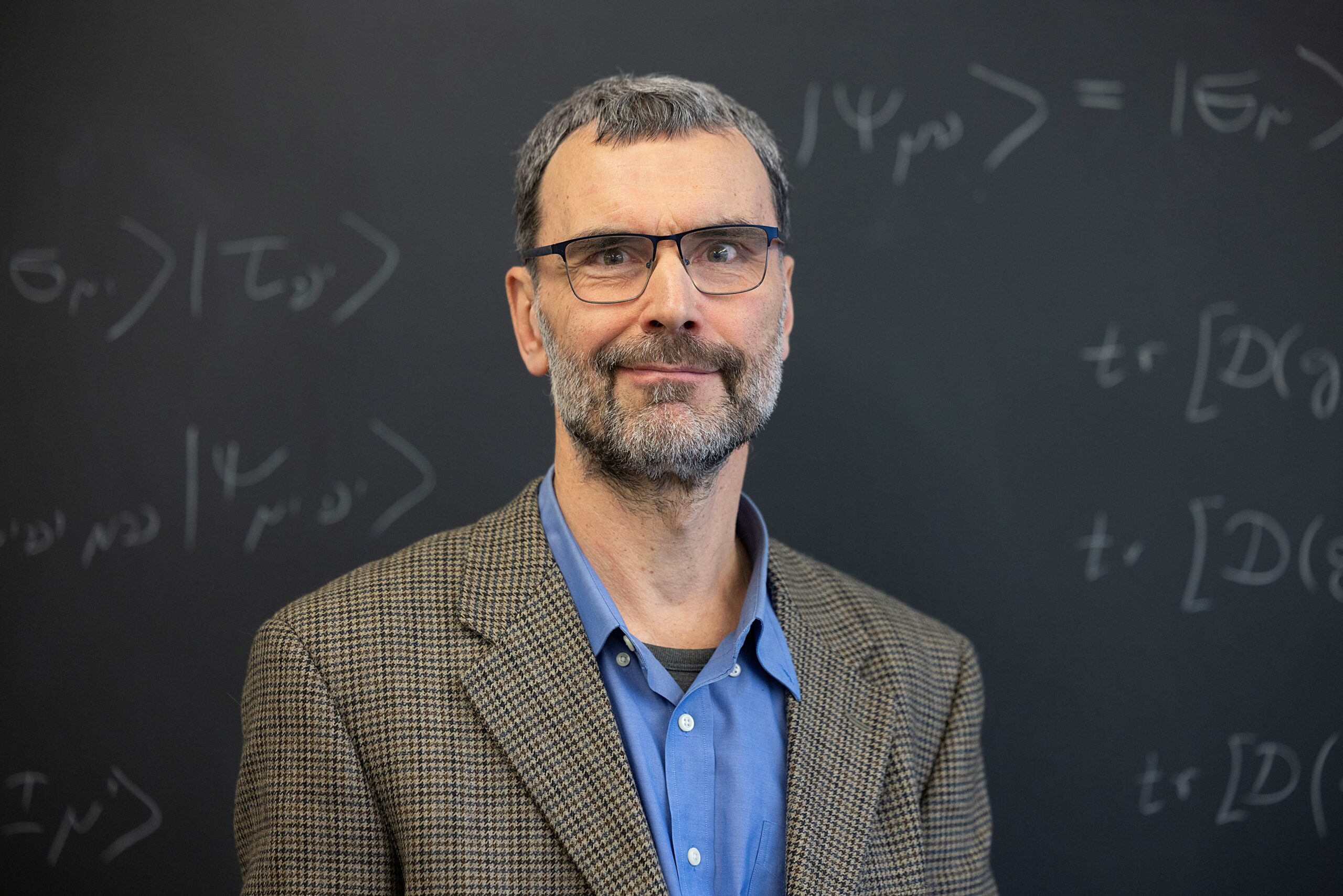
NIU Physics Professor Roland Winkler
The meeting was held in Boston. Winkler’s presentation was one of several lectures introducing science breakthroughs of 2024, as selected by the editors of Science, the flagship journal of AAAS.
Previously, physicists knew of only two types of permanently magnetic materials. Now, they’ve found a third.
Well known types of magnetism
The most well-known form of magnetism is ferromagnetism, which was first recognized more than 2,000 years ago. In familiar ferromagnets such as iron, unpaired electrons on the atoms spin in the same direction, magnetizing the material so that, for example, it sticks to a refrigerator.
“If one zoomed into such a bar magnet so we could see individual atoms, we’d see that each atom acts like a tiny bar magnet, where all these tiny bar magnets are aligned in parallel,” Winkler said. “Basically, in a ferromagnet all the tiny magnets on the atoms work together to create the big magnet.”
Scientists discovered antiferromagnets almost hundred years ago. They realized that the tiny magnets on the atoms can also line up antiparallel or in yet more complicated patterns, with neighboring electrons spinning in opposite directions, such that the effect of the tiny magnets cancels out. Antiferromagnets such as chromium have zero overall magnetism, but they possess an atomic-scale magnetic pattern nonetheless.
Newly discovered altermagnets
The newly discovered types of magnets are known as altermagnets.
It was realized that certain materials that do not stick to a fridge so that previously they were classified as antiferromagnets really share aspects of both ferromagnets and conventional antiferromagnets. Neighboring electrons spin in opposite ways, ensuring zero net magnetism, but on a deeper level, the materials resemble ferromagnets, too.
“The past two or three years, multiple groups demonstrated the split personality of altermagnets,” Winkler said. “Several groups around the world—including my long-term collaborator Uli Zülicke from Victoria University of Wellington, New Zealand, and myself— realized that several such ‘antiferromagnets’ are quite different from conventional antiferromagnets.
“Nature is very creative regarding the many ways how the tiny magnets on the atoms in magnetic materials can arrange each other,” he added. “This richness is one of the reasons why magnetism, though its basics are long known, has remained a very fascinating area of research.”
Future research implications
Magnetic materials play an important role in devices such as the hard disk drives of computers where they are used for data storage. An important advantage of magnetic materials lies in the fact that they can preserve their magnetic state without power supply.
“So a larger goal of research involving magnetic materials is motivated by the question whether we can just switch off computers when they are not needed, instead of draining batteries in a stand-by mode,” Winkler said. “Here, antiferromagnets are potentially yet more robust than ferromagnets, but also more difficult to work with. Altermagnets, that fall in between ferromagnets and conventional antiferromagnets, may offer new avenues for this research.”
Winkler’s talk at the AAAS meeting was well received, including by a group of high schoolers from England. They had their photograph taken with Winkler and told him they had traveled across the pond to hear him speak.
“I was certainly impressed by their dedication,” Winkler said.
Media Contact: Tom Parisi
About NIU
Northern Illinois University is a student-centered, nationally recognized public research university, with expertise that benefits its region and spans the globe in a wide variety of fields, including the sciences, humanities, arts, business, engineering, education, health and law. The Wall Street Journal and CollegeNET recognize NIU as a leading institution for social mobility, or helping its students climb the socioeconomic ladder. Through its main campus in DeKalb, Illinois, and education centers for students and working professionals in Chicago, Naperville and Rockford, NIU offers more than 100 areas of study while serving a diverse and international student body.
