
DEKALB, IL – Let’s just say you wouldn’t want to get hit in the head with the hailstone that NIU Ph.D. student Caitlin Roufa found near Roaring Springs, Texas, on May 25th.
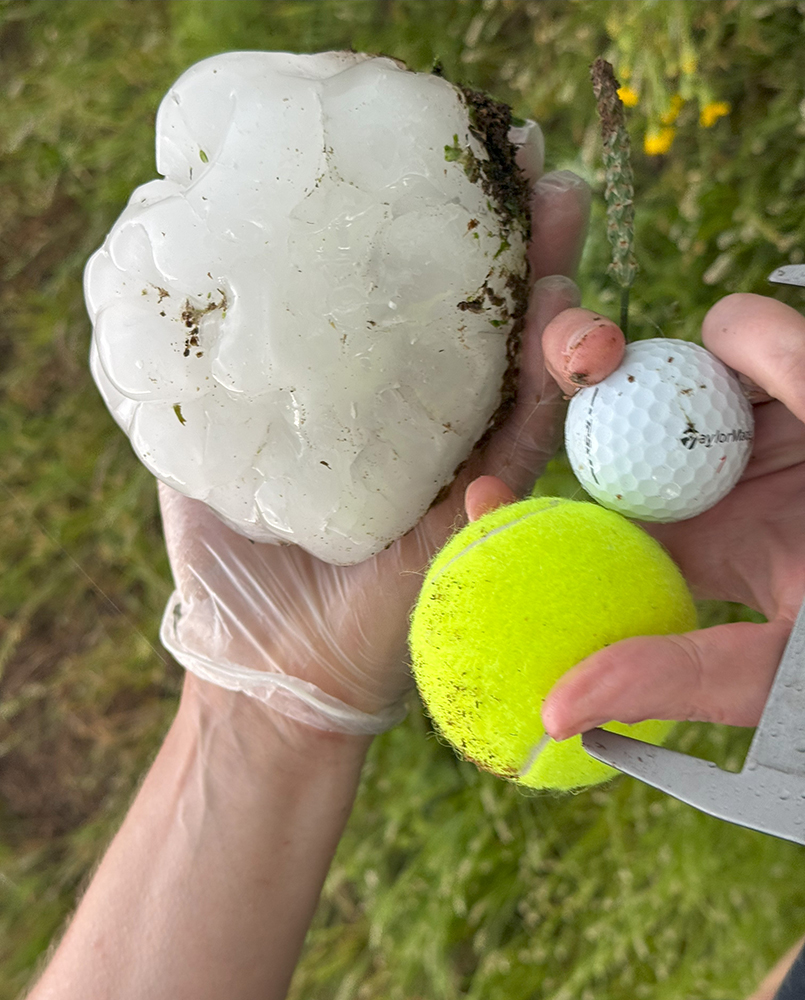
NIU Ph.D. student Caitlin Roufa recovered the biggest hailstone during the largest ever field study of hail. The stone weighed more than a pound. Photo by Caitlin Roufa, NIU.
Resting under a tree in a pasture, the cantaloupe-sized stone measured 5.5 inches in diameter and weighed a smidge over a pound, about the same weight as a pint of beer. Before she picked it up, it had been melting for nearly an hour.
Roufa couldn’t believe her eyes.
“I shouted and startled another student from Central Michigan University,” Roufa said, adding that the student saw the hailstone and gave her a big high five. “It’s just hard to imagine that air was suspending this big chunk of ice in the sky. It really makes you feel the power of storms.”
Largest hail study ever
Roufa’s discovery would later be duly noted as the biggest intact hailstone retrieved during a project known as ICECHIP, short for In-situ Collaborative Experiment for Collection of Hail in the Plains.
The largest hail study ever, ICECHIP brought together more than 100 scientists and students from across the country and beyond to document and analyze hailstorms. The massive effort, which aims to hone hailstorm forecasts and mitigate damage, will likely yield new research findings for years to come.
“We couldn’t have had a better year for studying hail, especially in the Southern Plains,” NIU Atmospheric Science Professor Victor Gensini said.
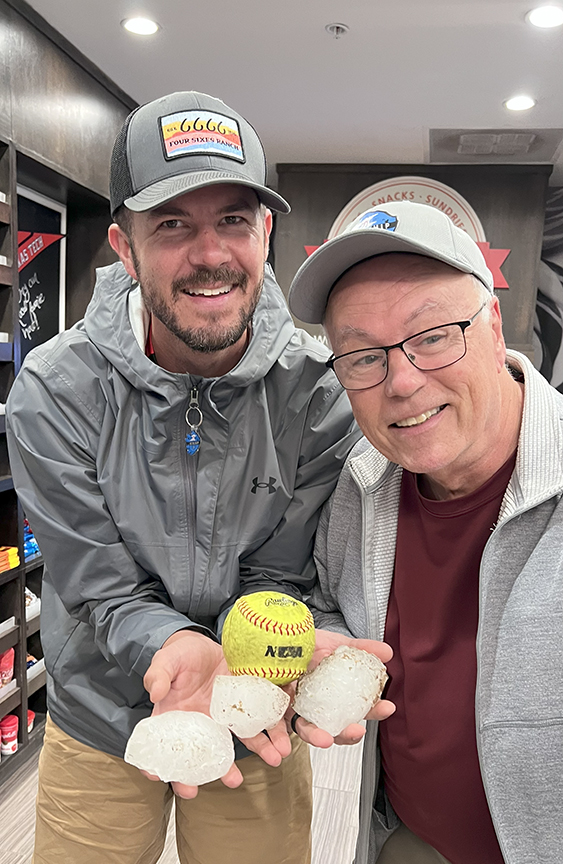
NIU Atmospheric Science Professor Victor Gensini and alumnus Tim Marshall show off some giant hail. Gensini is a co-leader of the ICECHIP research campaign. Photo by Landon Moeller, NIU.
Among the nation’s leading extreme weather researchers, Gensini serves as one of four principal investigators on ICECHIP, which is supported by an $11 million grant from the National Science Foundation (NSF). He brought along 19 NIU students and one alumnus for the ICECHIP field season, which ran for six weeks, from mid-May through June.
“Our goal for the field season was to get 20 operating days taking measurements in storms,” Gensini said. “We ended up with 24.”
The why and how of studying hail
As anyone who has had roof damage knows, hail can wreak havoc. Not only on houses, but also vehicles, businesses, aircraft, crops and solar panels. In fact, it is the most consistently damaging thunderstorm hazard, producing U.S. losses exceeding $10 billion per year.
Yet, relative to other weather phenomenon, little is known about forecasting hail. The last U.S. hail-focused campaign was over 40 years ago. ICECHIP researchers hope the new data they gathered will help improve hailstorm prediction, lessen its impact on property damage and help answer fundamental questions, such as how climate change will affect the frequency of hailstorms and stone size.
In addition to student scientists, ICECHIP field-season participants included university, governmental and private industry experts. They arrived armed with high technology instruments that included drones; weather balloons; mobile Doppler radars; hailpads and disdrometers to measure hail impact; and specially outfitted trucks equipped to quickly deploy instruments to capture localized weather data.
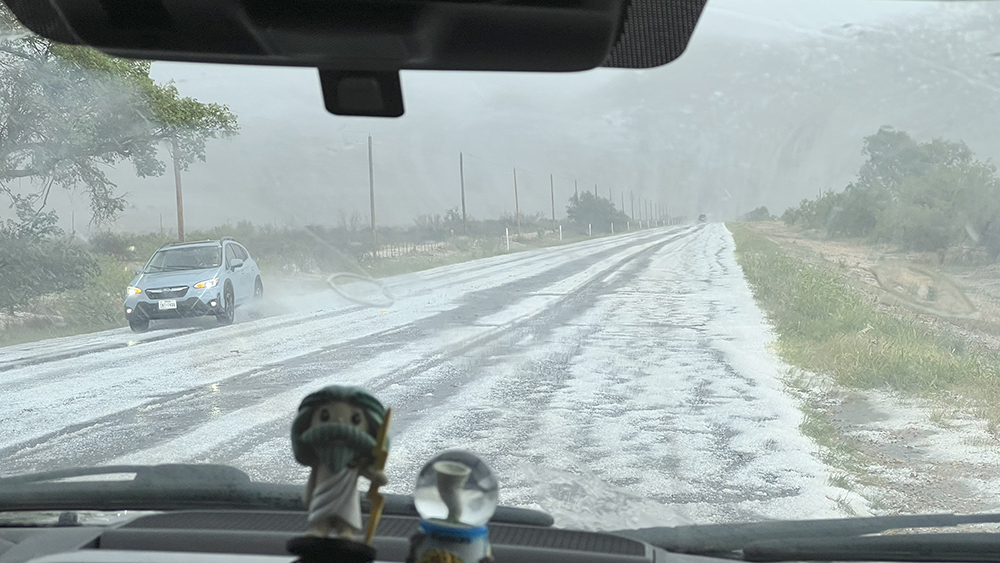
NIU students set out to find hail, and they found it plenty of times, on this occasion in Texas near the border with Mexico. Photo by Landon Moeller, NIU.
After three days of training in Boulder, Colorado, the team hit the road. Traveling in 30 vehicles, they moved from storm to storm, crisscrossing the Great Plains as they traversed over 15,000 miles. At different times, they nearly touched the Mexican and Canadian borders.
Along the way, ICECHIP teams overwhelmed fuel stops, restrooms, small-town restaurants, motels and hotels (60 rooms a night) and big-box parking lots that served as makeshift staging areas. They also attracted substantial media attention as journalists from the Associated Press, NBC News and the London-based New Scientist embedded for short periods with researchers.
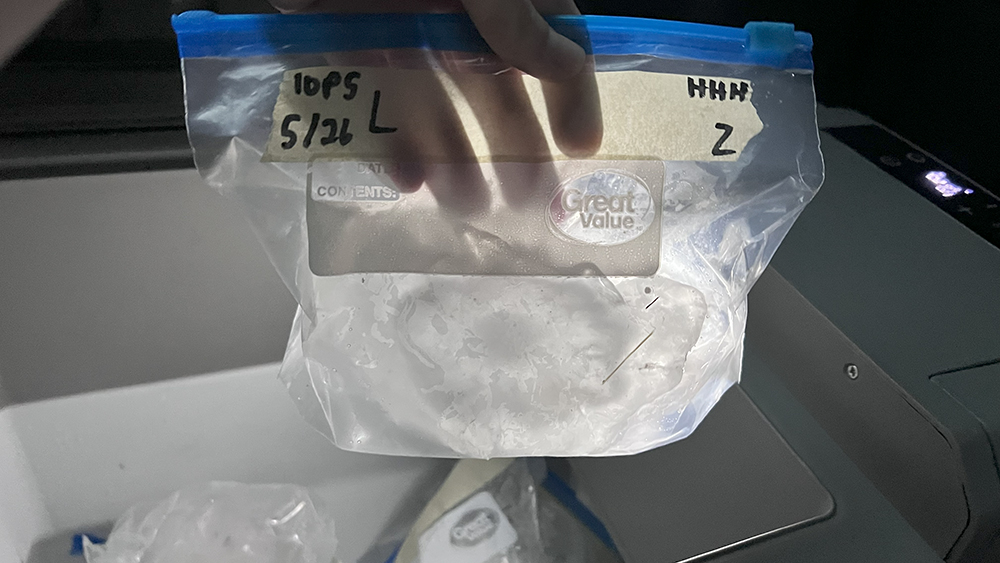
Researchers collected more than 10,000 hailstones on the field campaign. Many were bagged and transported for study to the NSF-funded National Center for Atmospheric Research cold labs in Boulder. Photo by Landon Moeller, NIU.
Big haul of hail and data
In all, more than 10,000 hailstones were collected for study, along with hundreds of terabytes of weather data.
Like snowflakes, no two hailstones are alike. The scientists weighed, measured, sliced, 3-D scanned and crushed the stones to reveal structure and hardness. Students bagged, tagged and packed away others in sub-zero-temperature coolers. Much of the hail haul was transported for study to the NSF-funded National Center for Atmospheric Research cold labs in Boulder. Some hail will find its way back to DeKalb to be analyzed in NIU’s stable isotope laboratory.
“We recovered tennis-ball-sized hail or greater in about half of our instrument deployments,” Gensini said. “You hope and dream for these kinds of observations in order to push forward hail science.”
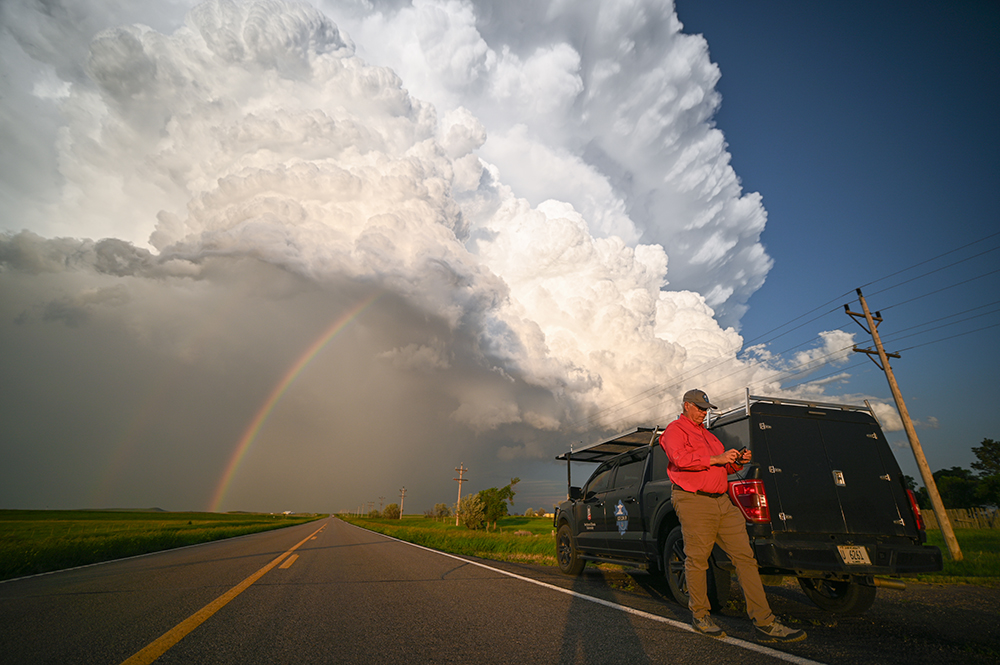
NIU alumnus Tim Marshall and the Huskie Hail Hunter in North Dakota, with a sight to behold in the background. Photo by Landon Moeller, NIU.
Long days, logistics and safety
For much of the trip, Gensini was the lead field coordinator, making sure equipment and vehicles were in place to safely capture storm data. He used a special software program to keep track of each vehicle and to guide scientists into positions where they would be out of harm’s way—no small task with scores of researchers encountering storms that sometimes spawned tornadoes.
“I was basically chief of air-traffic control for a majority of the campaign,” said Gensini, adding that 40-plus days in the field was physically and mentally exhausting for the team.
“You have to make hay when, in this case, the sun doesn’t shine,” he said. “Many of us felt like this trip was a once-in-a-lifetime opportunity.”
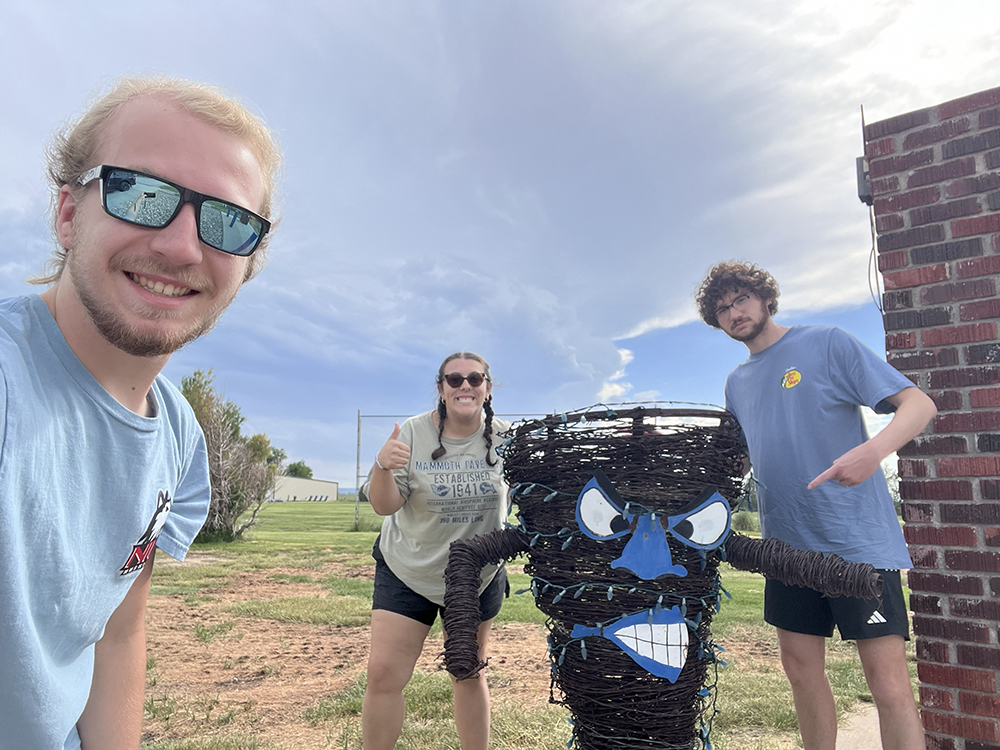
NIU meteorology student Landon Moeller (left) chronicled the ICECHIP adventure in video and photos. Here he and classmates Katie Wargowsky and Tony Illenden enjoy a little downtime. Photo by Landon Moeller, NIU.
Landon Moeller, a senior meteorology major from Schaumburg, was among the Huskie undergraduates who took part in the field season. Tasked with documenting the trip in video and photography, Moeller shared his front-row seat with the public. On X (@nsf_icechip) and Facebook (@Icechip2025), his social media accounts attracted more than 413,000 views.
“The days were longer than I expected but it was good,” said Moeller, who collected some “gorilla hail” as well. “I learned to be more independent and more confident in myself, and about the importance of teamwork—that was the biggest one.
“Dr. Gensini provided excellent direction to us,” he added. “He was very receptive to our questions and concerns and aimed to provide us with the best experience possible.”
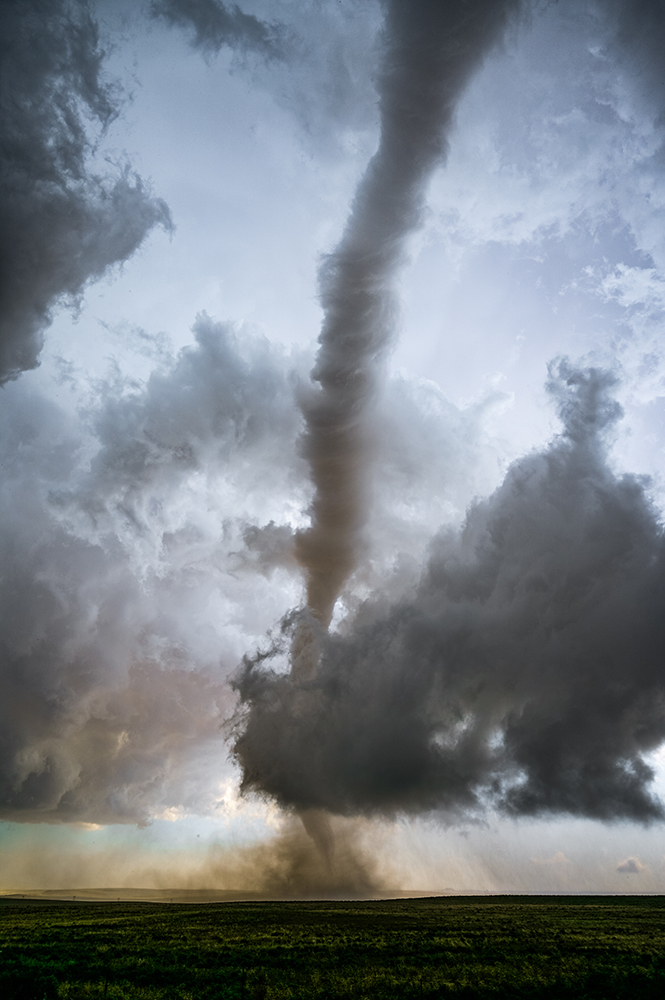
A twister encounter in Colorado. Photo by Landon Moeller, NIU.
Tower of power
For Moeller, the trip’s highlight happened along State Route 63 in Colorado. He was traveling in the backseat of a Ford F-150 pickup truck specially outfitted by NIU engineering students. Known as the Huskie Hail Hunter, a metal mesh frame protected the truck’s windshield and cab. But the pickup’s body was still being battered by hail stones, some the size of tennis balls.
Ping-ping-ping-thunk. Ping-ping-thunk.
Fellow meteorology graduate student Tony Illenden drove the vehicle with NIU alumnus Tim Marshall, a forensic engineer and meteorologist well known for his expertise in hail and wind damage, riding shotgun. With real-time forecasts coming in via radio, computer and cell phone, Marshall used his decades of experience to guide the team into an area where they might safely view a spectacular sight.
As the hail waned, the trio spotted it. In a farm field in the distance. Beginning as swirling wisps of dust. Building, piping, spiraling. Then a slender but towering tornado, kicking up crop debris as it needled the field for 30 minutes before roping out.
“I was shocked,” Moeller said. “You could see the spirals and the spin.”
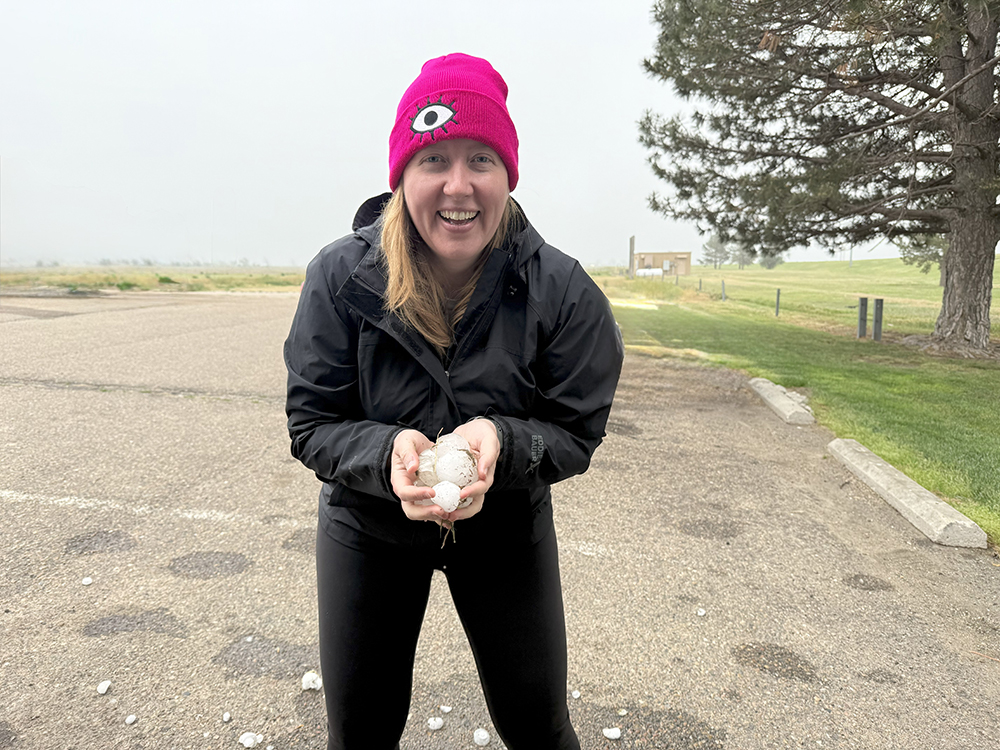
“There’s probably a decade’s worth of research papers here,” said Ph.D. student Caitlin Roufa. Photo by Caitlin Roufa, NIU.
Sheltering in a storm
For Roufa, who recovered the largest ICECHIP hailstone, the project rekindled her love of scientific instrumentation. A former physics teacher who is now working on her doctorate in earth, atmosphere and environment, the Caledonia, Illinois native drove a mobile mesonet truck during the field season.
Owned by the University of Alabama-Huntsville, the mesonet truck comes equipped with a custom-designed instrument mast and other technology to collect surface observations of temperature, pressure, humidity and wind. As storms approached, Roufa would unload several instrument pods, each weighing more than 100 pounds, and tote them to sites in the storm’s path. (It was a great workout, considering she did this 110 times—but who’s counting?)
“We usually were the first line of attack on a storm,” Roufa said. “We’d get our instruments in position before the worst weather arrived, and then we’d get out of the way.”
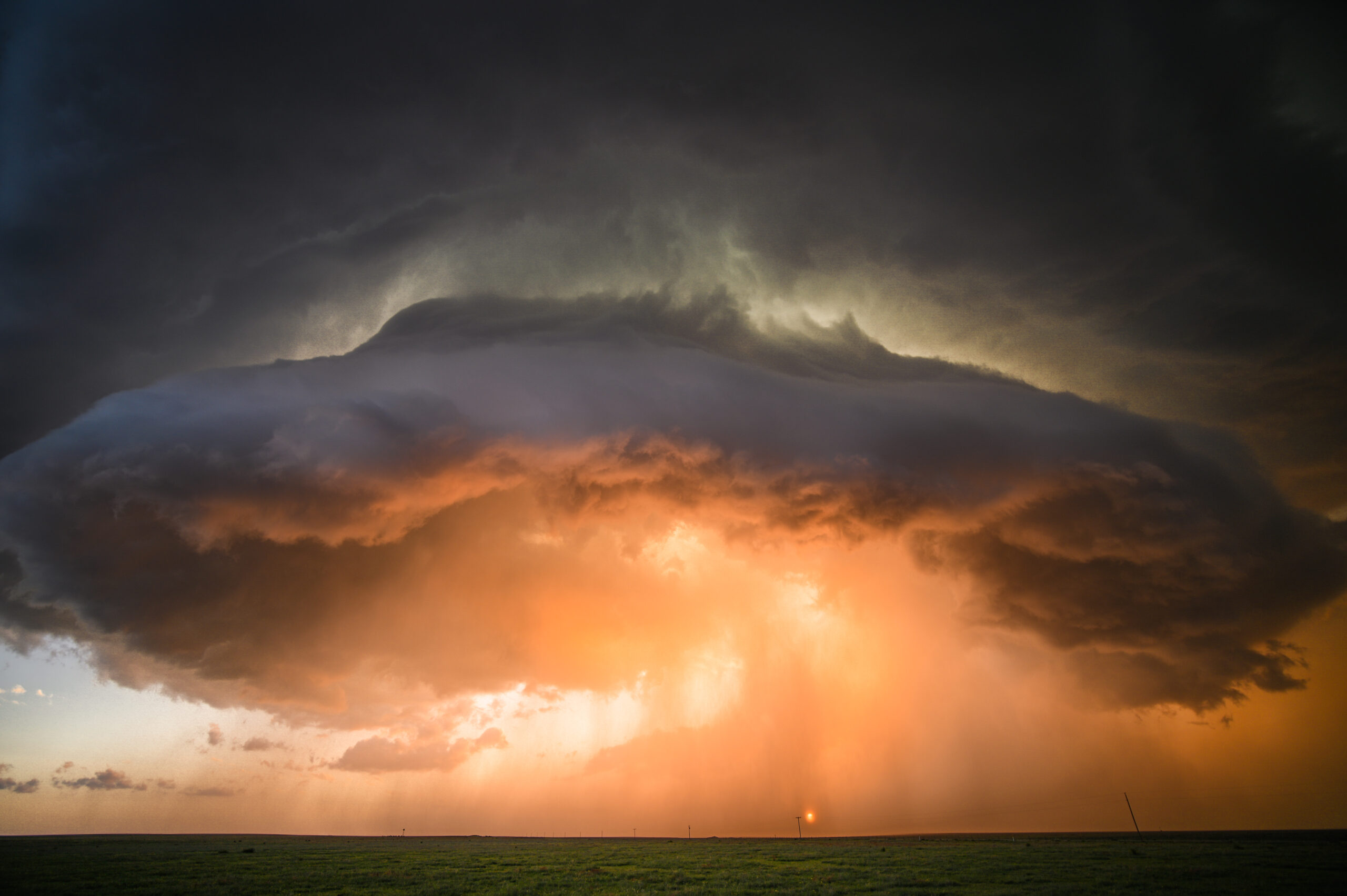
A highly structured supercell at sunset in New Mexico, with the updraft visible in the cloud and rain and hail falling on a grassy field. Photo by Landon Moeller, NIU.
Her days typically started with equipment checks at 7 a.m. and ended with data dumps during the wee hours of the next morning. In between: a planning briefing, driving toward forecasted storms, hours of waiting, pre-storm instrument deployment, then hustling to collect hailstones and retrieve the pods before dark.
Roufa could watch the movement of a storm and other ICECHIP vehicles on her laptop. Safety, she said, was always the top priority.
“If anyone felt unsafe, we would abort deployment—no questions asked,” Roufa said. “But if you know where you are in relation to a storm, you know where to be safe. We had multiple ways to communicate with the larger team, and we also had mapped out exit routes in advance of a storm’s arrival.”
Roufa said the ICECHIP field season will have a lasting impact on her career. Currently, her research focuses on connecting largescale climate dynamics to forecasting.
“Now I have so many ideas,” she said. “I’d love to start an instrumentation program, teaching students how to use these instruments. I also have so many new questions to explore. There’s probably a decade’s worth of research papers here.”
Gensini expects ICECHIP to result in numerous dissertations and master’s-level theses at NIU and other universities. Scientists will analyze the data for years to come, sifting through the voluminous data for forecasting gold.
“Now,” Gensini said, “the real work begins.”
Media Contact: Tom Parisi
About NIU
Northern Illinois University is a student-centered, nationally recognized public research university, with expertise that benefits its region and spans the globe in a wide variety of fields, including the sciences, humanities, arts, business, engineering, education, health and law. The Wall Street Journal and CollegeNET recognize NIU as a leading institution for social mobility, or helping its students climb the socioeconomic ladder. Through its main campus in DeKalb, Illinois, and education centers for students and working professionals in Chicago, Naperville and Rockford, NIU offers more than 100 areas of study while serving a diverse and international student body.
