
DEKALB, IL – The U.S. Department of Energy (DOE) has awarded NIU Chemistry Professor Tao Li with a new grant of $600,000 to develop improvements in lithium-ion batteries, used in everything from cell phones and electric vehicles to solar energy storage.
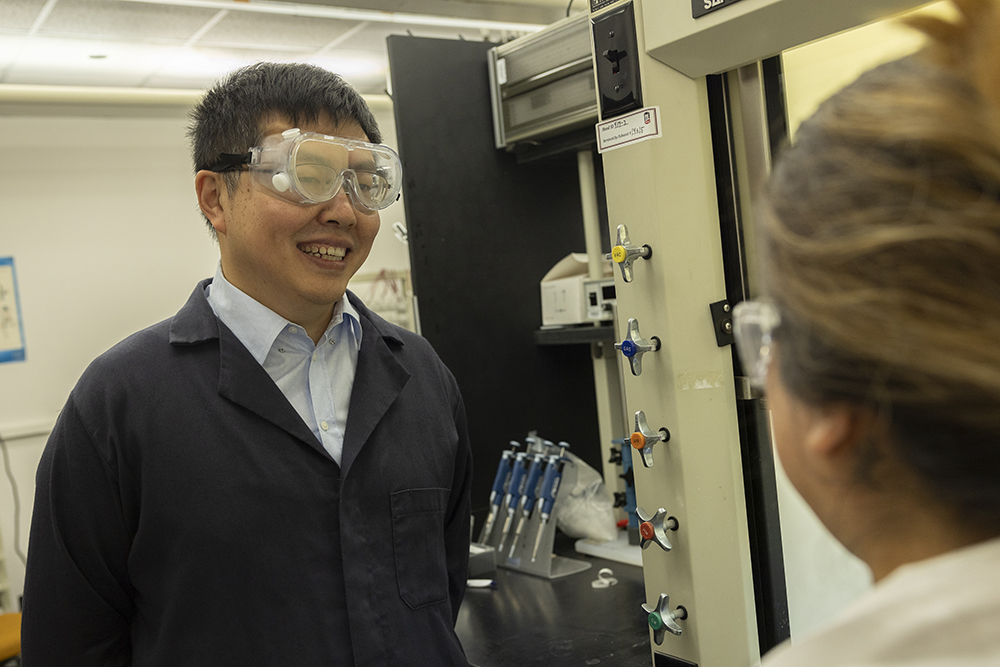
NIU Chemistry Professor Tao Li .
Over the next three years, Li and two NIU postdoctoral students will work with DOE’s Argonne National Laboratory on the project. Argonne is receiving an additional $200,000 award for the research.
“Li continues to be at the forefront of discovery,” said Richard Mocarski, NIU vice president of the Division of Research and Innovation Partnerships. “This funding represents his continued commitment to research and to partnership building and is an embodiment of the work NIU is proud to produce.”
Metal ions like nickel, cobalt or manganese, which are part of the cathode material in lithium-ion batteries, gradually dissolve into the electrolyte solution, reducing a battery’s lifespan and performance. The work aims to develop optimum electrolyte formulations that will prevent the dissolution of transition metals from lithium-ion battery cathodes and improve battery performance.
“The project seeks to understand and control the solvation structures of lithium ions,” said Li, who holds a joint appointment with NIU and Argonne. “These solvation structures are critical to how the electrolyte interacts with the cathode surface. Insights into these interactions will inform the rational design of next-generation electrolytes that minimize transition-metal loss, enhancing battery stability and longevity. “
The collaboration between NIU and Argonne combines expertise in chemistry and materials science with state-of-the-art experimental resources. Researchers will use sophisticated equipment at Argonne to employ a combination of advanced characterization techniques, including X-ray scattering, X-ray fluorescence microscopy, and high-resolution transmission electron microscopy.
“Using these tools, we’ll investigate the atomic-level changes at the electrolyte-cathode interface and map the distribution of transition metals within the battery,” Li said. “Understanding these dynamics will be crucial for developing electrolytes that effectively inhibit transition metal dissolution during battery operation.”
The DOE award to NIU was announced in November as part of $31 million in funding that aims to build research capacity at academic institutions nationwide.
Since arriving at NIU in 2018, Li has secured four DOE grants and nine National Science Foundation grants for his research. His work develops a highly fundable bio‐inspired interdisciplinary program to design and synthesize novel nanomaterials with a wide‐range applications in nanomedicine and energy‐related fields.
Media Contact: Tom Parisi
About NIU
Northern Illinois University is a student-centered, nationally recognized public research university, with expertise that benefits its region and spans the globe in a wide variety of fields, including the sciences, humanities, arts, business, engineering, education, health and law. The Wall Street Journal and CollegeNET recognize NIU as a leading institution for social mobility, or helping its students climb the socioeconomic ladder. Through its main campus in DeKalb, Illinois, and education centers for students and working professionals in Chicago, Naperville and Rockford, NIU offers more than 100 areas of study while serving a diverse and international student body.
