
As climate change brings more intense rainfall, the risk of rain-induced landslides is growing nationwide and could intensify in regions not historically prone to the natural disaster, according to a new study from Northern Illinois University.
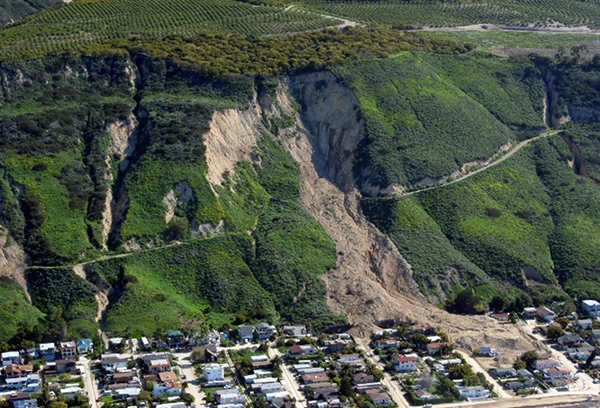
Landslides are among the most widespread and destructive natural disasters globally, occurring most frequently in mountainous regions. Although U.S. landslides are less frequent compared to other world regions, they do occur in every U.S. state and territory, causing an estimated 25 to 50 deaths each year and more than $1 billion in damages, according to the U.S. Geological Survey.
The frequency and intensity of extreme rainfall events have increased in recent decades, a trend expected to continue. The NIU analysis focused exclusively on rainfall-triggered landslides.
“Using nationwide landslide and rainfall data from 2006 to 2021, we found that some regions — especially along the Pacific Coast and Appalachian Mountains — are already experiencing landslide ‘hot spots’ closely linked to extreme precipitation,” said study author Wei Luo, a distinguished research professor in NIU’s Department of Earth, Atmosphere and Environment.
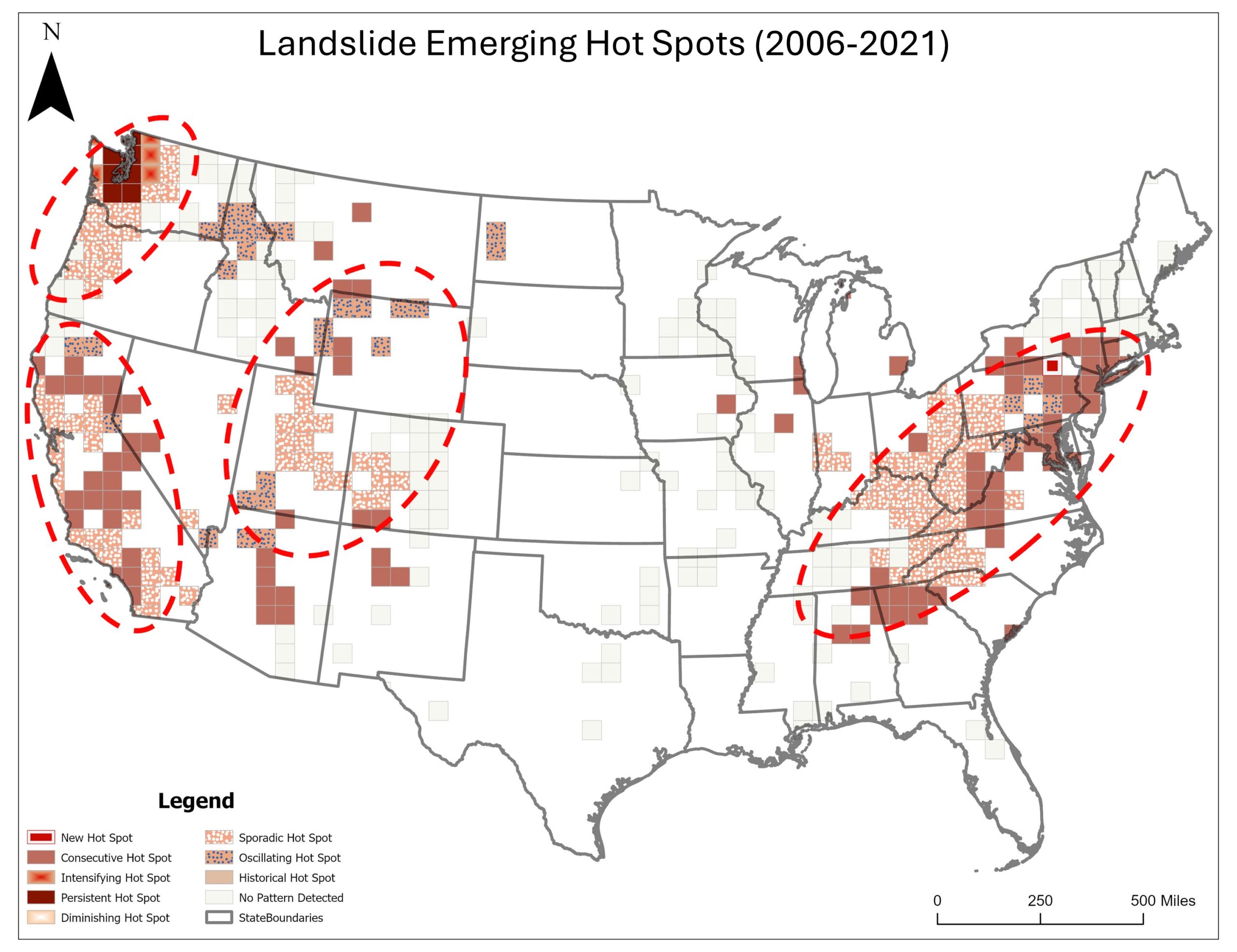
A landslide emerging hot spot analysis using data from 2006-2021. Dashed ellipses highlight a few notable regions. More information on different types of hot spots can be found here.
The study also indicates a potential geographic shift in future landslide vulnerability due to climate-driven changes in precipitation.
“By combining historical landslide-rainfall relationships with future climate projections, our study suggests that existing landslide hot spots may persist, while parts of the northeastern U.S. could emerge as new risk areas, exposing new communities and infrastructure to greater landslide risk,” Luo added.
The study was published online this month in the journal, Natural Hazards. It was led by former NIU student Karissa Duff under Luo’s guidance. The NIU professor has collaborated with colleagues to study landslides in Taiwan for more than a decade. Duff graduated with a master’s degree in 2025 and now works as a geographic information systems (GIS) technician for Will County.
The NIU researchers used modern geospatial statistical tools in geographic information systems to conduct their analysis of rainfall-triggered landslides across the contiguous United States.
This study integrated data from three primary sources: NASA’s Cooperative Open Online Landslide Repository (COOLR), the PRISM Group precipitation dataset and future climate projections from NASA Goddard Institute for Space Studies, which included three Representative Concentration Pathways (RCPs) used in the study. Precipitation was the sole variable analyzed over a time frame spanning 2026–2050 and included the low, medium and high greenhouse gas emission scenarios (RCP 2.6, 4.5 and 8.5, respectively).
Under all three projected climate change scenarios, future hot spots for precipitation emerge in the Northeast; in one scenario (RCP 2.6) hot spots also emerge in the central U.S., the researchers found. “We can infer that landslide risk also would increase in these regions,” Luo said.
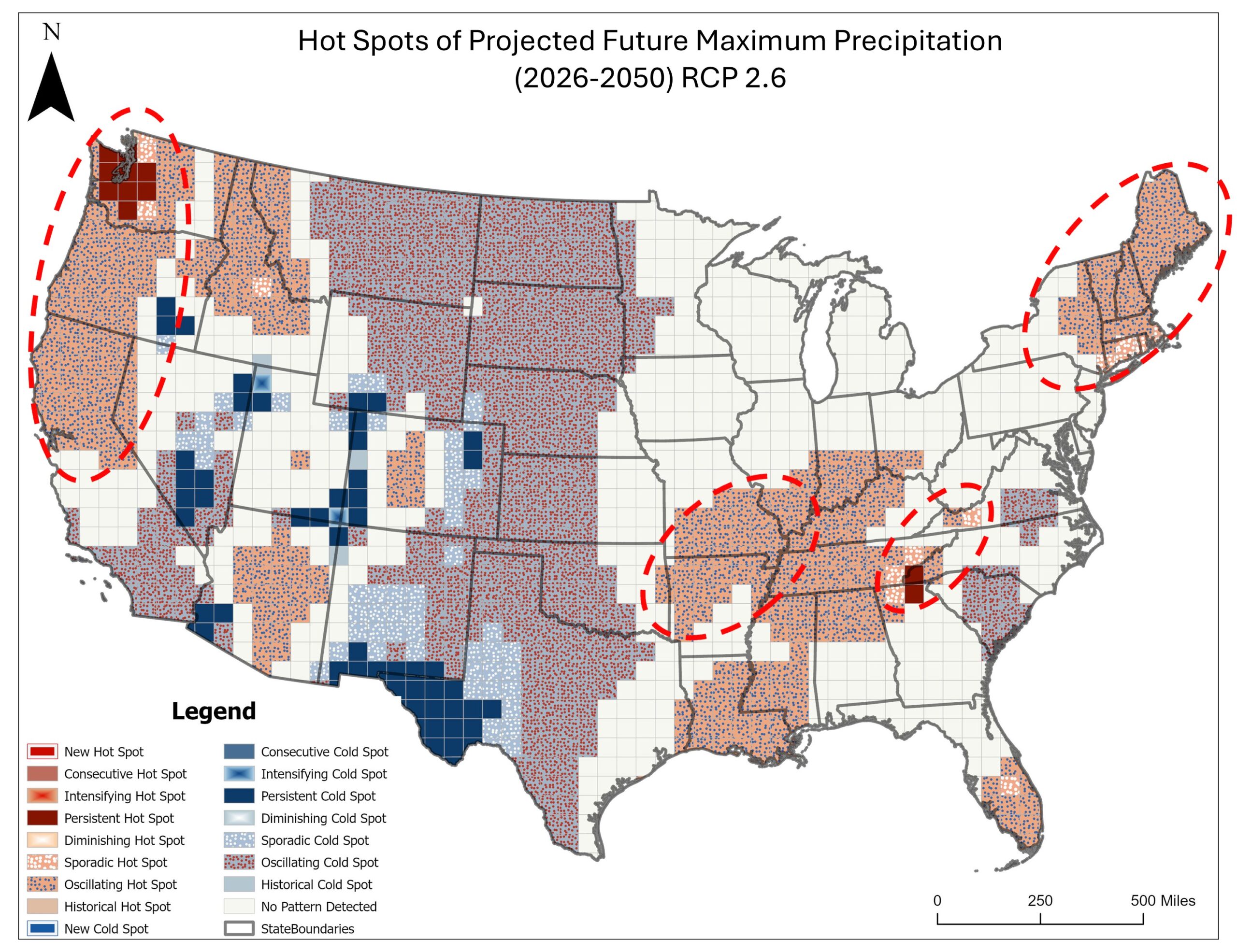
Spatial distribution of projected maximum precipitation hotspots under RCP 2.6 Scenario. Dashed ellipses highlight a few regions with potential higher landslide risk in coming decades.
“These findings could help emergency managers, city planners, insurers and the public better prepare for future disasters and strengthen resilience to increasingly extreme weather due to climate change in coming decades,” Luo said.
To improve future landslide projections, the study authors noted that a key priority is improving the completeness and consistency of landslide inventories. The growing availability of high-resolution satellite imagery and automated AI-assisted mapping techniques offer new opportunities to reduce reporting biases and develop more comprehensive national-scale inventories, the authors said. More detailed regional investigations also are needed to better understand local landslide processes.
Media Contact: Tom Parisi
About NIU
Northern Illinois University is a student-centered, nationally recognized public research university, with expertise that benefits its region and spans the globe in a wide variety of fields, including the sciences, humanities, arts, business, engineering, education, health and law. The university is recognized as a leading institution for social mobility, or helping its students climb the socioeconomic ladder. Through its main campus in DeKalb, Illinois, and education centers for students and working professionals in Chicago, Naperville and Rockford, NIU offers more than 100 areas of study while serving a diverse and international student body.
