
DEKALB, IL — A discovery made by NIU Chemistry Professor Tao Li and a team of researchers could help shape the future of batteries and beyond.
A study on the work has been published in the Journal of the American Chemical Society, the top national journal in chemistry.
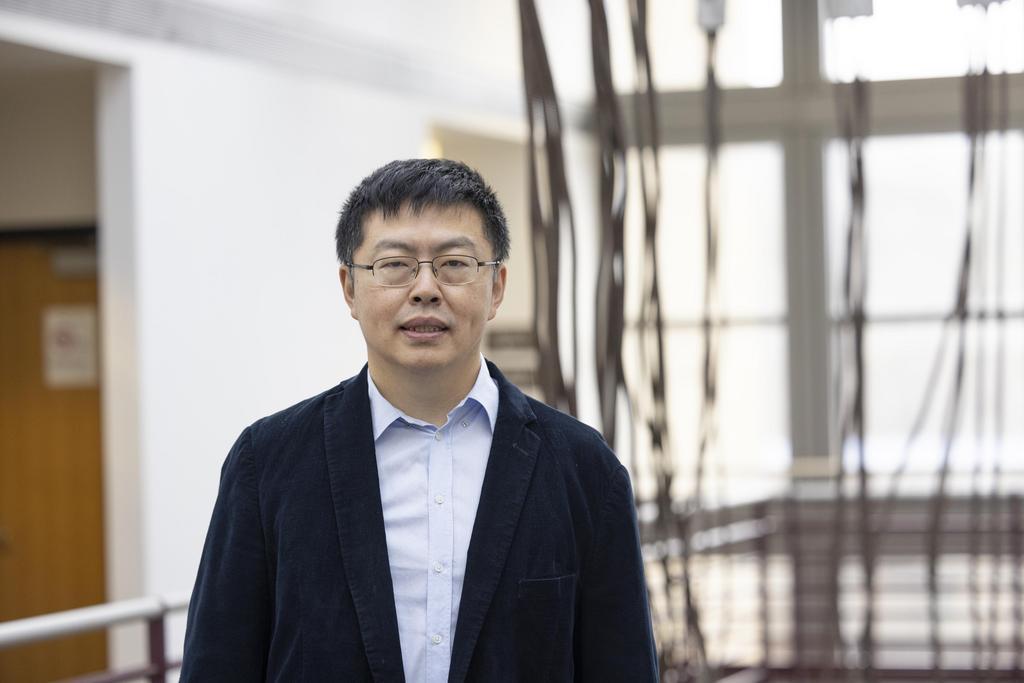
NIU Chemistry Professor Tao Li
Li, the study’s lead author, and his team found a universal rule that determines when certain high-performance battery materials — known as water-in-salt electrolytes — reach their peak efficiency. They discovered that ionic conductivity in these materials consistently maxes out when salt takes up about 37% of the total volume of the solution, no matter what types of ions are used.
“This discovery not only challenges long-standing assumptions in electrolyte science but also provides a powerful new design rule for building better batteries, and even informs research in biology, catalysis and environmental applications,” said Li, who has been studying the issue since 2018.
Performed at the U.S. Department of Energy’s Advanced Photon Source of Argonne National Laboratory in Lemont, IL, the work was funded through grants from the National Science Foundation and supported by the U.S. Department of Energy.
The study has major implications for energy storage and the design of batteries used in electric vehicles and stationary applications. Water-in-salt electrolytes are a relatively new type of battery electrolyte that pack more salt than water — a reversal of traditional formulations. These systems are safer, more cost-effective and have the potential to perform at higher voltages than conventional lithium-ion batteries.
But until now, scientists haven’t fully understood why these materials perform so well or how to optimize them.
“We knew conductivity didn’t just scale with how much salt you add by weight, but to see that it peaks when the volume fraction of salt hits this same number every time? That’s a big deal,” Li said.
Li and his team, which included three postdoctoral fellows, one graduate student and two undergraduates, used small-angle X-ray scattering and collaborated with researchers at the University of Michigan on molecular dynamics simulations.

Li and his team used small-angle X-ray scattering and collaborated with researchers at the University of Michigan on molecular dynamics simulations.
Li is especially proud of the students involved. Postdoctoral fellows involved included Huong Nguyen, Xingyi Lyu and Lingzhe Fang, along with students Rena Gonzalez, MJ Harr and Lalita Rai.
From Vietnam, Nguyen worked with Li for two years. Two undergraduate students began in his lab through summer internships and are now pursuing Ph.D. degrees under his direction.
“Seeing this come together with a group of young scientists makes it even more meaningful,” he said. “This discovery belongs to the whole team.”
They discovered that at the 37% salt volume threshold, the solution’s anions (ions with a negative electrical charge) begin to form interconnected nanostructures. These structures, in turn, create clear pathways that allow positively charged ions to move efficiently through the liquid.
The discovery doesn’t just help in the lab. It provides a new framework for designing better batteries, one that moves beyond traditional measurements such as molarity or weight percent and instead focuses on volume fraction and nanostructure.
And the impact goes even further. Because water-in-salt systems are so closely related to how ions behave in biology — inside cells, enzymes and proteins — Li believes the finding could eventually help inform work in other fields, including biophysics, catalysis and environmental science.
“This research started with battery questions, but the implications stretch into how we understand ion transport in general,” he said. “Our bodies are full of water and electrolytes. This kind of structural insight could help us better understand those systems, too.”
Media Contact: Jami Kunzer
About NIU
Northern Illinois University is a student-centered, nationally recognized public research university, with expertise that benefits its region and spans the globe in a wide variety of fields, including the sciences, humanities, arts, business, engineering, education, health and law. The Wall Street Journal and CollegeNET recognize NIU as a leading institution for social mobility, or helping its students climb the socioeconomic ladder. Through its main campus in DeKalb, Illinois, and education centers for students and working professionals in Chicago, Naperville and Rockford, NIU offers more than 100 areas of study while serving a diverse and international student body.
