DEKALB, IL – They might not have walked the red carpet at the star-studded gala dubbed the “Oscars® of Science,” but three NIU professors and seven of their former students are sharing in a prestigious 2026 Breakthrough Prize.
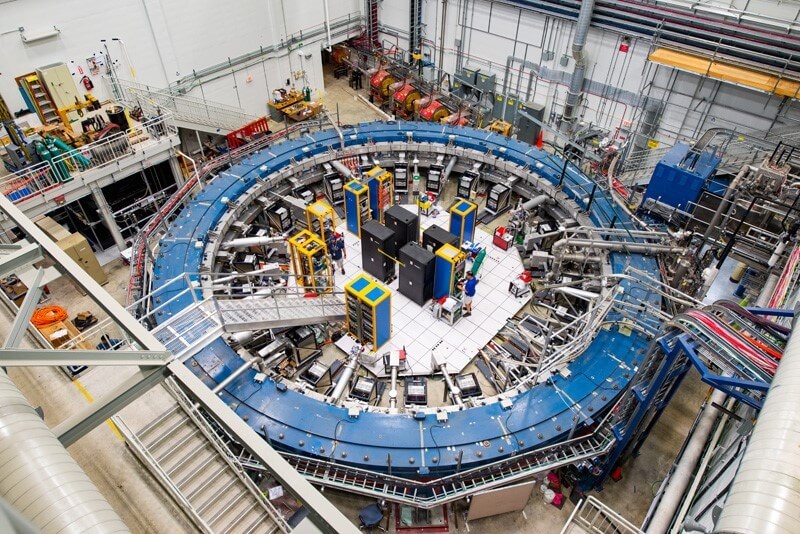
The Muon g-2 ring at Fermilab. Photo courtesy of Fermilab
To be sure, it’s a conversation starter and résumé-worthy honor. What’s more, each Huskie will get a small cut of $3 million in prize money for the award.
Scientists, CEOs and celebrities—including Ron Howard, Robert Downey Jr., Margot Robbie and Salma Hayek—gathered for the annual Breakthrough Prize Ceremony on April 18th, in Santa Monica, Calif. Actor and Emmy Award-winner James Corden hosted the event, where six Breakthrough Prizes of $3 million each were announced. The prizes are among the world’s most notable and prestigious scientific awards celebrating new discoveries.
OpenAI CEO Sam Altman and Airbnb founder and CEO Brian Chesky presented the 2026 Breakthrough Prize in Fundamental Physics to the Muon g-2 collaborations at CERN in Europe, Brookhaven National Laboratory in New York and Fermi National Accelerator Laboratory in nearby Batavia.
NIU Physics Professor Michael Eads, Mechanical Engineering Professor Nicholas Pohlman and Physics Professor Emeritus Michael Syphers contributed to the Fermilab collaboration and are listed among the official award contributors.
The Muon g-2 experiment began at CERN decades ago, shifted to Brookhaven in the 1990s and concluded at Fermilab with final publication in 2025. Roughly 400 collaborators listed in publications of experimental results will each receive prize money amounting to $7,500 per person.
A cousin of the electron, the muon is one of the fundamental subatomic particles, the most basic building blocks of the universe. Like the electron, it can behave like a tiny magnet. As described by Fermilab, Muon g-2 experiments were designed to measure the magnetic moment of the muon with ever-increasing precision, exploring the quantum realm where particles briefly appear and vanish—and where even tiny deviations could point to entirely new laws of nature outside of the current Standard Model of Particle Physics.
Pohlman said helping to custom build equipment for the experiment was a great experience for students that required partnership and precision. But until recently he wasn’t fully aware of the impact of experimental results in the physics community.
“This award made me realize the Muon g-2 results had an outcome that goes well beyond the high energy physics research community,” Pohlman said.
Collaborators listed among the award winners also include NIU alumni who worked on the experiment as students under the direction of Eads and Pohlman: Aaron Epps (physics), Mary Shenk (physics), Michael McEvoy (physics), Daniel Boyden (physics), Andrew Fiedler (physics), Greg Luo (mechanical engineering) and Andrew Behnke (mechanical engineering).
“It’s incredibly exciting to see the Muon g‑2 project earn a Breakthrough Prize after all these years,” Luo said. He conducted thermal simulations on a muon-capturing device to assess heat-dissipation designs needed for safe and reliable operation in a vacuum environment. Nowadays, he works as a Manager of Data Engineering at CIBC, one of Canada’s “big five” banks.
“I’m proud to have played even a small part in something that became such a milestone for fundamental physics,” Luo said.
Behnke contributed to the experiment as part of his master’s thesis. The work included designing a test stand for muon beam detectors to ensure that they worked properly. Now an analysis engineer at an engineering services company, Behnke was surprised to learn of the Breakthrough Prize.
“I didn’t really expect to be revisiting this project in this way almost 10 years after the fact,” he said.
Professor Eads said he is thrilled to see the entire collaboration recognized, including NIU alumni. The university’s location in Chicago’s backyard is often a boon for students.
“Being close to two federal labs—not only Fermilab but also Argonne National Laboratory—continues to be a big bonus for our students in the sciences and engineering because it provides extraordinary hands-on learning opportunities,” Eads said.
Amazingly, for Eads, this wasn’t his first rodeo when it comes to breakthroughs.
He also was among the winners of the Breakthrough Prize in Fundamental Physics in 2025—along with NIU Physics Professors Jahred Adelman, Dhiman Chakraborty and Hector de la Torre Perez; students Will Kostecka, Gretel Mercado, Alec Lancaster and Arthur Charles Kraus; postdocs Kevin Sedlaczek and Ana Maria Rodriguez Vera; and software engineers Ioannis Maznas and Yuri Smirnov.
That award went to co-authors of research publications based on CERN’s Large Hadron Collider Run-2 data released between 2015 and 2024, at four experimental collaborations. In all there were 4,000 collaborators, and the prize money was distributed to the experimental groups, rather than individuals.
The Breakthrough Prizes were founded by Sergey Brin, Priscilla Chan and Mark Zuckerberg, Julia and Yuri Milner, and Anne Wojcicki and have been sponsored by foundations established by them. Selection Committees composed of previous Breakthrough Prize laureates in each field choose the winners. Information on the Breakthrough Prize is available at breakthroughprize.org.
Media Contact: Tom Parisi
About NIU
Northern Illinois University is a student-centered, nationally recognized public research university, with expertise that benefits its region and spans the globe in a wide variety of fields, including the sciences, humanities, arts, business, engineering, education, health and law. The Wall Street Journal and CollegeNET recognize NIU as a leading institution for social mobility, or helping its students climb the socioeconomic ladder. Through its main campus in DeKalb, Illinois, and education centers for students and working professionals in Chicago, Naperville and Rockford, NIU offers more than 100 areas of study while serving a diverse and international student body.
