
DeKalb, IL – Decoys are commonly associated with hunting, but when it comes to threatened seabirds, a new study shows such trickery can also be used as species savers.
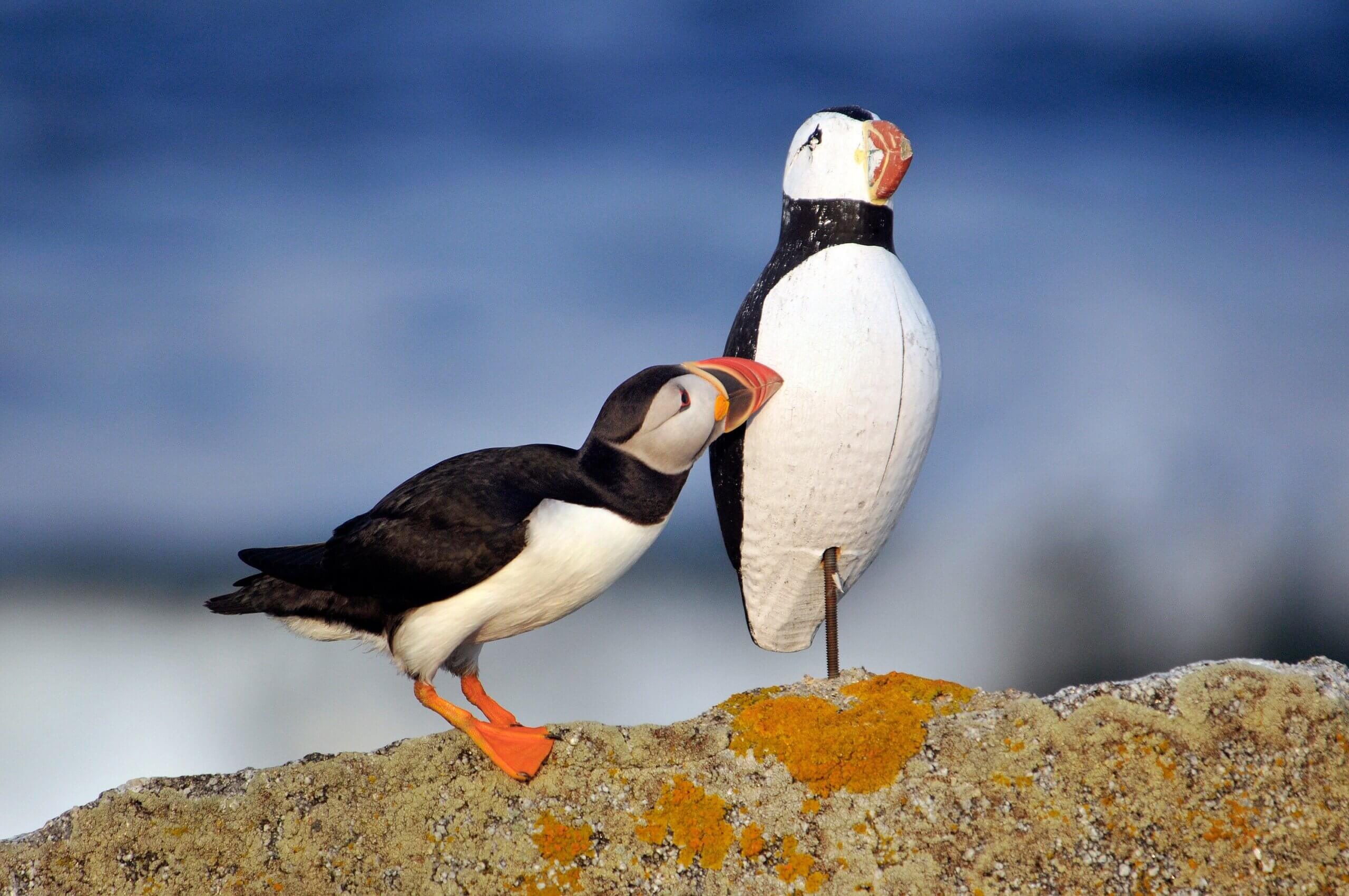
An Atlantic Puffin interacts with a decoy on a nesting island in Maine. Photo: Derrick Z. Jackson
Northern Illinois University Professor Holly Jones, Ph.D., is a member of a research team that for the first time demonstrates the effectiveness of restoring seabird populations around the world. The study is a global synthesis of all reported seabird translocation and social attraction restoration efforts, which spans nearly 70 years and over 850 efforts across 36 countries, targeting 138 seabird species—roughly one-third of all seabirds worldwide.
The team’s new research is published in the Proceedings of the National Academies of Sciences.
“Seabirds play key roles in coastal and island ecosystems, yet they are suffering massive declines across the planet,” said Dena Spatz, Ph.D., senior conservation scientist at Pacific Rim Conservation and lead author of the paper. “That’s why it’s crucial that conservationists world-wide have shared knowledge on their restoration experiences, which can now help to restore seabirds in the most efficient way possible.”
Seabirds are one of the most threatened bird groups on the planet with about 30% of species at enhanced risk of extinction, primarily due to threats from invasive predators at breeding sites, habitat loss, and harmful fishing practices. Climate change poses yet another challenge, as sea-level rise and increasing storms can flood low-lying seabird breeding habitat.
“Seabird restoration uses active methods to get seabirds back, often after invasive mammals are removed from islands,” said Jones, who holds a joint appointment at NIU with Biological Sciences and the Institute for the Study of the Environment, Sustainability, and Energy.
“These methods can include decoys, vocalization playbacks and/or mirrors to trick seabirds into thinking a colony is there, which entices new birds to breed,” Jones said. “Another common method is to translocate chicks before they’ve imprinted on their birth colony to a restoration site in hopes they will imprint there and return to breed.”
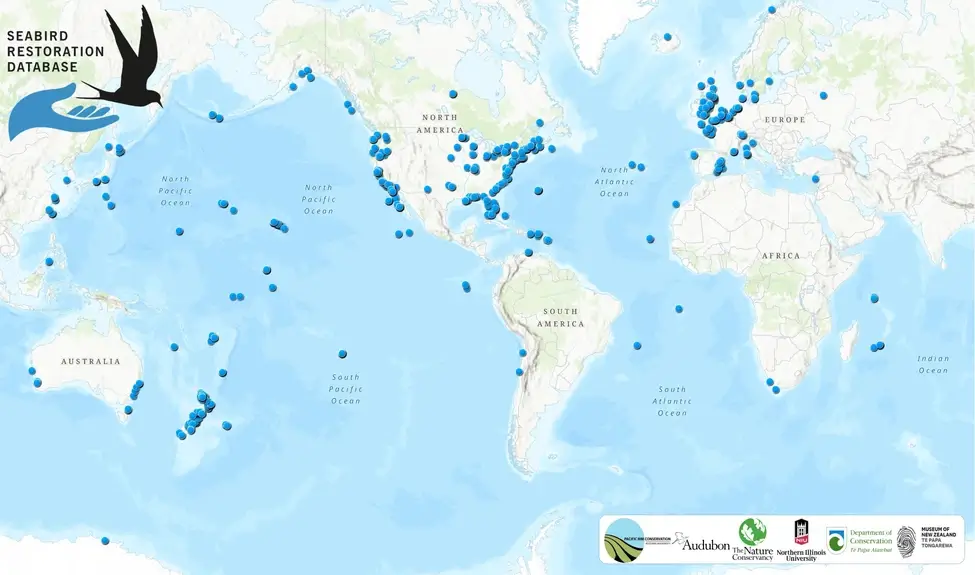
The Seabird Restoration Database includes an interactive map of over 850 efforts to restore seabird populations across 36 countries.
To understand which restoration methods have been most successful and guide future best-practices, Spatz and co-authors created the Seabird Restoration Database, an interactive catalog of efforts to help seabirds recover based on a review of over 1,400 resources and communications with over 300 experts.
The study authors analyzed the success of these seabird projects, finding the outcomes largely positive—within an average of two years from the project’s start, 80% of seabird projects resulted in birds visiting the site, and 76% achieved breeding.
The researchers also found that terns, gulls and auks are among the seabird groups seeing the most success, as these groups are among the most commonly restored. The most highly threatened seabird group—petrels, shearwaters and albatrosses—have also been common targets for active restoration, typically using social attraction or a combination of social attraction and translocation, both of which have also had high success rates.
“Fifty years ago, Audubon first combined translocation and social attraction to successfully bring a healthy population of Atlantic Puffins back to Maine’s coast, so it was amazing to learn of more than 800 projects undertaken since then,” said coauthorDonald Lyons, Ph.D., Director of Conservation Science for Audubon’s Seabird Institute. “These projects are a powerful testament to the dedication of seabird practitioners around the globe, and Audubon is proud to have supported restoration training for many of these devoted conservationists.”
“Seabird restoration projects are game changers for these incredibly important, and often endangered birds, many of whom won’t be able to stave off extinction if we don’t do something to help,” Jones said. “Helping out seabirds helps to restore entire island ecosystems because as top ocean predators, they bring marine nutrients to islands on which they’re restored, positively impacting flora, fauna and functioning.”
The Seabird Restoration Database partners include NIU, Pacific Rim Conservation, the National Audubon Society, The Nature Conservancy, New Zealand Department of Conservation and the Museum of New Zealand Te Papa Tongarewa.
Media Contact: Tom Parisi
About
Northern Illinois University is a student-centered, nationally recognized public research university, with expertise that benefits its region and spans the globe in a wide variety of fields, including the sciences, humanities, arts, business, engineering, education, health and law. Through its main campus in DeKalb, Illinois, and education centers for students and working professionals in Chicago, Hoffman Estates, Naperville, Oregon and Rockford, NIU offers more than 100 areas of study while serving a diverse and international student body.
Pacific Rim Conservation is a Hawaii-based 501(c)3 non-profit organization. We are a conservation organization whose primary focus is wildlife research and management, with a specialty in native birds. Our mission is to maintain and restore native bird diversity, populations, and ecosystems in Hawaii and the Pacific Region.
The National Audubon Society protects birds and the places they need, today and tomorrow. Audubon works throughout the Americas using science, advocacy, education, and on-the-ground conservation. State programs, nature centers, chapters, and partners give Audubon an unparalleled wingspan that reaches millions of people each year to inform, inspire, and unite diverse communities in conservation action. A nonprofit conservation organization since 1905, Audubon believes in a world in which people and wildlife thrive.
The Nature Conservancy is a global conservation organization dedicated to conserving the lands and waters on which all life depends. Guided by science, we create innovative, on-the-ground solutions to our world’s toughest challenges so that nature and people can thrive together. We are tackling climate change, conserving lands, waters and oceans at an unprecedented scale, providing food and water sustainably and helping make cities more sustainable. Working in 79 countries and territories, we use a collaborative approach that engages local communities, governments, the private sector, and other partners. To learn more, visit www.nature.org or follow @nature_press on Twitter.
