DEKALB, IL — “These students are time-traveling.”
Undergraduates took a tactile trip through the revolutionary evolution from written to printed texts in this spring’s inaugural class for a humanities-inspired laboratory and learning space at Northern Illinois University.
Officially unveiled at the end of April, the BookLab in Founders Memorial Library has been operating as a portal through ages of pages for Huskies and the community alike since last year. That’s why English Graduate Teaching Assistant Angela Marcelino sees this literary lab as “time-traveling” — with its fully functional artifacts of NIU’s own storied printing past.
“It’s enriching to see your work and your major come to life beyond just words on a page. You’re touching, rather than writing about or studying history,” said Marcelino, a first-year doctoral student hired last year to help organize the Booklab. “As literature students, we don’t always get to be hands-on aside from looking at archival records and manuscripts.”

Rachael Manning (far left) cheers with other students after her classmate created a print during the Technologies of the Word course in NIU’s BookLab this spring.
Alongside graduate teaching assistants Bosompemaa Dankwa and Juliet Tawiah, Marcelino has assisted English Professor Nicole Clifton, Ph.D., in teaching Technologies of the Word. By the time finals week rolled around in May, the BookLab’s first group for ENGL 398 had literally tried their hand at writing and printing practices from the brink of antiquity, and compared these older tools to today’s digital-driven, sometimes automated content.
Recording their progress the analog way in lab notebooks, students stripped wordsmithing to its essential elements — making their own paper, cutting quills and dipping into ink to script assignments. The work meant witnessing global literacy’s journey firsthand.
“How did writing happen before computers or phones? People are used to doing everything electronically now,” Clifton said. “Technologies of the Word is this whole history of ‘things’ that goes back, really, to the beginning. You don’t have history until you can write it down in some way — it’s writing that makes history. Before that, you have to deal with archaeology.”
‘I just think telling stories is really cool’
Before spring break, the class scrawled manually on beeswax tablets — an early “Etch-a-Sketch” of sorts first uncovered by archaeologists — and closed out the semester having printed and bound their own books. On a warm February afternoon in the lab, students clustered around a table holding the BookBeetle, a miniature letterpress. This was their initial chance to create colorful ink prints from elaborately engraved wooden blocks.
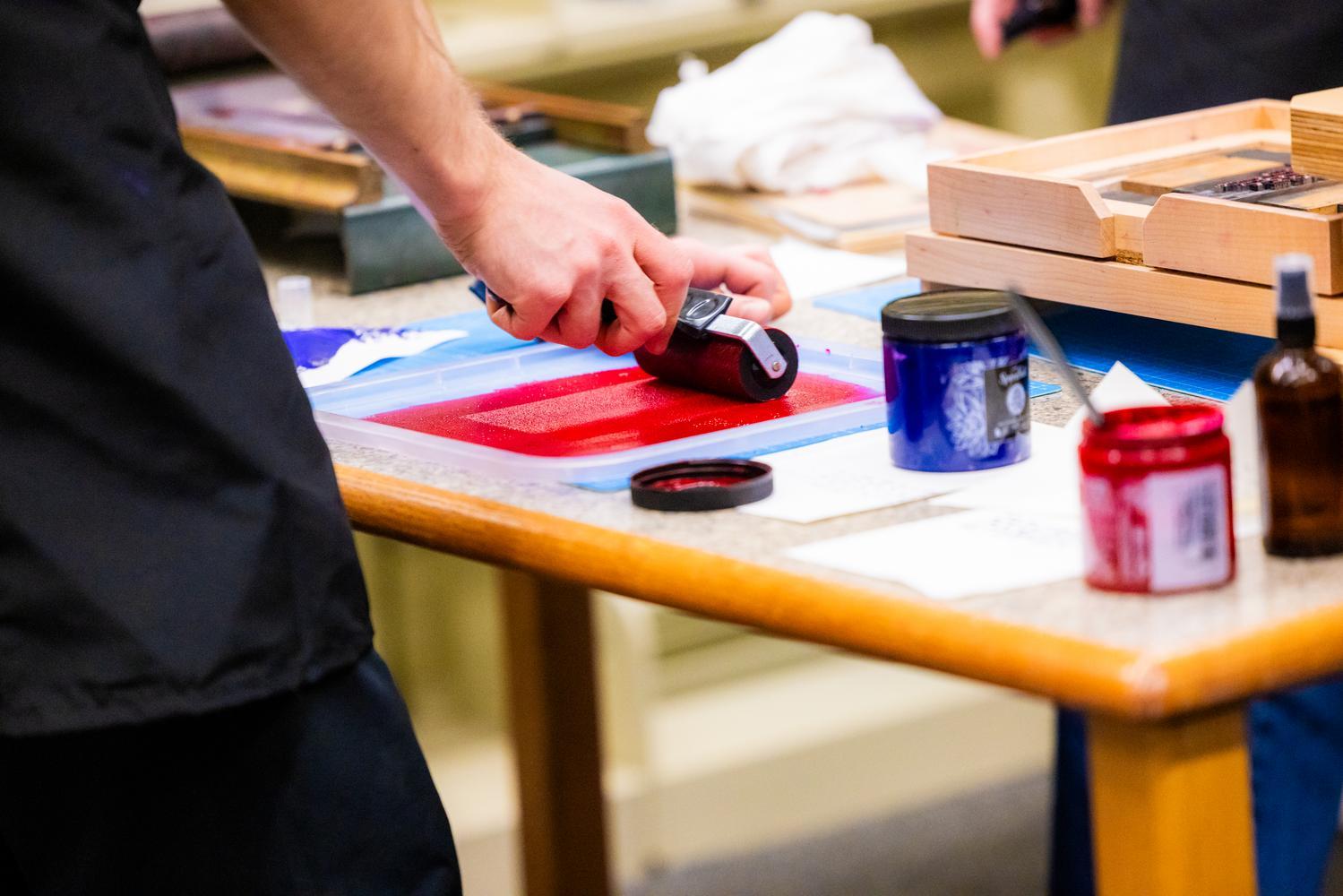
A student spreads ink onto a roller to make a print on the BookBeetle.
The first to volunteer an attempt was Rachael Manning, a transfer from Rock Valley College majoring in English. With Marcelino’s guidance, she chose a design, laid it into the “coffin” tray of the press and packed pieces of wooden “furniture” tightly around the block.
Then, she turned her attention from prepping to printing. She rolled vivid red ink over the engraving, delicately laid a damp piece of paper over the top and covered it, slid the design into the base of the press, cranked a wheel to clamp down onto her print — and counted with her classmates.
“One Mississippi, two Mississippi, three Mississippi, four Mississippi, five Mississippi.”
Moving in reverse, Manning unpeeled her prize from the press to the delight of the group. Her cohort members lined up to give it a try themselves, and Manning found herself back in the queue waiting to craft more prints. She left class with the most freshly made artwork.
“I’ve been in and out of libraries my whole life. I have so many books I am always collecting and reading. I just think telling stories is really cool,” Manning said. “All my teachers knew me for writing and reading growing up, and there wasn’t really a true alternative option for me to study. And so here I am, still having fun with my books, just with extra work attached to them.”
Fresh fanfare for half a century of heritage
The centerpiece of NIU’s new BookLab is a 50-year-old replica of the world’s first fully mechanized press. Among the first modern incarnations of Johannes Gutenberg’s 1440 press made at a United States university, this carbon-copy of the original common press that revolutionized 15th-century European literacy holds a rather uncommon distinction.
“The invention of the printing press wasn’t just a technological breakthrough — it fundamentally changed the course of education, politics, religion and culture,” said University Libraries Dean Fred Barnhart, JD, MLS. “With the BookLab, we want to create a space where people can explore those ideas, experiment with old and new tools, and see themselves as part of the story of the printed word.”
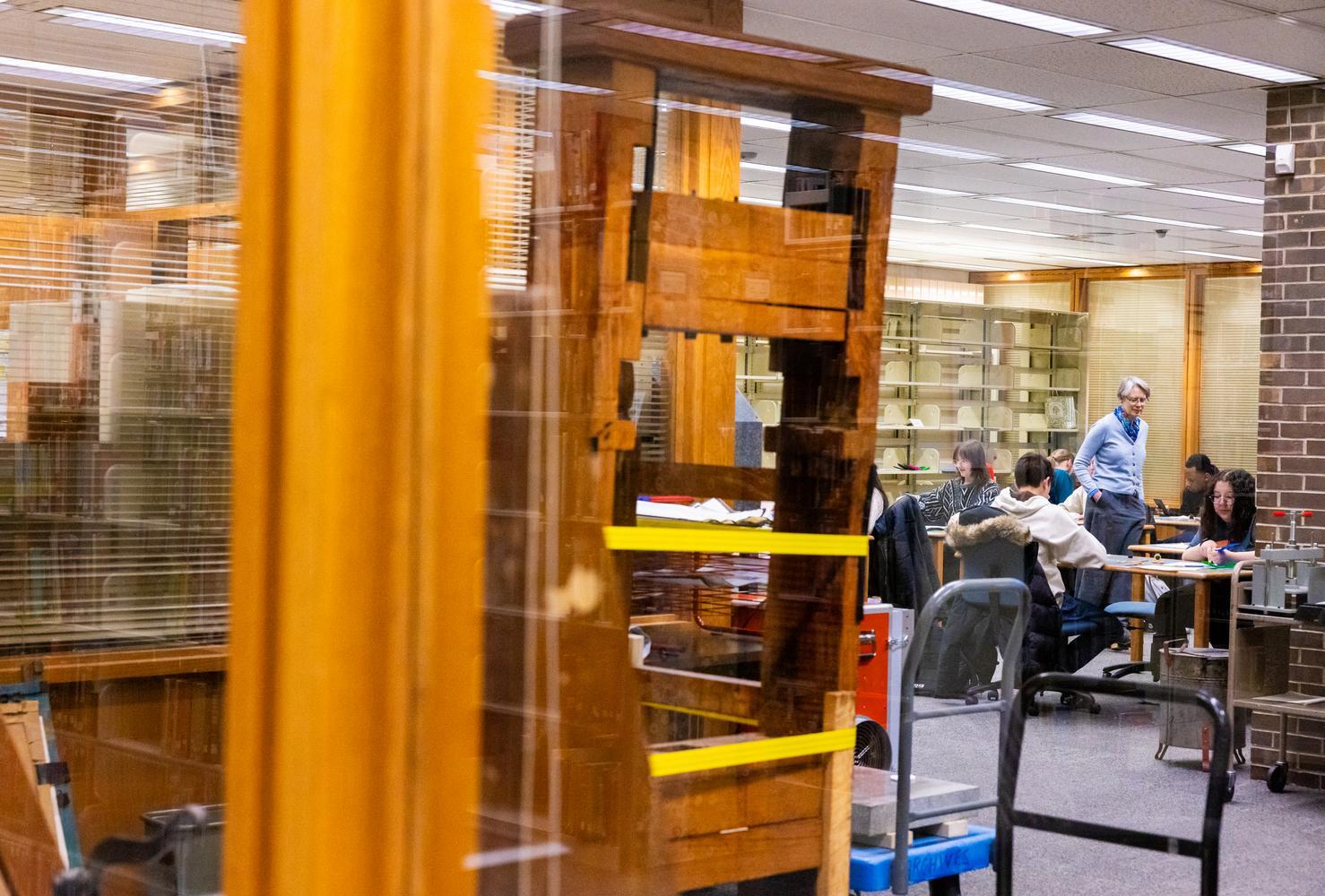
NIU’s common press sits in the foreground as Nicole Clifton teaches class.
For his 1975 senior project, technology student Joe Frieders built NIU’s common press, drawn from a historical patchwork of plans after Gutenberg’s model that made mass-printing possible. In recent years, the working press sat mostly on display in Founders, falling into mild disrepair before it became a central figure in a new kind of reformation.
“Part of the story of the BookLab is a generations-old story of the collections that previous curators of the Rare Books Room and English department worked to build — and how they had already been teaching book history at NIU since the ‘70s, really,” said Professor of English Melissa Adams-Campbell, Ph.D. “And because of that legacy and those relationships, we had accumulated this incredible collection of hands-on materials that just needed a space in order for students to be able to start using them.”
The BookBeetle, a more recent BookLab addition, has the same basic components and was designed to demonstrate how a common press works, albeit on a miniaturized scale. Its creator was inspired by a replica of Gutenberg’s invention at the University of Virginia, using research compiled by the Smithsonian Institution. Because NIU was one of the only schools with a common press in the 1970s, a representative from the Smithsonian wrote to the university for guidance on their report, exchanging letters with then-librarian Tony Bliss.
Professor, librarian initiate a novel chapter
“NIU’s scholarly engagement with the history of the book goes back half a century,” said Rare Books and Special Collections Librarian Beth McGowan, Ph.D. “Opening the BookLab is a physical manifestation of that legacy. In this way, we see the lab as both honoring the past and forging the future.”

English Professor Melissa Adams-Campbell says of founding the BookLab with Rare Books and Special Collections Librarian Beth McGowan: “… We had accumulated this incredible collection of hands-on materials that just needed a space in order for students to be able to start using them.”
The BookLab is a culmination of a few years of groundwork that started with Adams-Campbell approaching McGowan, an expert specialist for the English department. Adams-Campbell had toured University Libraries’ collections and wanted students to have “amazing treasures” at their fingertips for typesetting, printing and old-fashioned writing.
“And we were incredibly lucky because just as we were coming up with this idea of the BookLab, we also realized that we needed to repair our common press, so we began our first crowdfunding campaign,” McGowan said. “We had hoped to raise $14,000. We raised closer to $25,000 — and we were astonished. It was a pleasure to find out how well-known NIU is nationally for this collection of presses and materials.”
About 200 people passed through the BookLab for its grand opening April 28, meeting the project’s organizers and students like Manning and Marcelino. Attendees put the lab’s tools to the test for themselves and watched printmaking demonstrations on the common press. A documentary from Ken Jerger, an Integrated Media Technologies staff member from the Division of Information Technology, offered a look through time at NIU’s Gutenberg replica.
“When you realize the humanities are dictated by the history of technology, it’s not wild to go from learning about presses to generative AI and other forms of digital communication,” said English Chair and Professor Scott Balcerzak, Ph.D. “NIU’s BookLab builds off what we already have toward further potential innovation and curriculum development.”
Leading a restoration of learning by creation
Since starting as co-collaborators, Adams-Campbell and McGowan have drawn in many more pairs of helping hands from both the administrative and academic sides of the house. Printmaking Professor Michael Barnes from the School of Art and Design has rebuilt several pieces of NIU’s half-century-old press by manual labor — “primitive-style,” as he calls it.
“Students are using their hands so much less, like in the physical sense of drawing on paper; they have their iPads now, and they can do amazing things with those,” Barnes said. “But the hand-eye coordination that they get from smudging, charcoal or ink on a piece of paper, or scratching into a piece of copper, has a visceral quality to it. It develops other senses in your body. This wonderful project advocates for that sense of holistic education.”
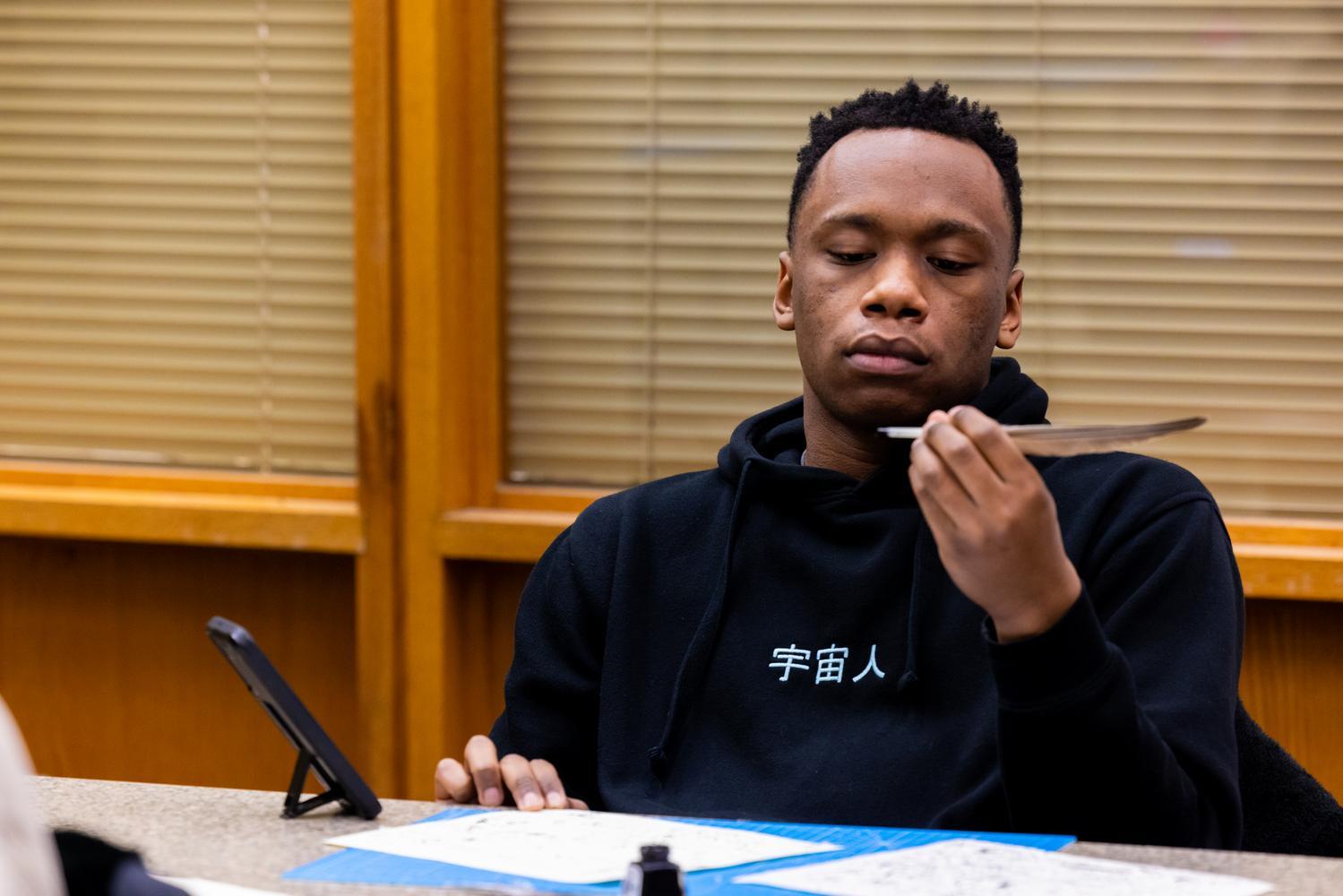
Students in Technologies of the Word made quill pens, prints and books.
Adams-Campbell and McGowan dream of enabling this type of tinkering for all disciplines and academic levels — and every age group. Children flocked to make their own prints on the BookBeetle last fall at NIU STEAM’s free STEM Fest, which draws thousands annually. This week, the pair traveled to a “Building Books Labs Symposium” at the University of Illinois Urbana-Champaign, bringing together early adopters of these learning spaces.
“I am proud of all the faculty and graduate students who worked so hard to bring this to fruition,” said Robert Brinkmann, Ph.D., dean of the College of Liberal Arts and Sciences. “The BookLab represents a marvelous transdisciplinary project that focuses on the heart of what drives many of us to scholarly pursuits — the book.”
Beyond the lab’s kickoff class this spring, Adams-Campbell used the BookLab to explore indigenous printing with the graduate students from her Native American Literature class. Barnes has similarly pulled in his MFA students to help repair equipment in the BookLab.
Monsters and Makers, movers and shakers
This fall, Adams-Campbell will teach her first undergraduate-level honors seminar within the BookLab space — Monsters and Makers: “Frankenstein,” Text and Technology. The course will make use of the library’s rare 1831 and 1869 editions of English author Mary Shelley’s iconic science-fiction novel “Frankenstein.”
“We’ll be spending a few weeks doing letterpress in the BookLab and will also be using generative AI as we write research papers. We’re going to experiment with what it’s like to do that work in a responsible and ethical manner, as ‘Frankenstein’ the novel invites us to think about those questions,” Adams-Campbell said. “I think that’s really the vision of what the BookLab can do — we can take the things we know and help students piece together how they envision that history of technology and communication moving forward.”

Graduate Teaching Assistant Angela Marcelino helps students arrange a print.
The BookLab has garnered interest from departments within and outside the humanities. This spring, Adams-Campbell and McGowan announced a tentative plan for a cross-campus committee. They hope collaboration grows concurrently with awareness.
“Librarians want people in the library, because we want people to use our resources and to love them as much as we do,” McGowan said. “For librarians, interdisciplinarity is part and parcel of who we are.”
Marcelino refers to this collective-coalescing concept as “interdisciplinary awesomeness.” She believes when students form the bigger picture outside their fields while also actively creating their own work, ideas become more accessible. She and Clifton will reunite in the BookLab next spring to help make Technologies of the Word a regular course offering.
“The BookLab has made me feel confident in everything I’m doing, from researching and studying to teaching and preserving literature,” Marcelino said. “Getting an A is one thing, but seeing your assignments captured in physical form is another. We don’t have to just sit and talk in class — we can make things with our hands.”
Media Contact: Jeniece Smith
About NIU
Northern Illinois University is a student-centered, nationally recognized public research university, with expertise that benefits its region and spans the globe in a wide variety of fields, including the sciences, humanities, arts, business, engineering, education, health and law. The Wall Street Journal and CollegeNET recognize NIU as a leading institution for social mobility, or helping its students climb the socioeconomic ladder. Through its main campus in DeKalb, Illinois, and education centers for students and working professionals in Chicago, Naperville and Rockford, NIU offers more than 100 areas of study while serving a diverse and international student body.
