
DeKalb, IL – In warming U.S. climates toward the end of this century, supercell storms could become more frequent, more intense and more active earlier in the storm season, especially in the nation’s eastern regions, a new study by Northern Illinois University researchers finds.
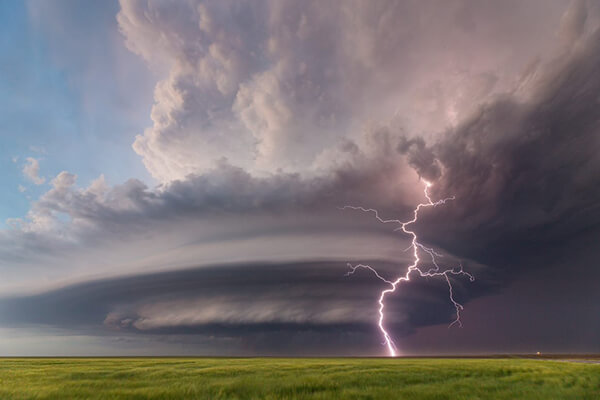
A June 2019 supercell over a field in Kansas. Photo Credit: Walker Ashley
A supercell is a distinct type of intense, long-lived thunderstorm that contains a rotating updraft. Supercells are responsible for most damaging hail and deadly tornadoes, causing billions of dollars in losses and hundreds of casualties annually.
“These results suggest the potential by the century’s end for more significant tornadoes, hail and extreme rainfall that, when combined with an increasingly vulnerable society, might produce disastrous consequences,” said lead author Walker Ashley, an NIU professor of meteorology.
The study is published online in the Bulletin of the American Meteorological Society.
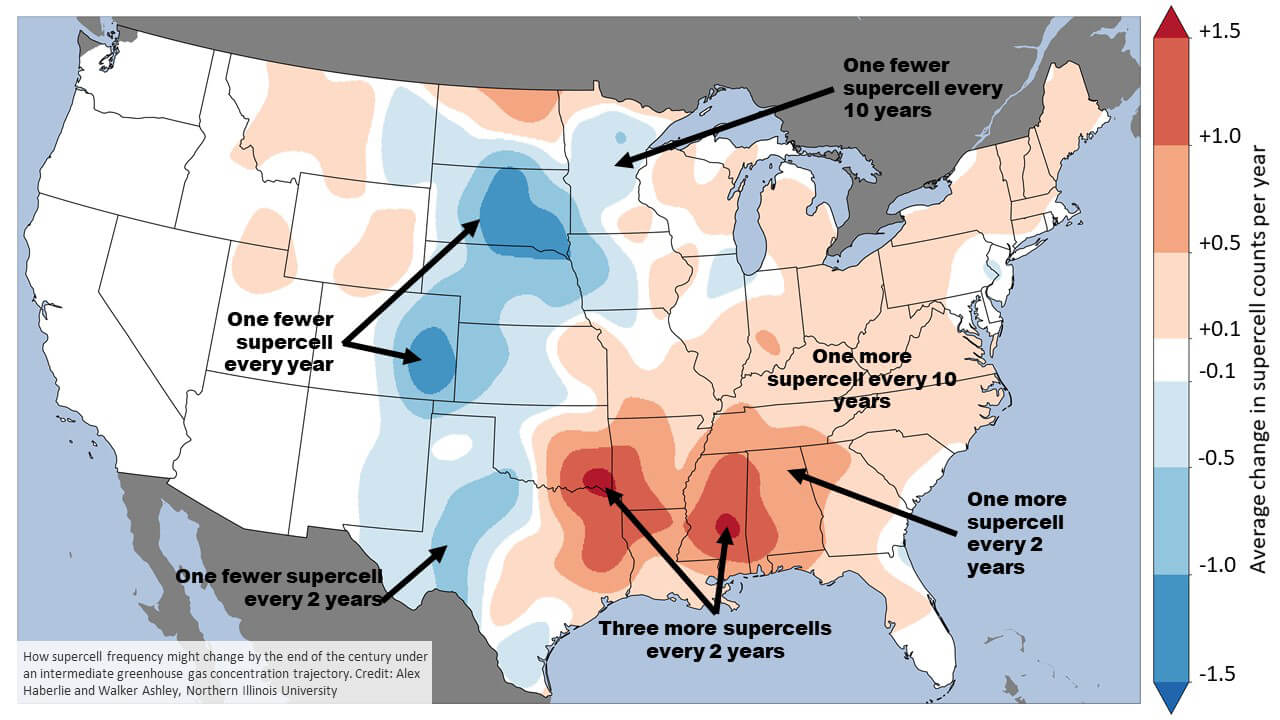 Ashley and his co-authors, NIU Atmospheric Science Professors Victor Gensini and Alex Haberlie, tracked future supercell storms using supercomputer-powered simulations of climate under two greenhouse gas concentration trajectories, one considered “intermediate” and the other “pessimistic.” They compared simulated late-20th-century supercell populations (similar to actual populations) with their late-21st-century counterparts.
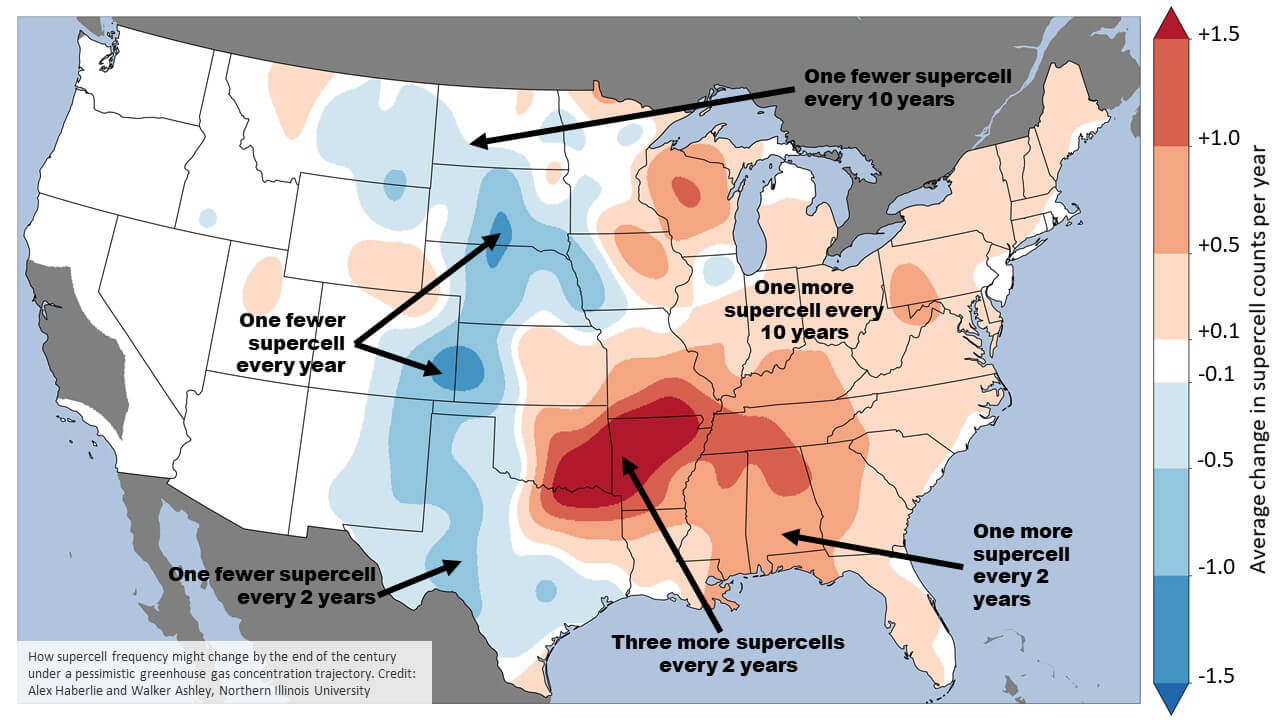 Under both future trajectories, the number of annual supercell storms becomes more frequent and intense, with the mean U.S. supercell activity increasing by 7% (intermediate) to 15% (pessimistic).
“These high-resolution simulations took about 18 months to run and are groundbreaking in terms of their scale and resolution,” Gensini said. “They allow us to extract detailed information and peer inside these specific types of storms in the future.”
Ashley said the rise in supercell storm counts is only part of the story.
“What’s most concerning from an impact standpoint is that the cumulative footprint of the most intense portions of the strongest supercells is projected to increase from 26% (intermediate) to 60% (pessimistic),” he said.
Ashley added that society is becoming more vulnerable to violent weather in part because of the “expanding bull’s eye effect,” or sprawl, which enlarges targets for severe storms.
The study identified a projected eastward shift in heightened supercell activity under both climate scenarios, particularly in the Ozarks and mid-South. North and central regions of the Eastern U.S., where these severe storms are now infrequent, are also projected to experience slight increases.
NIU Professor Walker Ashley.
The simulations, however, show regions of the U.S. roughly west of the Interstate 35 corridor experiencing diminished supercell activity. That region includes much of the U.S. Great Plains, which is traditionally thought of as “tornado alley.”
Under the warming scenarios, the timing of late 21st century supercell storms shift as well.
“Supercells are projected to be more prevalent in the early severe weather season—with more in February, March and April—while trailing off somewhat in frequency in the late season months,” Ashley said.
Historically, May and June have been the peak months for supercell storms.
“The simulations indicate March and April will see marked increases in supercell activity,” Haberlie said. “May and June continue to be active months for supercell activity, but the simulations project that July will not be as active as it has been historically.”
Gensini noted that results of the study’s future projections of supercells are consistent with changes scientists are already seeing in tornado frequency.
Climate simulations for the new study, supported by the National Science Foundation, were conducted at the NCAR-Wyoming Supercomputing Center. The intermediate greenhouse gas concentration trajectory (Representative Concentration Pathway 4.5) used end-of-the century global-climate-warming projections of 2 degrees to 5 degrees Fahrenheit, while the more pessimistic trajectory (RCP 8.5) factored in a warming of 5 degrees to 9 degrees Fahrenheit.
Ashley cautioned that scientists’ understanding of how human-caused climate change will affect severe storms remains in its early stages.
“This study provided an initial set of perspectives on how the climatology of supercells might change, but more research is needed,” he said.
Media Contact: Tom Parisi
About NIU
Northern Illinois University is a student-centered, nationally recognized public research university, with expertise that benefits its region and spans the globe in a wide variety of fields, including the sciences, humanities, arts, business, engineering, education, health and law. Through its main campus in DeKalb, Illinois, and education centers for students and working professionals in Chicago, Naperville, Oregon and Rockford, NIU offers more than 100 areas of study while serving a diverse and international student body.
