
DeKalb, IL – Two Northern Illinois University psychology professors have received an $800,000 grant to evaluate the effectiveness of a social, emotional and behavioral intervention program they have developed for young children.
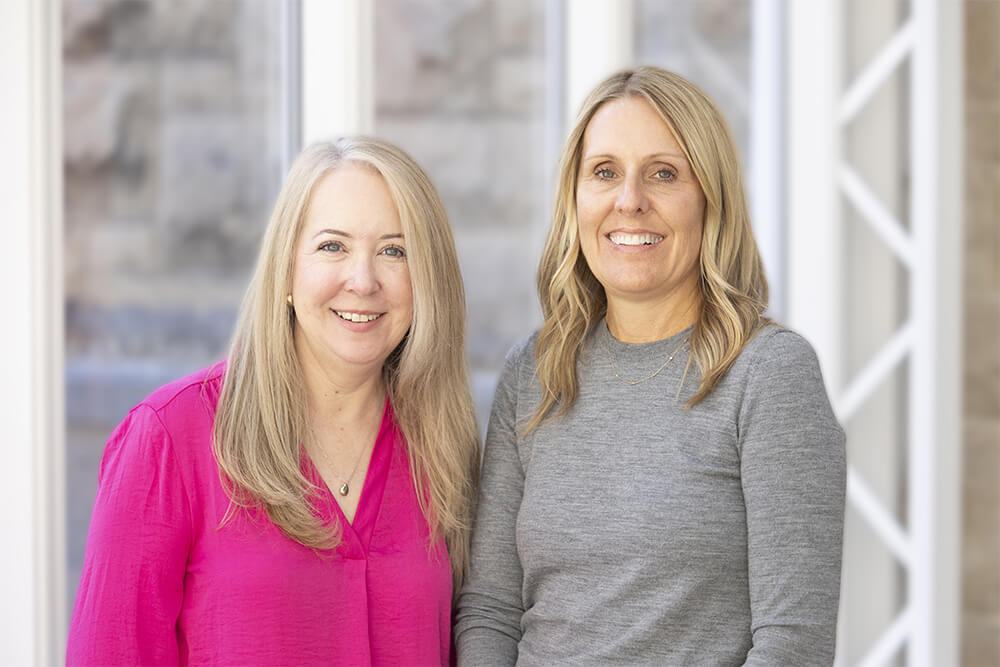
Psychology Professors Christine Malecki and Michelle Demaray
Psychology Professors Michelle Demaray and Christine Malecki are overseeing the rollout of a pilot program for fourth- and fifth-grade students in five DeKalb elementary schools. Malecki and Demaray are faculty in NIU’s School Psychology Program.
The funding covers a two-year period and is provided by the Institute of Education Sciences, an arm of the U.S. Department of Education that seeks to provide scientific evidence on which to ground education practice and policy.
Entitled “A Randomized Pilot Study of Brief Intervention Group Support (BIGS): A Tier 2 Intervention for Students with Social-Emotional and Behavioral (SEB) Concerns,” the study is expected to initiate student participation in January 2024, Malecki said.
The focus of the BIGS intervention is on helping students manage stress, connecting with their peers for social support, and increasing their positive thoughts and behaviors as they develop resilience.
The study is “rigorous and randomized,” Malecki said. It will consist of 50% of students who receive the BIGS Pilot approach to intervention, with an equal number of students in a control group that employs existing approaches to intervention. Students who are identified as having social, emotional and behavioral concerns will be invited to participate, with parental permission required to enroll in the program. Students in the control group will be offered the intervention after the study.
Steve Elliott, who advised Malecki and Demaray when both were in graduate school at the University of Wisconsin-Madison, is the program’s co-developer. He is currently the Mickelson Foundation Professor at Arizona State University’s Sanford School of Social and Family Dynamics. To avoid bias, evaluation of the new pilot program, including data from the two subgroups, will be analyzed by researchers at Penn State University.
Demaray and Malecki will be assisted by two graduate students in the School Psychology Program. They will help with intervention training, collecting data and conducting observations of the intervention to provide feedback to facilitators and to record data about the grant’s implementation.
“Undergraduate and other graduate students in our research labs will likely get exposure to the project and benefit from what we learn, too,” Malecki said.
Among other roles, Demaray will have primary responsibility for project leadership. She and Malecki will provide training on BIGS to the support staff, supervise the NIU graduate students, conduct observations of BIGS implementation, and aid the district as needed.
The program has already been deployed in a small number of school districts, including in Illinois, Ohio and Arizona. The principles undergirding it flowed out of exploring how a small group receiving social emotional skill building could be supportive of one another through that experience and “together learn healthy skills and behaviors as part of a healthy and well-functioning group,” Malecki said.
With the COVID-19 pandemic causing a move to remote learning, children experienced increased disconnection from one another and are struggling to reconnect now that they are back together, noted Demaray.
“Social support is so important in so many areas of children’s lives,” Demaray added. “The more support kids feel they have in their lives from peers and important adults, the better they do academically, the more friendships they develop, and the lower their rate of depression.”
A key element of the program is for children to reflect on their stress levels, learn ways to manage that stress and develop skills in expressing support for one another in the early stages of their meetings. The professors also emphasize that not all stress is “bad,” and BIGS group leaders will offer insight to children on ways to adjust their mindset and behaviors to turn harmful levels of stress into “healthy stress.”
“We know that when learning any skill, you have to practice it,” Malecki said. “So the instructional phases we go through in the lessons are designed around good science and what we know about good instruction.”
The NIU professors lauded DeKalb School District 428 for its participation, particularly Lisa Becker, assistant director of Student Services; Sara Oakland-Bates, social emotional learning coordinator; and Kyle Gerdes, director of Student Services.
“They’re just amazing partners,” Malecki said. “If they didn’t think this could benefit the students of DeKalb, they wouldn’t do it. They are doing all they can to serve the students of District 428.”
One of the program’s potential strengths is its ability to serve a large group of children at the same time, Malecki said. “It’s broad and can help a lot of kids with a wide range of issues. It’s geared toward helping kids build helpful foundational strategies.
“We are even using the skills and the routines that are taught as part of this intervention ourselves, for our own positive mental health,” Malecki added. “We’re excited about its potential because it is very relevant. We think most youth can benefit from this.”
About NIU
Northern Illinois University is a student-centered, nationally recognized public research university, with expertise that benefits its region and spans the globe in a wide variety of fields, including the sciences, humanities, arts, business, engineering, education, health and law. Through its main campus in DeKalb, Illinois, and education centers for students and working professionals in Chicago, Naperville, Oregon and Rockford, NIU offers more than 100 areas of study while serving a diverse and international student body.
