
DEKALB, IL — Northern Illinois University Physics Professor Roland Winkler has a new research publication that he hopes will make a lasting impact on the physics community.
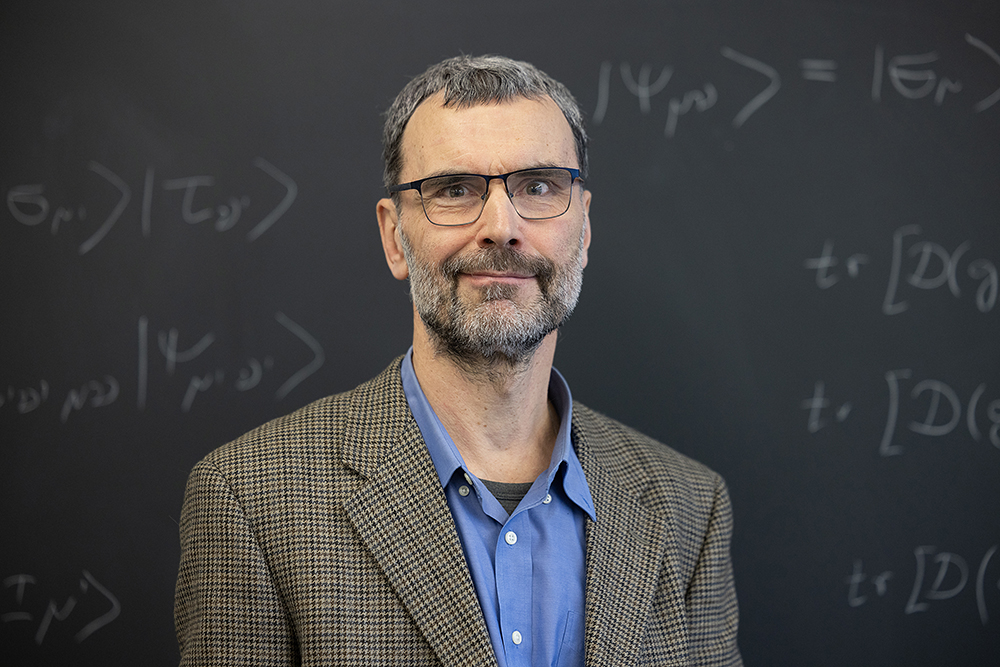
NIU Physics Professor Roland Winkler.
Winkler and colleague Uli Zülicke, a professor in the School of Chemical and Physical Sciences at Victoria University of Wellington in New Zealand, propose a new physics model that organizes and interprets the many new phenomena in quantum materials discovered in recent research worldwide. They believe the framework will provide a foundation for discovering and engineering multifunctional materials with targeted properties.
The work, titled the “Standard Model of Electromagnetism and Chirality in Crystals,” is published in the prestigious physics journal Physical Review X.
“You may have heard of the standard model of particle physics that describes our world on the smallest subatomic scales. There is also the standard model of astrophysics—the Big Bang theory—that describes our world on the largest scales of the universe,” Winkler said.
“Our new work fits half-way in between; it describes the world we live in on the intermediate scale when atoms form crystals and materials with vastly different properties,” he said.
In the past, Winkler and Zülicke have produced theoretical work on some of the hottest topics of condensed matter physics. This branch of physics studies the properties and behaviors of matter at the tiny atomic and molecular levels as they form crystals. In scientific context, crystals are not shiny glass-like objects but rather solid materials whose atoms, molecules and ions form highly ordered structures.
Condensed matter physics has been instrumental in technological discovery and development. For example, the field has helped scientists to design materials like silicon and germanium, leading to the electronics revolution; to refine fluids that enable displays in TVs and smart phones; and to make superconducting materials used in MRI machines and levitating trains.
Winkler said that classifying crystalline solids based on their emergent visible characteristics has remained a central challenge because conventional approaches often overlook subtle symmetries that dictate complex electric, magnetic and chiral properties.
“We addressed this by developing a comprehensive classification that uses symmetry principles to sort crystal structures into five categories of electric and magnetic order and five categories of chirality.”
Chirality means “handedness.” Your hands, for example, are mirror images of each other, but you can’t line them up on top of each other. (That’s why the left glove won’t fit the right hand.) Common in nature, chirality affects how molecules interact and function. One chiral form of a drug, for example, might help you, while the other might be harmful.
Mirrors can be used to test chirality. While we might call ordinary mirrors “space mirrors,” as they affect the spatial arrangement of objects, Winkler and Zülicke showed that chirality also exists in the dimension of time.
“Time mirrors” map all objects on their backwards-moving counterparts. Although this is inconsequential for objects at rest, it is important for magnetic systems whose magnetic properties can be ascribed to microscopic electric currents that flow backwards in a time mirror. If both the space- and time-mirror images differ from the original object, there are four distinct versions of the object, known as enantiomorphs.
“These findings are critical for a large community working on fundamental and applied aspects of novel quantum materials,” Winkler said.
The complete framework developed by Winkler and Zülicke identifies 12 unique types of crystal classes, each possessing distinct physical properties, and accounts for previously overlooked configurations.
“This work represents a paradigm shift in our basic understanding of how crystal order shapes the physical properties of crystalline materials,” Winkler said. “It provides a complete taxonomy for predicting the physical characteristics of complex materials from their structural symmetries and so establishes a foundation for discovery and creation of new materials.”
Media Contact: Tom Parisi
About NIU
Northern Illinois University is a student-centered, nationally recognized public research university, with expertise that benefits its region and spans the globe in a wide variety of fields, including the sciences, humanities, arts, business, engineering, education, health and law. The university is recognized as a leading institution for social mobility, or helping its students climb the socioeconomic ladder. Through its main campus in DeKalb, Illinois, and education centers for students and working professionals in Chicago, Naperville and Rockford, NIU offers more than 100 areas of study while serving a diverse and international student body.
