
In the face of escalating political tension and increasing polarization, NIU political science professor Scot Schraufnagel has released a timely and innovative exploration of legislative conflict.
Schraufnagel’s fifth and latest book, “Conflict in Congress: A Call for Moderation,” proposes a new way to think about the clashes that dominate the political landscape. In doing so, he advocates for a more nuanced understanding of the legislative process as a path forward.
“We just have sort of a powder keg of unrest,” he said of today’s political landscape.
’We’re in this era of hyper-conflict. I think it could be destabilizing. We could lose hold of democracy. There’s a fraction of a chance that could happen. It’s tough to come back from that once you’ve crossed over.”
Drawing from recent historical events, including the George Floyd protests in 2020 and the Jan. 6, 2021, Capitol attack, Schraufnagel sets the stage for a compelling discussion on the nature of conflict in modern American politics.
Schraufnagel does not intend to make the case that things are “worse than ever.” He points to the 19th and 20th centuries, when the Civil War and the World Wars serve as stark reminders of chaos throughout U.S. history.
“Yet, the only era we can do anything about is the future,” he writes.
In today’s state of political affairs, he said, citizens on the hard left and hard right are both unsatisfied. Neither seems to feel they have an effective voice in the governing process.

NIU Political Science Professor Scot Schraufnagel
“Individuals from both groups, in recent years, have resorted to violence as a means of political communication,” Schraufnagel writes. “Moreover, the public’s approval of Congress, in the contemporary era, is typically abysmal.
“Threats of government shutdowns as a result of legislative stalemate are commonplace. These risks frustrate economic markets both at home and around the world. Pressing issues such as climate change, healthcare cost, immigration reform and gun violence routinely go unaddressed by the national legislature in the United States.”
Offering a fresh lens through which to view the political discord, Schraufnagel introduces Legislative Conflict Theory. The theory suggests that conflict in legislatures is two-dimensional and that a moderate level of conflict is most productive. It’s what keeps democracy vibrant and functional.
“There’s more to conflict than just partisan differences,” Schraufnagel said. “Partisan difference in and of itself should be a good thing. It can be a good thing. We should be encouraging it, but we need people who can get along.”
Schraufnagel defines the two types of conflicts as policy differences and relational conflict. Relational conflict involves individuals being unable to get along with one another on a personnel level.
Using the U.S. Congress as a testing ground, and novel indicators of both forms of conflict and legislative productivity, the book tests the theory various ways. The analyses arrive at the conclusion that specific Congresses and historical eras, easily identified as more productive, experienced a median level of two-dimensional conflict.
In the end, the research makes the case for recruiting the right type of people to serve.
“Legislators should express, and even argue passionately, alternative points of view in legislative settings. This is a fundamental aspect of effective discourse in a democracy,” Schraufnagel writes.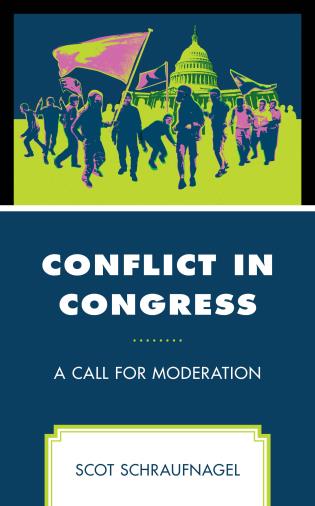
“Name-calling, on the other hand, does not seem as important. Indeed, incivilities may poison the legislative environment in a manner that makes it more difficult to move legislation forward or otherwise get things done.”
Schraufnagel also tackles the measurement of legislative productivity and finds recent Congresses, which experience hyper-conflict, unable to address the pressing issues of our times. The most effective legislators will be context dependent, Schraufnagel argues. In low conflict scenarios, rabble-rousers become the most effective legislators. When two-dimensional conflict is too high, as it is today, the need is for disciplined-mannerly legislators committed to compromise, he said.
Schraufnagel hints at solutions in the final chapter of his book, setting the stage for his next work, which will delve deeper into campaign financing, gerrymandering and the structural changes needed to foster a more effective and less polarized legislature.
“A more perfect union largely defines my base motivation,” Schraufnagel writes. “This book is a call to understand and appreciate the essential character of sociopolitical conflict. If we can develop a better grasp of its nature, especially in our legislative bodies, we might then begin to formulate comprehensive solutions to the violence and unrest that have become all too common.”
Media Contact: Jami Kunzer
About NIU
Northern Illinois University is a student-centered, nationally recognized public research university, with expertise that benefits its region and spans the globe in a wide variety of fields, including the sciences, humanities, arts, business, engineering, education, health and law. Through its main campus in DeKalb, Illinois, and education centers for students and working professionals in Chicago, Naperville, Oregon and Rockford, NIU offers more than 100 areas of study while serving a diverse and international student body.
