
DEKALB, Ill. – NIU leaders, faculty, students and community partners gathered Thursday to celebrate the groundbreaking of the $21.5 million Northern Illinois Center for Community Sustainability (NICCS), a transformative new facility that will serve as a regional hub for sustainability research, innovation and public engagement.
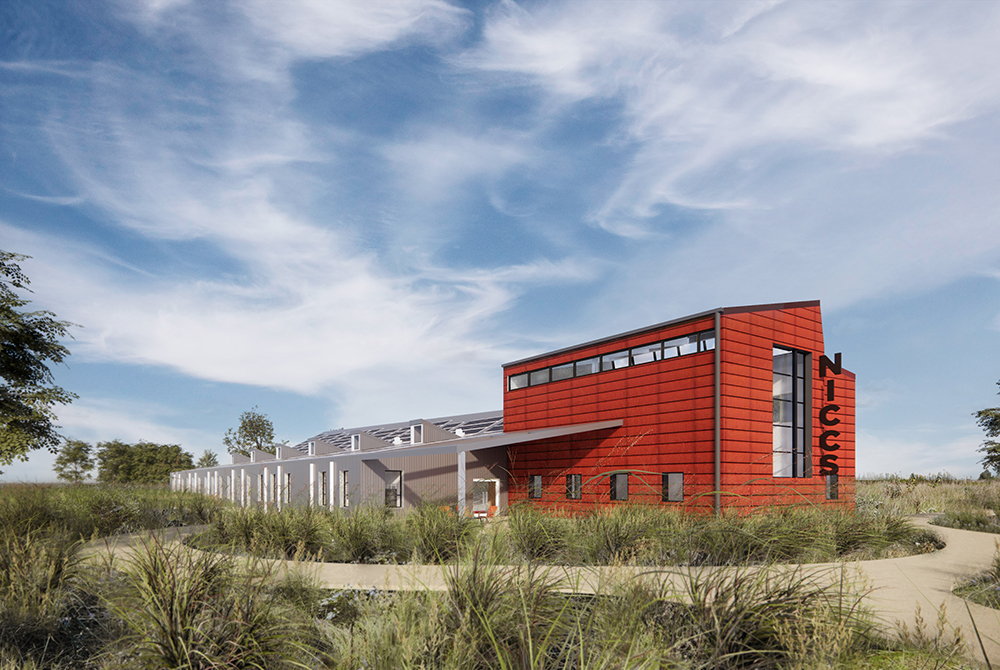
Rendering by Farr Associates
Part of the statewide Illinois Innovation Network, NICCS brings together researchers, students, industry partners and community stakeholders to address some of the most pressing sustainability challenges facing northern Illinois and beyond, including energy, water quality, food systems and environmental adaptation.
“This new innovation hub will build partnerships across the region and chart the path to future discoveries,” Gov. JB Pritzker said in a video message shown at the event. “As construction ramps up, we celebrate more than the start of a new building; we mark the beginning of an exciting new chapter for NIU, one grounded in curiosity, collaboration and service.”
The 16,000-square-foot facility being built on the west side of NIU’s campus is expected to become one of the most technologically advanced, sustainability-focused research and teaching centers in Illinois.
“We gather to break ground on the Northern Illinois Center for Community Sustainability, but what we’re really celebrating is something much larger: a shared commitment to building a stronger, healthier and more resilient future for our communities, our region and our world,” NIU President Lisa Freeman said. “We’re grateful to the State of Illinois and to our generous donors who recognize NICCS as an investment in the future.”
Designed for collaboration
The center will create opportunities for students to engage in hands-on research, provide faculty scientists with cutting-edge research tools, strengthen partnerships with communities and businesses, and develop solutions to sustainability challenges that affect people’s daily lives.
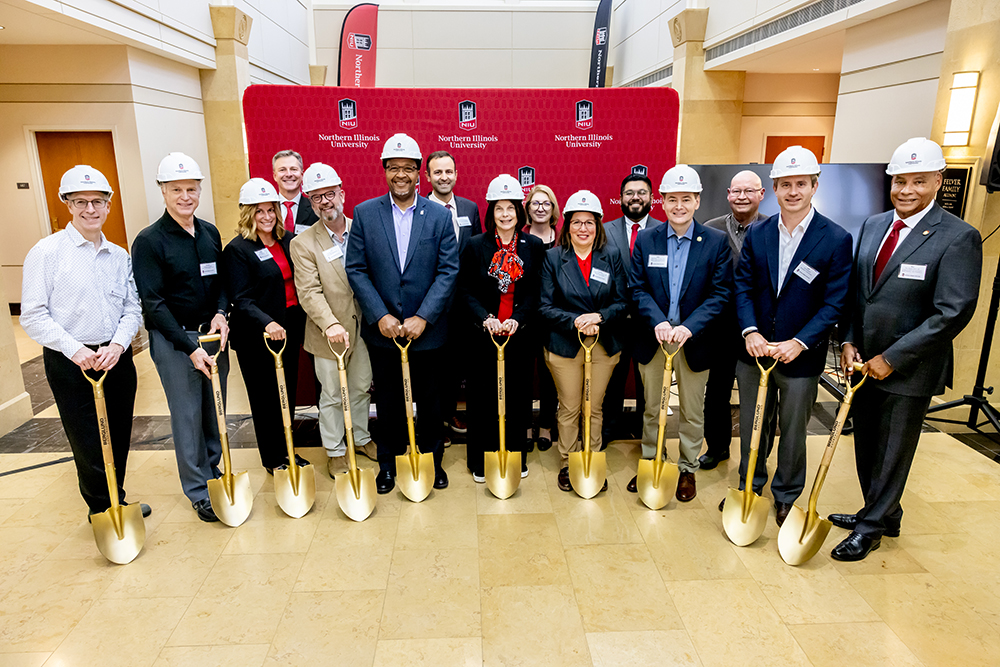
The groundbreaking ceremony for the new NICCS building was held Oct. 15. The building is expected to open in January 2028.
At the heart of the facility will be a bright, welcoming atrium designed as a gathering and learning place for students, researchers and community members. The flexible commons area will serve as both the building’s grand gallery and community living room. It will host workshops and meetings while also showcasing sustainability research, environmental data and community projects through interactive displays.
“Designed to encourage collaboration across disciplines, the NICCS building will feature flexible learning spaces, specialized laboratories and innovative technologies seldom found together under one roof,” said Richard Mocarski, NIU vice president for Research and Innovation Partnerships. “The building itself will be a model of sustainability.”
The center’s interior spaces will leverage natural lighting, and the building will initially generate 20% of its power from solar—with the capability to add more later. Walls in the facility will be highly insulated and designed to reduce energy use. Exterior landscaping will include native plants as well as a rain garden to reduce stormwater runoff.
Advanced facilities for innovation and discovery
NICCS will include a nearly 2,000-square-foot, high-ceiling research space for the design, construction and testing of large-scale engineering and sustainability projects. With 20 feet of vertical clearance, a loading dock and equipment for moving heavy materials, the facility will provide capabilities available in only a handful of locations on campus.
A hallmark of the building will be its Building Energy Systems Lab, where faculty, students and industry partners can use portions of the facility as a living laboratory. Through an advanced network of sensors, controls and interchangeable system components, researchers will test technologies to improve energy efficiency, building performance and sustainability. Few institutions nationwide have facilities that compare in scope and capability.
Strengthening food and environmental research
The center also will strengthen NIU’s role in food innovation through a flexible Food Systems Lab equipped with all-electric appliances and integrated audiovisual technology. The lab will support food product development and nutrition research while demonstrating sustainable approaches to food preparation and consumption.
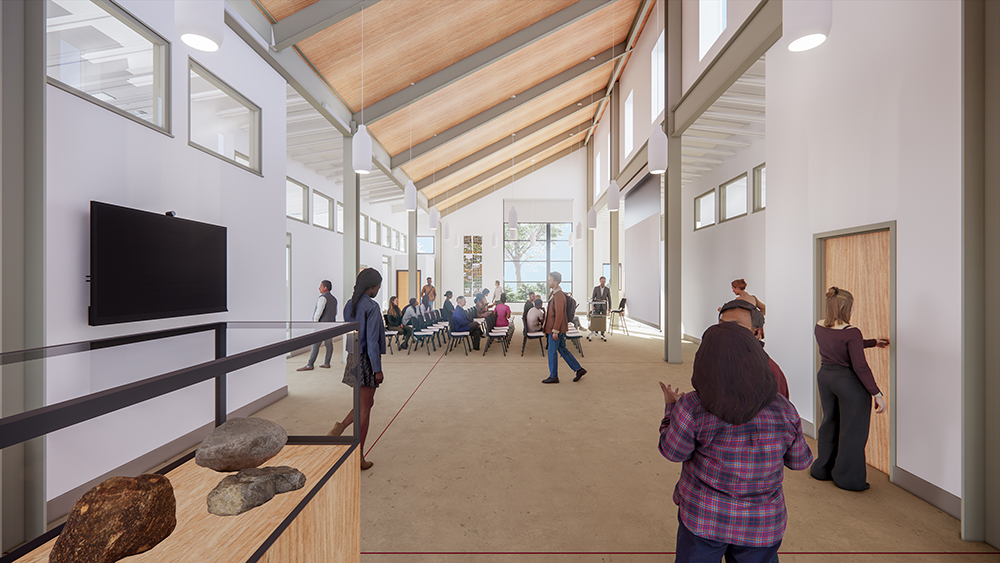
Rendering by Farr Associates
Specialized environmental research labs will provide opportunities to investigate issues affecting Illinois ecosystems and communities. The Earth Materials Lab will support analysis of soil, plant and water samples, while a nearby Water Lab will allow researchers to study nutrient levels, water quality and ecosystem health.
NICCS is also poised to become a regional leader in environmental science through its Microplastics Lab. Researchers will use sophisticated equipment to identify and characterize tiny plastic particles in the environment to help better understand their sources and impacts. The facility will give students hands-on experience with cutting-edge technologies in a rapidly growing field.
Supporting these efforts will be an Instrumentation Lab housing advanced analytical equipment capable of identifying and measuring chemicals and other materials in environmental samples.
Visualizing complex challenges
Among the building’s most striking features will be its Visualization Lab, anchored by a high-resolution, curved display wall connected to NIU’s Metis high-performance computing cluster. The immersive space will allow audiences to explore science in new ways, as well as showcase visual art exhibitions and student art projects.
The building will also include two flexible classrooms designed for transdisciplinary teaching. Equipped with advanced audiovisual technology, modular furnishings and movable partitions, the classrooms will make it easier for students and faculty from different academic areas to work together on sustainability challenges.
Investing in the region’s future
The State of Illinois is providing $19.1 million in funding for construction. The remainder of funding is coming from in-kind NIU contributions and donor gifts, including from Northwestern Medicine for creation of the food laboratory and from Ray Banks, M.S. ’86 and Eric Erickson. An outdoor classroom at NICCS will be named in honor of two of Banks’ NIU mentors—the late Clarence “Clancy” Casella and the late Malcolm “Mac” Weiss, both of whom were members of the geology faculty.
Donor support for NICCS is directed through Forward: The Campaign for NIU, helping advance the university’s vision for innovation, experiential learning and community engagement. As one of the campaign’s marquee projects, the center reflects the transformational opportunities made possible through philanthropic investment.
“The new building will provide unique spaces,” NICCS Director Matt Deitch said, “where ideas can be explored, partnerships can flourish and students can gain hands-on experiences that will help shape their careers and our region’s future.”
Construction of the building will continue through the fall of 2027. The center is expected to open in January of 2028.
Media Contact: Tom Parisi
About NIU
Northern Illinois University is a student-centered, nationally recognized public research university, with expertise that benefits its region and spans the globe in a wide variety of fields, including the sciences, humanities, arts, business, engineering, education, health and law. The university is recognized as a leading institution for social mobility, or helping its students climb the socioeconomic ladder. Through its main campus in DeKalb, Illinois, and education centers for students and working professionals in Chicago, Naperville and Rockford, NIU offers more than 100 areas of study while serving a diverse and international student body.
