
DEKALB, IL — As a doctoral student at NIU, Regina Mae Francia asked herself what mattered most to her.
The answer resulted in not only a Ph.D. degree in restoration ecology, but also research published in one of the top journals in her field.
Francia is the lead author of a study recently published in Restoration Ecology that argues ecological restoration can help address environmental inequities, but only if restoration projects are intentionally directed toward underserved communities. The paper grew from the first chapter of her doctoral dissertation.
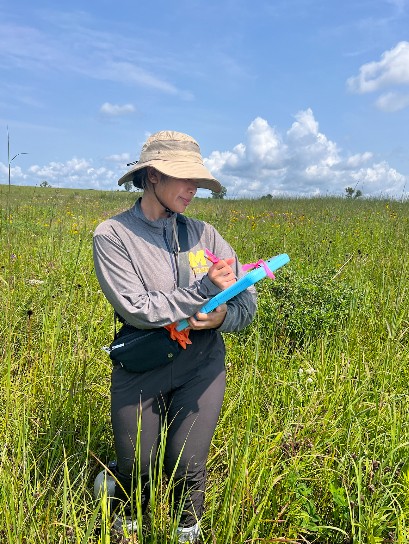
Working with NIU Professor Holly Jones, recent doctoral graduate Regina Mae Francia is the lead author of a study published in Restoration Ecology, among the top journals in her field.
It reflects a mission that guided Francia throughout her academic journey.
“Social justice has always been really important to me,” said Francia, a first-generation college student and daughter of immigrants. “That’s my passion. That’s what feeds my resilience in my work.”
Francia’s path to NIU began in California. After earning a bachelor’s degree in environmental science from UCLA and a master’s degree with a focus on plant ecology from California State University, Los Angeles, she came across a graduate opportunity at NIU in the Evidence-based Restoration Lab of Professor Holly Jones.
Jones, a presidential research, scholarship and artistry professor joint appointed to NIU’s Department of Biological Sciences and Institute for the Study of the Environment, Sustainability and Energy, stood out. A fellow first-generation student, Jones drew Francia to NIU.
“She’s big science-wise, but also really balances mental health and cares about her students,” Francia said.
From the beginning, Jones said, Francia’s passion for equity was evident.
“I’m really proud of the hard work Reg put in to get this work out in the world because it hits really close to who Reg is,” Jones said. “She’s always been passionate about lifting up the voices of marginalized communities, and found a way to work that into the science she did while she was at NIU. I know that passion will help her go far in her life after graduate school.”
A Filipino American in the field of science, Francia described her research as a fusion of her identity, what she cares about and what she wants to do as a career.
“This feels like my baby,” she said. “I worked really hard, and I feel like my heart is just written all over this study.”
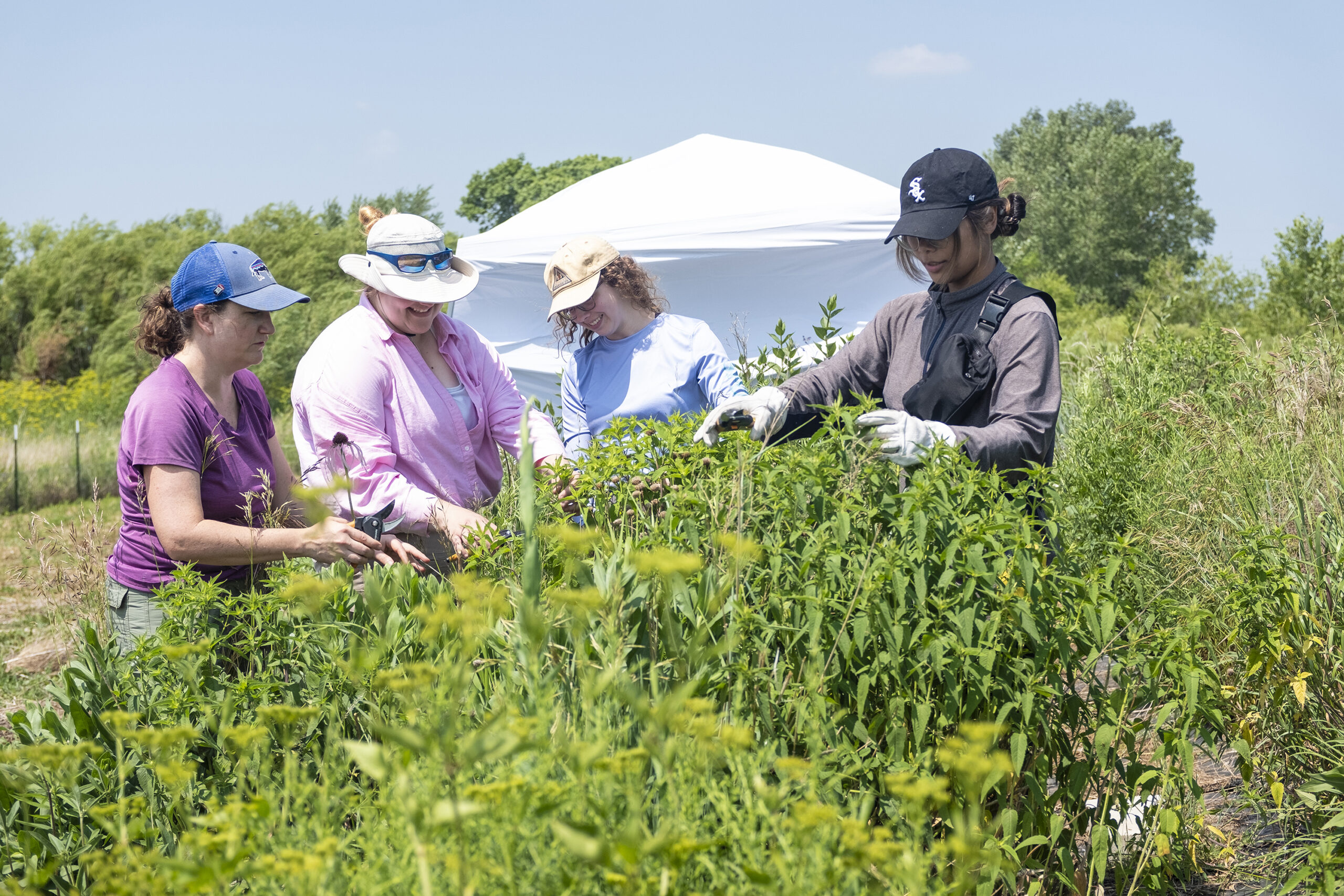
A fellow first-generation student, Professor Holly Jones drew Francia to NIU to work in Jones’ Evidence-based Restoration Lab.
The study examined 84 restoration sites across the United States and found that ecological restoration provides similar ecological benefits regardless of a community’s income, educational level or racial makeup. However, restoration projects are far less common in low-income and black, indigenous and people of color (BIPOC) communities.
Only 17 percent of restoration sites were located in communities more diverse than the national average, and just 8 percent were in low-income areas, according to the study.
For Francia, who graduated in May, the findings are about more than ecology.
“Restoration can do so much,” she said. “It can restore ecosystems and environmental amenities, but it can also restore services and opportunities for communities that have historically been left out. That’s what’s often missing in marginalized communities.”
She hopes the study will encourage scientists and policymakers to think more carefully about where restoration work happens and who benefits from it.
“When we talk about science, we sometimes focus on the technical side and forget the people around it,” Francia said. “Community resilience in the face of climate change will depend on where resources are allocated. Every decision has an impact.”
Media Contact: Jami Kunzer
About NIU
Northern Illinois University is a student-centered, nationally recognized public research university, with expertise that benefits its region and spans the globe in a wide variety of fields, including the sciences, humanities, arts, business, engineering, education, health and law. The Wall Street Journal and CollegeNET recognize NIU as a leading institution for social mobility, or helping its students climb the socioeconomic ladder. Through its main campus in DeKalb, Illinois, and education centers for students and working professionals in Chicago, Naperville and Rockford, NIU offers more than 100 areas of study while serving a diverse and international student body.
