
DEKALB, IL — Kamal Ehrlich is crossing disciplines to uncover how cattle fodder with colonial roots continues to resist rigorous restoration efforts at Nachusa Grasslands.
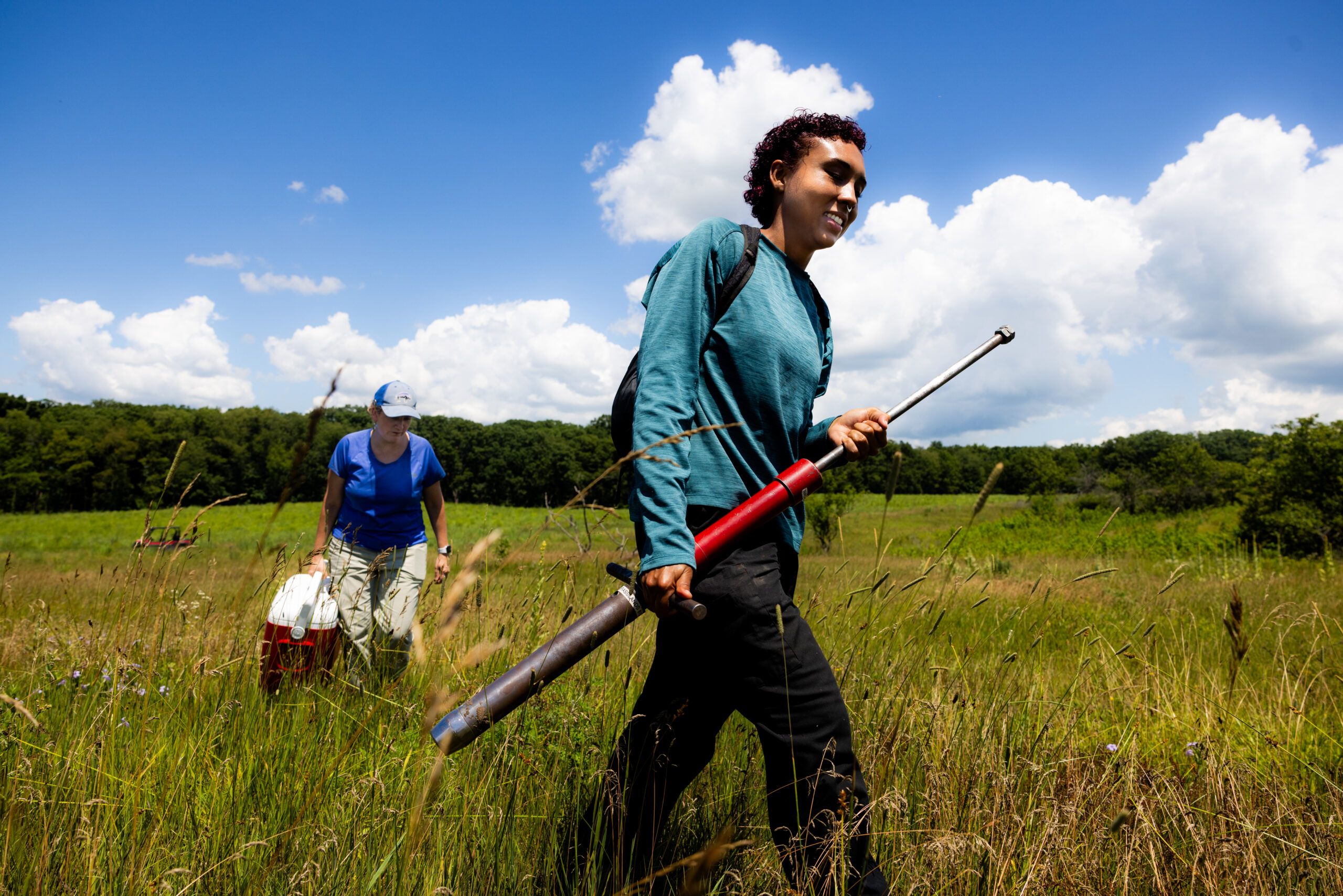
Kamal Ehrlich (right), a biological sciences graduate student at Northern Illinois University, collects soil samples at Nachusa Grasslands with Professor Holly Jones (left).
By next fall when they graduate, the second-year master’s student will have taken hundreds of soil samples at Nachusa in search of answers for managing birdsfoot trefoil, one of the Franklin Grove preserve’s most persistent invasive species. Midwesterners might know this adaptable agricultural plant with yellow flowers by its folksier moniker, “bacon and eggs.”
Ehrlich’s thesis proposal for biological sciences at Northern Illinois University was included in this year’s first round of funding offered to 1,500 college students across the U.S. through the National Science Foundation’s Graduate Research Fellowship Program. A fellow for five years, he can receive tuition and research support and a living stipend for up to three years.
“Being from Florida, invasive species are very present in my mind, and I think they were already the focus of my studies because of how rife for invasives the climate of Florida is,” Ehrlich said. “When I applied for the fellowship, my department knew they wanted someone to study birdsfoot trefoil specifically because it’s such a problem.”
An ‘interdisciplinary lens’ on ‘ecological memory’
Ehrlich holds a B.S. in environmental science and a B.A. in sustainability studies with a minor in English from the University of Florida. With their fieldwork at Nachusa underway, Ehrlich joins the ranks of a select few scholars from Professor Holly Jones’ Evidence-based Restoration Lab to receive the NSF’s notoriously competitive grants for graduate students.

Kamal Ehrlich, who uses they/he pronouns, stands near Nachusa’s bison herd.
Jones, who is dually appointed in biological sciences and environmental studies at NIU, overhauled an orientation course so all incoming Huskies write a fellowship application.
“Students get to start thinking about their research or teaching early, articulate goals and hypotheses and kick-start their project — all in the first couple months of a degree,” Jones said. “Kamal brings a unique interdisciplinary lens to this scholarship, which deepens our understanding and ensures that while I remain their mentor, they are teaching me as well.”
Within weeks of receiving the fellowship, Ehrlich incorporated some of their original paintings into a presentation on their research plans at the Nachusa Grasslands Science Symposium in Franklin Grove. Participants were invited to leave their own mark on a black-and-white drawing of the prairie landscape with ink stamps Ehrlich also created from his artwork — bison, plants, hay bales and a cow.
“People could stamp whatever they wanted onto the paper. My goal was to show when you use the land, it holds onto something called an ecological memory,” Ehrlich said. “It was interactive to demonstrate the imprint we’re leaving, and how once you put it there, you can’t remove it.”
Birdsfoot trefoil — farmland staple, prairie pest
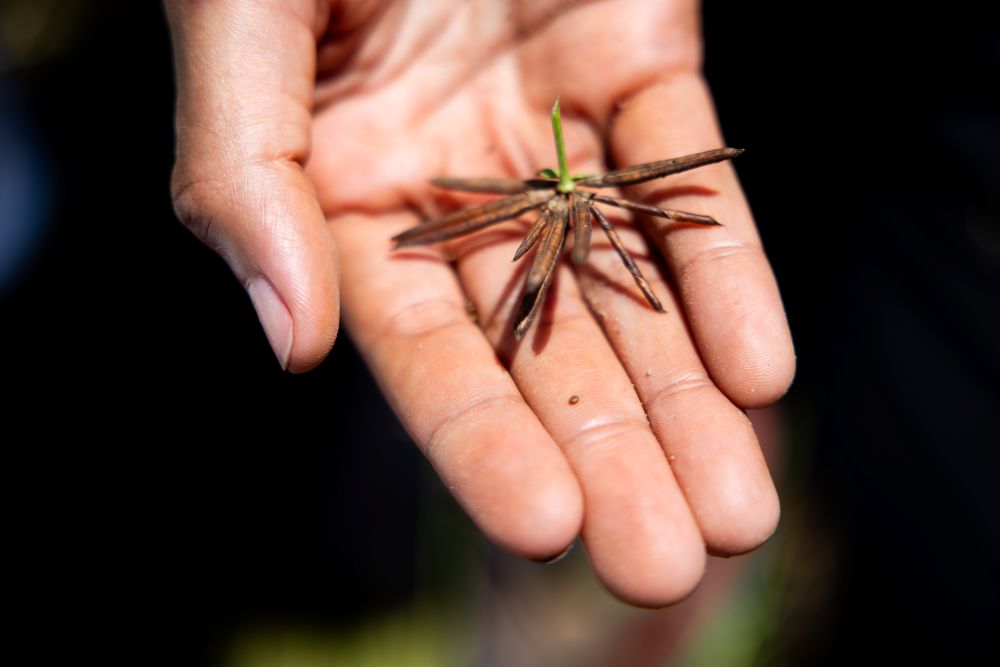
Birdsfoot trefoil’s distinct seed pods inspired its name.
Brought to the U.S. by European settlers hundreds of years ago for grazing cattle, birdsfoot trefoil is still a popular pasture crop for ranchers because the legume packs a hefty serving of protein without causing cows to bloat. Lotus corniculatus, as it’s known scientifically, is hardy across climates and aggressive wherever it takes hold — spreading like a mat over mowed grass on lawns or stretching higher to wrap and entrap native plants in a prairie.
The only bovine residents on the former farmland Nachusa occupies today are about a hundred bison, introduced just over a decade ago to help restore a 1,500-acre parcel of tallgrass prairie on The Nature Conservancy’s nearly 4,000-acre preserve.
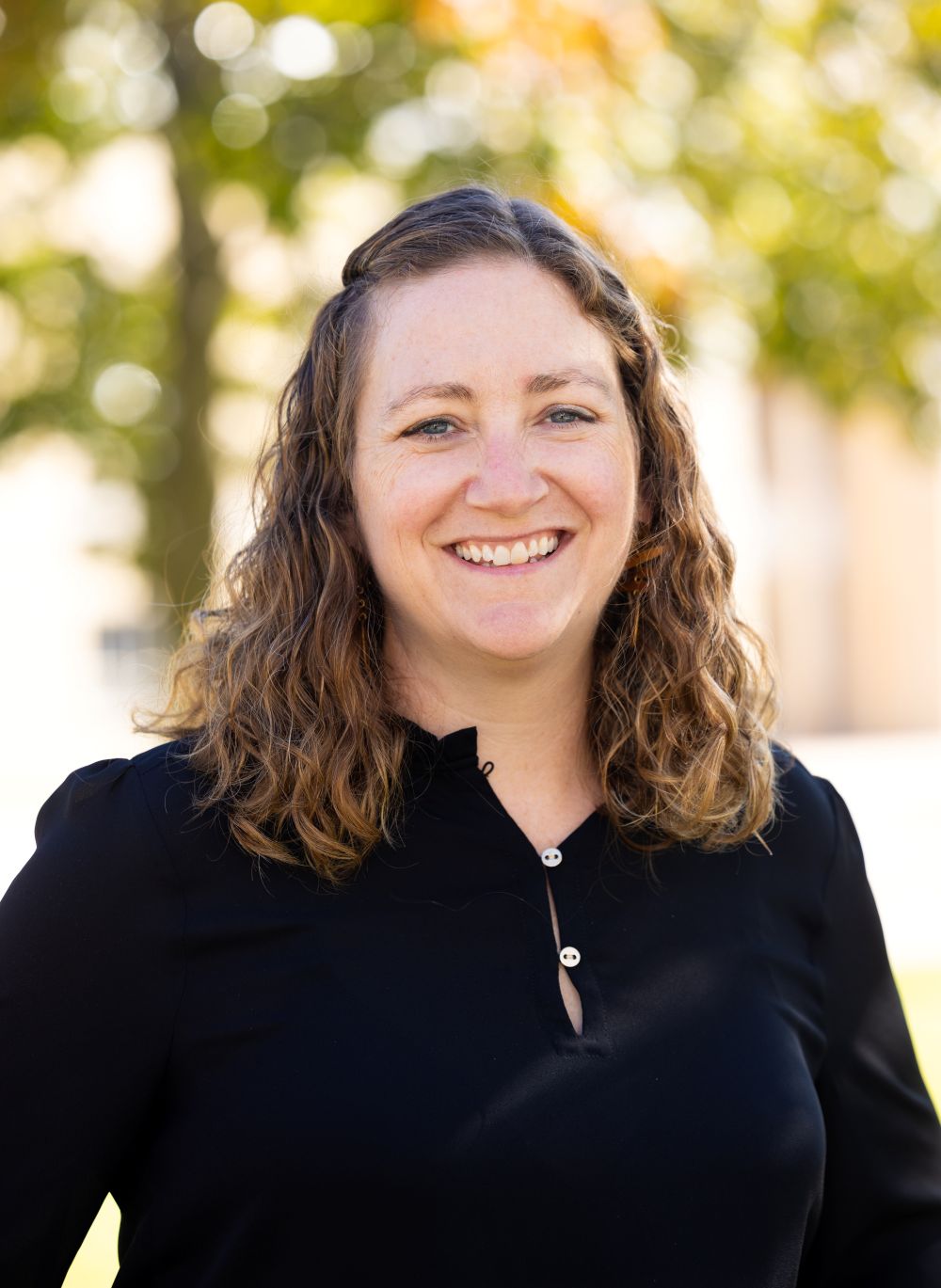
Biological Sciences and Environmental Studies Professor Holly Jones.
“Birdsfoot trefoil is a savvy invader and a major concern for folks trying to restore prairie ecosystems,” Jones said. “Nachusa Grasslands has been trying to control birdsfoot trefoil for decades now, and there’s so little research about its invasiveness. Kamal’s project will add to our knowledge of the species, with practical application for how to control it.”
Like many legumes, birdsfoot trefoil is a nitrogen fixer capable of changing an ecosystem to its advantage — with multifaceted environmental repercussions. Ehrlich chose to analyze a hidden aspect of the invasion below ground, with a project to sample Nachusa Grasslands’ soil and determine how pervasive this common crop’s foothold is in the prairie’s seed bank.
Quantifying the invasive species’ presence in an altered environment and the compounded costs of managing its spread will illustrate a broader disconnect between economic and ecological interests. In practical applications, Ehrlich hopes to offer conservationists more refined mapping and removal strategies for this widespread nuisance on natural lands.
‘Connecting people to their local environment’
“Kamal brings such passion and enthusiasm about blending their love of science, art and history,” Jones said. “They could have stopped with a greenhouse study, but they have so much creativity and curiosity that we sought a way to fully incorporate those passions, rather than letting them live as side projects for Kamal.”

“Connecting people to their local environment and making it accessible is my dream,” Kamal Ehrlich says.
Beyond incorporating his creative work into the project, Ehrlich is offering a full narrative of what he describes as the prairie’s biological legacy. Tracing the history of human impact on the land is part of their research — from such indigenous practices as controlled burns to the colonial farming practices that introduced invasive plants like birdsfoot trefoil as crops.
While the research could easily lead him toward a Ph.D., Ehrlich is just as focused on how to share their work with others in the more immediate future.
“My ideal job would be public-facing, planning restoration projects and parks while also incorporating community events around them,” Ehrlich said. “The university town where I used to live, Gainseville, Fla., has an annual one-day event called the Great Invader Raider Rally — which has had incredible results reducing invasive plant species. Connecting people to their local environment and making it accessible is my dream.”
Media Contact: Jeniece Smith
About NIU
Northern Illinois University is a student-centered, nationally recognized public research university, with expertise that benefits its region and spans the globe in a wide variety of fields, including the sciences, humanities, arts, business, engineering, education, health and law. The Wall Street Journal and CollegeNET recognize NIU as a leading institution for social mobility, or helping its students climb the socioeconomic ladder. Through its main campus in DeKalb, Illinois, and education centers for students and working professionals in Chicago, Naperville and Rockford, NIU offers more than 100 areas of study while serving a diverse and international student body.
