
DEKALB, IL — Logan Bundy knows the exact day he decided to pursue his interest in meteorology. It was his 12th birthday: Saturday, June 5, 2010.
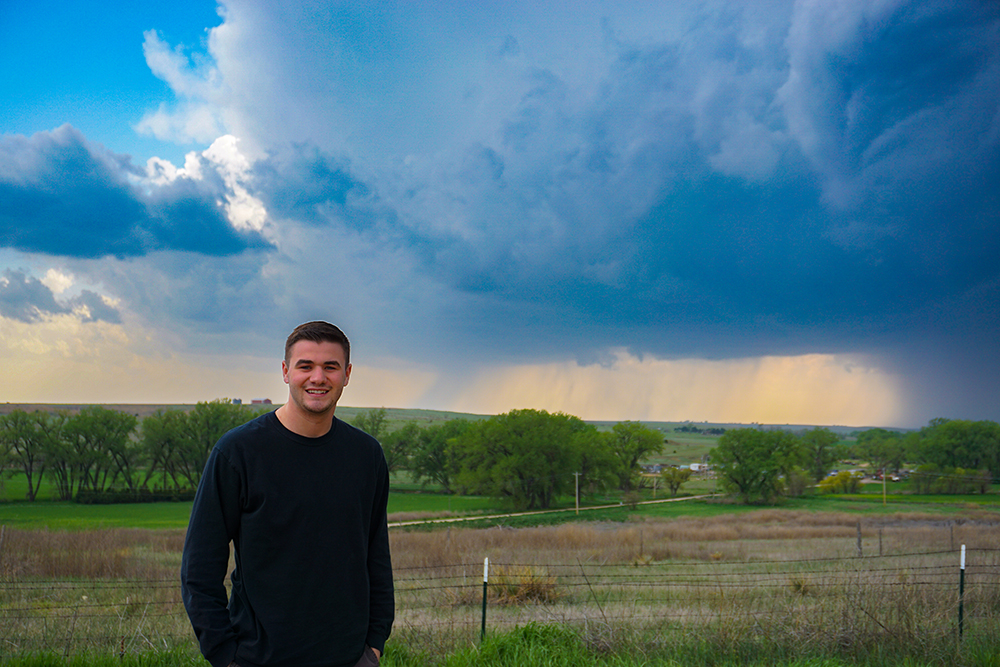
Logan Bundy
That’s when a tornado struck his hometown of Streator, Illinois, destroying homes and injuring more than a dozen people.
“Learning about the casualties and witnessing the storm’s impact firsthand sparked a deep curiosity in me,” Logan said. “I wanted to understand how nature could produce such powerful forces.”
Now a 26-year-old Ph.D. student at Northern Illinois University, Logan will be part of a large team of researchers who will conduct a six-week field study of severe weather beginning in mid-May. The researchers won’t be searching for tornadoes, however, but rather hail, which can wreak havoc on roofs, vehicles, businesses, aircraft, crops and solar panels—and even injure livestock, pets and people.
First big hail campaign in 40 years
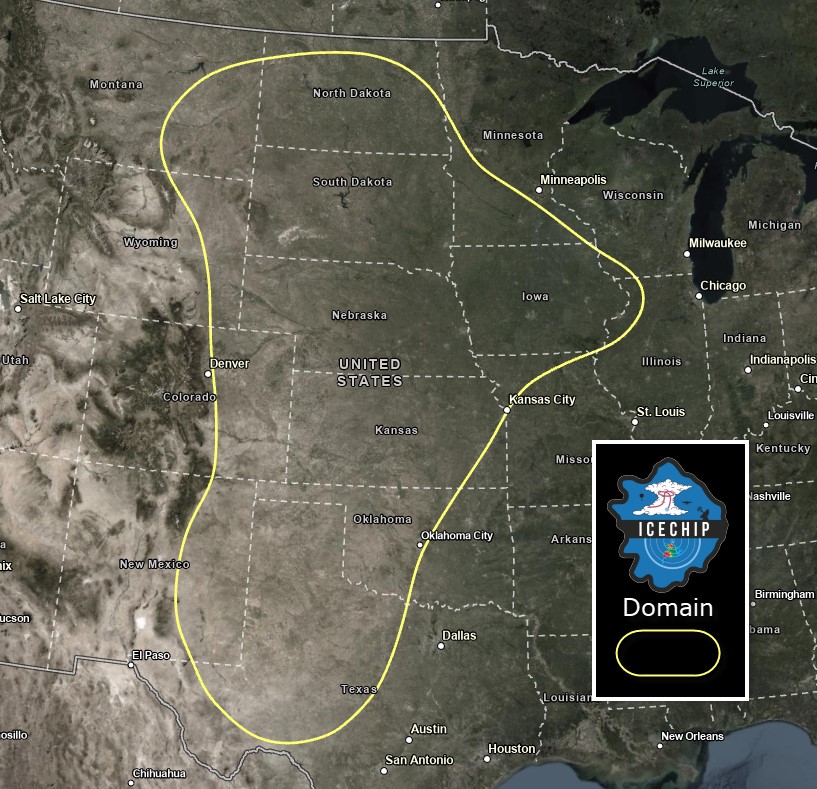
A map of the field study area. Researchers will travel to areas where the greatest hail threats exist.
The new field study is dubbed ICECHIP, short for In-situ Collaborative Experiment for Collection of Hail in the Plains. The project will include roughly 100 researchers, including NIU faculty and students, who are planning fieldwork in and around the U.S. Central Plains and the Front Range of the Rocky Mountains.
NIU Atmospheric Science Professor Victor Gensini is one of four leaders of the $11 million National Science Foundation-supported project, the world’s largest ever coordinated effort to study hail. Gensini notes that hail causes about $10 billion in damages across the country annually. Yet, the field study will be the first large hail-focused campaign in over 40 years.
“Tornadoes often dominate the headlines, but hail actually causes far more damage to property and agriculture,” Gensini explained. “Our goal is to leverage cutting-edge technology to enhance forecasters’ ability to detect and predict severe hail, ultimately helping people protect themselves, their property and their livelihoods.”
‘Huskie Hail Hunter’
In addition to Gensini, the project’s co-leaders are Becky Adams-Selin, a hail scientist at Atmospheric and Environmental Research, John Allen of Central Michigan University and Andy Heymsfield of the National Center for Atmospheric Research.
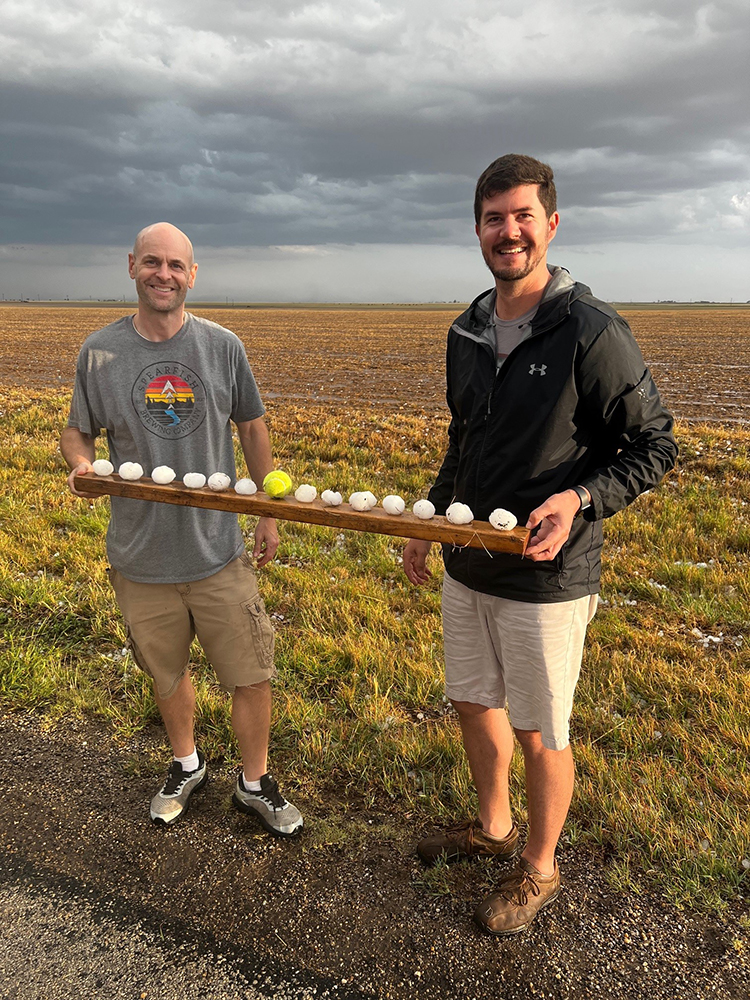
NIU Professors Walker Ashley and Victor Gensini hold a flight of severe hailstones in a field near Tulia, TX on May 31, 2022. Photo courtesy of Laura Hedien.
Participating NIU researchers include Atmospheric Science Professor Walker Ashley, Geochemistry Professor Justin Dodd and Mechanical Engineering Professors Nicholas Pohlman and Iman Salehinia, who are overseeing a crew of six undergraduate student engineers outfitting a 2022 Ford F-150 pickup truck to make it hail resistant.
Dubbed the “Huskie Hail Hunter,” the vehicle will undergo verification testing that will include launching 2-inch ice balls from the top of Huskie Stadium onto the vehicle.
“It has been a practical challenge for the engineers whose primary focus is to protect the glass surfaces on an established vehicle frame,” Pohlman said. “A cracked windshield is repairable but could consume valuable field-work time for collecting hail samples. The team considered a deployable system to be more fuel efficient but ultimately decided to keep it simple with a rail-mounted protective mesh.”
The ICECHIP project is truly a cross-disciplinary effort, Dodd adds.
“As a geochemist, I primarily study fluid-rock interactions through measuring the chemistry of geologic materials from around the world, including places like Antarctica,” Dodd said.
“For ICECHIP, I will measure the oxygen and hydrogen isotope values of the hailstones we plan to collect. Large hailstones form by adding new ice in sequential layers, so by looking at the water isotopes in the hail we hope to reconstruct the history of each hailstone from formation to when we collect it on the ground.”
Hands-on experience for students
In all, 15 NIU Atmospheric Science students are involved in the field study. For students like Bundy, the project presents an incredible opportunity to participate in leading-edge research.
“I’m eager to see how this experience shapes my personal and professional growth,” said Bundy, who’s pursuing his Ph.D. in Earth, Atmosphere and Environment. “After nine years in college, I see this as one of the best opportunities I have had. It is incredible to be part of something with such a meaningful impact.”
Technology to be deployed in the field will include drones, weather balloons, hail-impact disdrometers for distinguishing hail sizes, hail pads measuring strike impacts and vehicles equipped with radar and environmental monitoring equipment.
“I look forward to gaining hands-on knowledge of advanced instrumentation and technologies, deepening my understanding of hail science in real time,” Bundy said. “Just as exciting is the opportunity to connect with leading scientists and peers from other universities—building relationships with some of the top minds in the field will be invaluable.”

Evelynn Mantia
Like Bundy, Evelynn Mantia, a senior meteorology major from Joliet, got hooked on weather as a youngster. Learning about severe weather helped her ease her storm anxiety. Now meteorology is her passion.
“My main research interest is hail,” Mantia said. “I’m thrilled to contribute to the goals of this field campaign, which will help us gain a deeper understanding of hail processes in thunderstorms. The data we collect will be invaluable, not only to the meteorological community but also to industries such as insurance and agriculture, which are directly impacted by hail. Being part of this data collection effort, which will support those who rely on our science, is incredibly exciting.”
Aiming for improved forecasting
Gensini hopes the project will make strides in forecasting that students will use throughout their careers.
“Storm forecasting has improved dramatically in recent decades, but there’s still no current hail forecasting method that produces reliable, skillful forecasts of significantly severe hail occurrence a day in advance or even at less than an hour lead times,” he said. “Even one successful forecast of hail enabled by the campaign could save millions of dollars.”
The study will kick off on May 13, when the NIU Team will head to Boulder, Colo., for training. Thereafter, the scientists will travel toward wherever the greatest risk for hail potential occurs—likely somewhere in the Great Plains.
Media Contact: Tom Parisi
About NIU
Northern Illinois University is a student-centered, nationally recognized public research university, with expertise that benefits its region and spans the globe in a wide variety of fields, including the sciences, humanities, arts, business, engineering, education, health and law. The Wall Street Journal and CollegeNET recognize NIU as a leading institution for social mobility, or helping its students climb the socioeconomic ladder. Through its main campus in DeKalb, Illinois, and education centers for students and working professionals in Chicago, Naperville and Rockford, NIU offers more than 100 areas of study while serving a diverse and international student body.
