DeKalb, IL – A Northern Illinois University professor renowned worldwide for his research on the literatures and languages of early America and the Middle East is featured in the Public Broadcasting Service (PBS) documentary series “American Muslims: A History Revealed.”
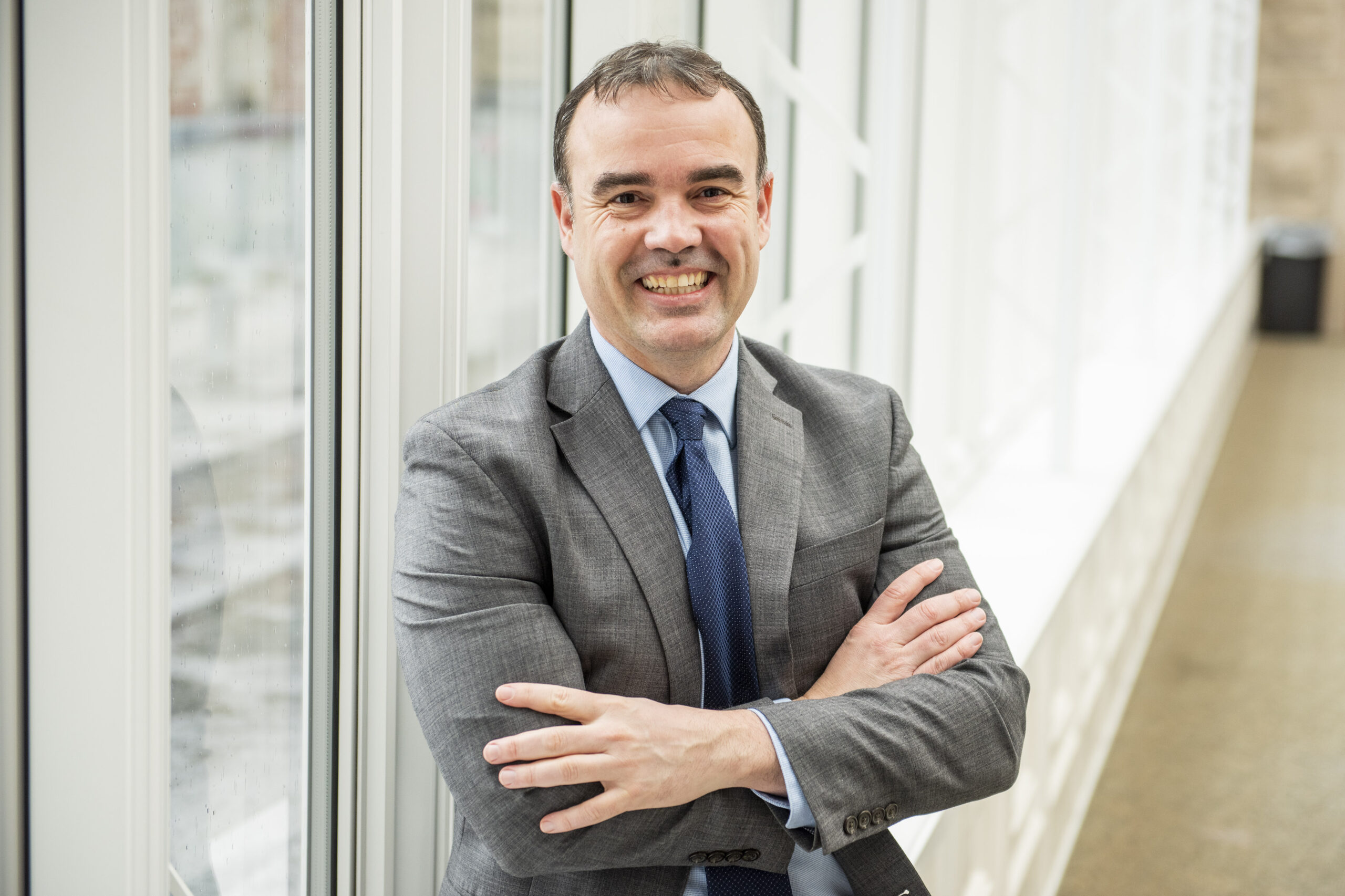
NIU English Professor Jeffrey Einboden is working on a new book, “Chains and the Crescent,” which will advance his translation research from “Jefferson’s Muslim Fugitives” to the period of the American Civil War. Einboden is featured in the PBS documentary “American Muslims: A History Revealed.”
Jeffrey Einboden, who joined the Department of English in NIU’s College of Liberal Arts and Sciences in 2006 after earning his Ph.D. from the University of Cambridge two decades ago, was interviewed based on material covered in his book “Jefferson’s Muslim Fugitives: The Lost Story of Enslaved Africans, their Arabic Letters, and an American President.”
Before being awarded a Presidential Research, Scholarship and Artistry professorship from NIU in 2019, Einboden received the American Council of Learned Societies’ coveted fellowship in 2017. He has translated previously undeciphered archival manuscripts and published several monographs — the most recent of which garnered the attention of PBS.
“As academics, we’re used to producing the books, and they often have a little bit more of a narrow audience, just by their nature,” said Einboden. “I did try to write the 2020 Oxford book ‘Jefferson’s Muslim Fugitives’ in a more accessible way for a broader audience, so it is particularly pleasing to me that it did catch some notice from folks outside my smaller academic niche.”
PBS’ years-long production of the documentary culminated in Einboden’s appearance on “How Muslims Influenced Thomas Jefferson and America’s Founders,” the penultimate installment of the six-part “American Muslims” series, which debuted fall 2024 to January. The documentary crew came to NIU’s campus in 2023, filming Einboden’s interview for the fifth episode in the Barsema Alumni and Visitors Center’s sleek Castle Faculty Library.
Part five has proven one of the most popular of the “American Muslims” episodes since airing in December, pulling in 650,000-plus views where the series is posted on YouTube.
“I think part of that is the attraction of Jefferson, to be honest,” said Einboden. “But putting Jefferson together with Islam and, of course, the most problematic and powerful theme that connects those two is enslavement, is slavery, so this perhaps attracted — because of the power of the subject matter or subject matters — more people to it.”
‘Jefferson and liberty, freedom and literacy’
Beyond being the third president and leading author of the Declaration of Independence, Thomas Jefferson desired an additional legacy within national memory: religious freedom. Jefferson, who owned a copy of the Qur’an and in 1805 hosted a Muslim diplomat for what was considered to be the White House’s first iftar dinner, held strong beliefs about religious freedom that were incongruent with his ownership of slaves. More than 400 enslaved men, women and children provided the labor to build and run Jefferson’s plantation, Monticello.
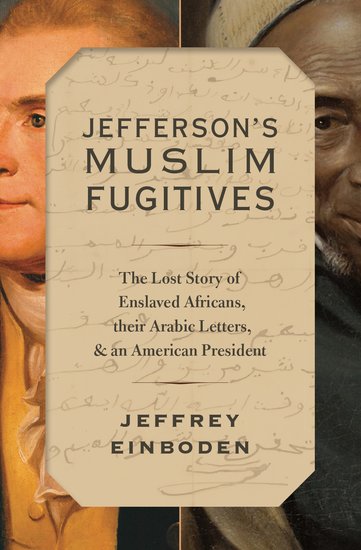
Jeffrey Einboden’s 2020 monograph, “Jefferson’s Muslim Fugitives,” inspired an interview request from PBS documentary producers.
Before his presidency, in 1777 Jefferson wrote the Virginia Statute for Religious Freedom, which paved the way for the religious clauses within the U.S. Constitution’s Bill of Rights in 1791. PBS examines Jefferson’s assertion that the Founding Fathers’ definition of religious freedom was “meant to comprehend, within the mantle of it’s [sic] protection, the Jew and the Gentile, the Christian and Mahometan, the Hindoo and infidel of every denomination.”
“That episode was very important, having to do with Jefferson and liberty, freedom and literacy — and reaches back to a very NIU-based initiative I founded in 2011 with a National Endowment for the Humanities (NEH) grant called Arabic Slave Writings and the American Canon,” said Einboden. “The NEH grant yielded an NIU website featuring Arabic documents which I translated into English, and really was my first effort to recover Arabic documents written by enslaved West African people before the Civil War.”
As many as one in five adults and children captured through the slave trade and brought to the Americas came from Muslim regions of West Africa, where Islam is the primary religion. Even the United States’ first president, George Washington, owned at least two slaves whose names suggested their Muslim heritage. In 1807, Jefferson attempted to come to the aid of two Muslim slaves whose call for help via a letter written in Arabic landed in his hands. Einboden’s research sifting through documents over a decade and a half yielded his 2020 book about the event.
Another chapter with ‘Chains and the Crescent’
Einboden anticipates PBS will conduct follow-up work on their documentary, and he continues to rediscover the stories of literate enslaved Muslims, some of whose remaining letters, autobiographies, prayers and poetry have been lost for two centuries or more.
“Part of the gift of the profession is to launch on these detective tracking expeditions, some of which return fruits and many of them that don’t,” said Einboden. “But when they do, and when you open that packet or envelope or the pages tucked inside of a book and you realize there are documents written in Arabic by an enslaved person from West Africa — amongst the most august keepings of the National Archives — it’s a very, very poignant and powerful moment.”
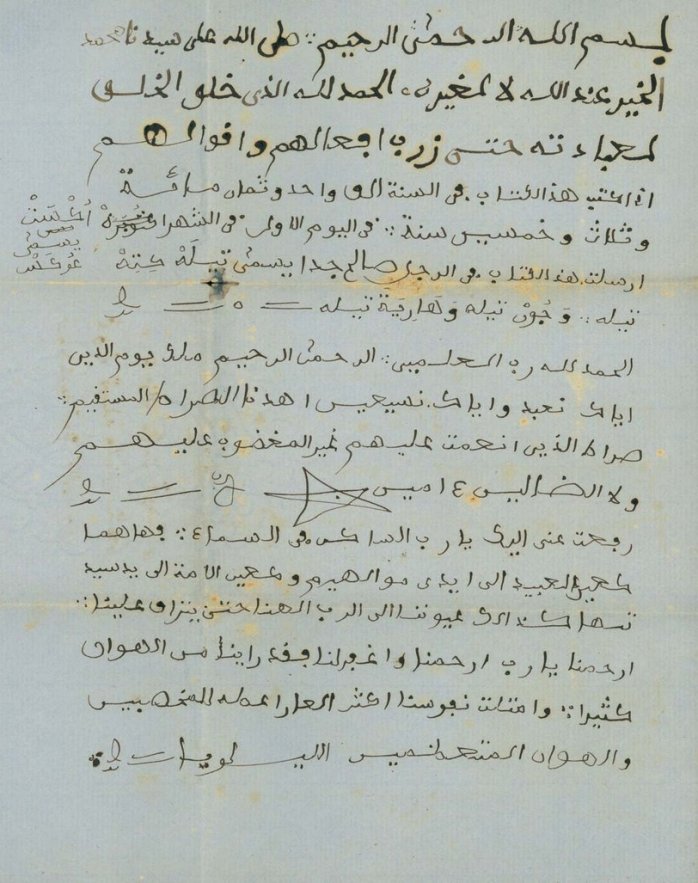
Part of an 1853 letter from ‘Umar ibn Sayyid is shown in a digital archival scan from the original manuscript.
Einboden is working on a new book, “Chains and the Crescent,” a sequel to his “Jefferson’s Muslim Fugitives,” which will advance his research into Arabic manuscripts up through the Civil War in the 1860s. His past books include “The Qur’an and Kerygma” (2019), “The Islamic Lineage of American Literary Culture” (2016), “Islam and Romanticism: Muslim Currents from Goethe to Emerson” (2014), and “Nineteenth-Century U.S. Literature in Middle Eastern Languages” (2013).
One particular narrative from the PBS episode Einboden will persist in tracing is that of ‘Umar ibn Sayyid, a Muslim man born to a well-to-do family in 1770, abducted from West Africa, sold at auction in the U.S. during Jefferson’s presidency and enslaved until his death in 1864 before the end of the Civil War. In 1831, Ibn Sayyid penned the only known slave autobiography written in Arabic. The nearly 200-year-old memoir was rediscovered in the 1990s, and Einboden’s work brought an additional 1853 letter from Ibn Sayyid to light.
On top of creating a scholarly record revealing newly translated material to the world, “Chains and the Crescent” will consider how Arabic writings by Muslims enslaved in the U.S. may have helped catalyze abolitionism or otherwise advance the anti-slavery movement.
Rediscovering America’s polyglottal heritage
Beloved Illinois figure Abraham Lincoln will play a critical role, as Einboden uses the 16th president’s Gettysburg Address to segue from “Jefferson’s Muslim Fugitives.”
The lesser-known two-hour opening oration before Lincoln’s two-minute address was given by Edward Everett, at the time a prolifically appointed politician and former president of Harvard University. Everett had met one of the other subjects of the PBS documentary and Einboden’s research, Ibrahim ‘Abd ar-Rahman, and owned an artifact of writing from the formerly enslaved West African prince who was emancipated with his wife in 1828.
Bringing these findings back into national memory demonstrates that America has always been multilingual, and that the country’s early leadership devoted significant effort to be a collector of these languages — from Jefferson advising that the Lewis and Clark Expedition record indigenous languages to Arabic writings informing the Union’s Civil War discourse.
“Language is one of those things, like freedom, that is most essential to a human being as part of the architecture of who we are — but is also profoundly communal,” said Einboden.
Despite recent technological advances to scan and digitize the country’s historical archives, Einboden believes the manuscripts he describes as “landmarks of lives” will continue to be found in the traditionally quite tangible way: in person by trained translators.
“Written in the flowing, beautiful script of Arabic, these manuscripts by enslaved Muslims have suffered neglect due, in part, to their language,” said Einboden. “They’ve lain silent for a reason, despite being archived adjacent to the most recognized documents in American history.”
Media Contact: Jeniece Smith
About NIU
Northern Illinois University is a student-centered, nationally recognized public research university, with expertise that benefits its region and spans the globe in a wide variety of fields, including the sciences, humanities, arts, business, engineering, education, health and law. The Wall Street Journal and CollegeNET recognize NIU as a leading institution for social mobility, or helping its students climb the socioeconomic ladder. Through its main campus in DeKalb, Illinois, and education centers for students and working professionals in Chicago, Naperville and Rockford, NIU offers more than 100 areas of study while serving a diverse and international student body.
