
DeKalb, IL – About five years ago, NIU Psychology Professor Brad Sagarin’s passion for playing Pokémon Go sparked a research project that sought to answer this central question: What effect does the augmented reality game have on players’ sense of belonging?
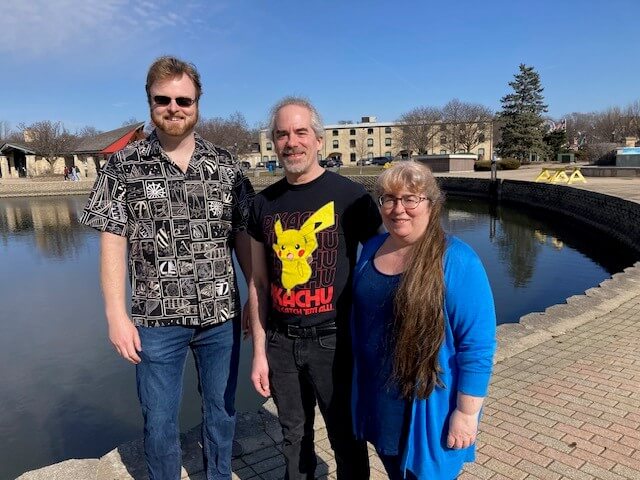
Andrew Pederson (left) with Professors Brad Sagarin and Kimberly Lawler-Sagarin at the Batavia Riverwalk, a hot spot for Pokémon Go enthusiasts.
Along with his Pokémon Go-playing wife, Elmhurst University Chemistry Professor Kimberly Lawler-Sagarin, and then-NIU student Andrew Pederson, Sagarin’s yearlong inquiry netted a resounding answer—the game strengthens that feeling of belonging among players.
Since its debut in 2016 – there were over 230 million users globally at its peak — Pokémon Go has been a popular out-and-about endeavor that defies video games’ longstanding reputation as a refuge for couch potatoes. Building on the Pokémon card craze that went global in the late 1990s, the game’s players catch fictitious creatures they see and interact with through a smartphone.
Among other findings, the survey of 449 players between August 2018 and September 2019 found that 88% reported meeting someone playing the game, 78% reported visiting a new location, and 35% reported patronizing a new business. The results were derived from a 16-question survey; data indicated that the more someone played, the greater the chance they’d develop a stronger sense of belonging to the community where they play.
Their research paper, entitled “Enhanced Community Through Augmented Reality: Social Benefits of Pokémon Go,” was published in a recent issue of Psychological Reports, a bimonthly peer-reviewed academic journal covering research in psychology.
Previously, other researchers had found the phone-based game encourages physical exercise and social interaction.
Building on those findings, the authors stated that their research holds multiple implications, including “that areas such as town centers or college campuses could benefit from welcoming augmented reality games as these games have the potential to increase community engagement.”
The results affirm what the Sagarins have experienced. Residents of Batavia since 2001, “what really highlighted things for us is we discovered the Batavia Riverwalk through playing Pokémon Go,” Sagarin recalled. “We said, ‘What are all these Pokéstops over here? This is gorgeous. How did we not know about this?’ ”
Along the way, through their game play, “we would see this incredible diversity of people show up for events—kids on bikes, older couples walking up,” Sagarin added. “It’s really a wonderful way of seeing a group of people come together that probably would not have converged for other reasons.”
As a student majoring in psychology, Pederson met Sagarin in late 2017, a meeting that would perfectly foreshadow their research. At the recommendation of other psychology professors, Pederson signed up for Sagarin’s office hours to explore possibilities at the school.
After signing up, Pederson went outside to play Pokémon Go nearby with about 15 other players all engaged in one of the in-game group activities. After the activity wrapped up, Pederson announced he was “off to meet Sagarin.”
Much to everyone’s surprise, the man to his right looked up from his phone and asked “Oh, you’re my 1 o’clock?” It was Dr. Sagarin.
In the ensuing conversation, Pederson agreed to join Sagarin’s independent study group. The next semester, Sagarin invited Pederson, a 2019 NIU graduate with a degree in psychology, to be part of the Pokémon Go research project.
At Elmhurst University, in addition to being a chemistry professor, Lawler-Sagarin is associate dean of the faculty. In that latter role, she is studying factors that increase belonging and the role of belonging in student and faculty retention in higher education.
“There is an increasing body of evidence in the literature that shows a student’s sense of belonging enhances retention and persistence, especially in STEM,” Lawler-Sagarin explained. “Our experience with Pokémon Go highlighted the power of sense of belonging. We met so many different people in Batavia through playing Pokémon Go, the possibility that the game might increase a player’s sense of belonging to their community was something we were excited to explore.”
Computer gaming, historically, has tended to be “a solo kind of thing,” said Sagarin, who hopes the research will highlight the ability of some augmented reality games to provide a more social outlet.
“A lot of computer gaming can feel very isolating,” Sagarin said. “It’s cool the way Pokémon Go has gotten people out and about. It’s a nice way to change the narrative.”
Media Contact: Tom Parisi
About NIU
Northern Illinois University is a student-centered, nationally recognized public research university, with expertise that benefits its region and spans the globe in a wide variety of fields, including the sciences, humanities, arts, business, engineering, education, health and law. Through its main campus in DeKalb, Illinois, and education centers for students and working professionals in Chicago, Naperville, Oregon and Rockford, NIU offers more than 100 areas of study while serving a diverse and international student body.
