
DeKalb, IL – NIU Chemistry Professor Tao Li is a member of a new center at the U.S. Department of Energy’s Argonne National Laboratory that is making a major research push toward the decarbonization of steelmaking.
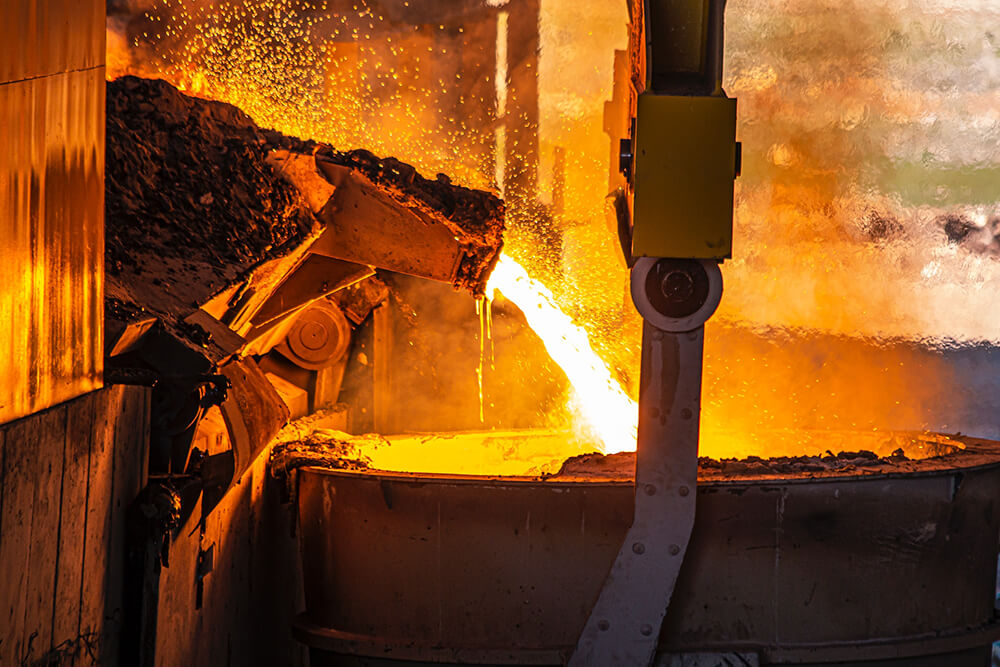
Photo by Yasin Hemmati on Unsplash
Steel has a major impact on people’s lives and the U.S. economy. The material is crucial to cars, trucks, airplanes, buildings and more, but there is a significant issue with the steelmaking production process. Globally, it accounts for a large percentage of greenhouse gas emissions from the industrial sector.
The U.S. Department of Energy (DOE) last week announced $19 million in funding over four years for Argonne to lead a multi-institutional Center for Steel Electrification by Electrosynthesis (C-STEEL). The center’s charge is to develop an innovative and low-cost process that would replace blast furnaces in steelmaking and reduce greenhouse gas emissions by 85%.
“It’s a big target that has a high reward if successful,” said Brian Ingram, the C-STEEL director and an Argonne group leader and materials scientist.
C-STEEL is a key project of the DOE’s Industrial Heat Energy Earthshot initiative, which aims to significantly cut emissions from the energy-intensive process of industrial heating. In addition to NIU, partners in the center include Oak Ridge National Laboratory, Case Western Reserve University, Purdue University Northwest and the University of Illinois Chicago.

NIU Professor Tao Li
As a center researcher, NIU’s Li will receive $850,000 in funding to study the solvation behavior of iron electrolytes. Solvation is the interaction of a solvent with a dissolved molecule. Li will hire one postdoctoral student and one Ph.D. student to assist with the study.
Currently, the most energy-intensive step in steel production involves converting iron ore into purified iron metal or iron alloys using blast furnaces. This demands temperatures of 2500 to 2700 degrees Fahrenheit, hotter than an erupting volcano. The center’s target is to develop a process that will essentially eliminate that heat demand, achieving an 85% reduction in greenhouse gas emissions by 2035.
“C-STEEL will apply electrodeposition processes to steelmaking,” said Li, who holds a joint appointment with NIU and Argonne. “Shifting away from the traditional blast-furnace method to a low or no-heat electrodeposition process would represent a leap toward more energy-efficient and environmentally sustainable steel production.”
The electrodeposition process involves dissolving iron ore in a solution and using electricity to initiate a reaction that deposits a useable iron metal or alloy for steelmaking. The solution is a liquid electrolyte similar to those found in batteries.
“Drawing from my knowledge gained at the Joint Center for Energy Storage Research at Argonne, especially in battery electrolytes, I see an opportunity to contribute insights into tailoring the liquid electrolyte crucial for this novel steelmaking process,” Li said. “I plan to use the synchrotron X-ray scattering technique to understand the relationships between electrolyte structures and properties.”
Li is excited to be part of the project and noted that the work demonstrates the importance of cross-disciplinary collaboration.
“It highlights the potential for transformative advancements when ideas from one field are applied to another,” Li said. “I look forward to contributing to developing a more sustainable and innovative approach to steel production by exploring this exciting intersection of steelmaking, electrochemistry and X-ray characterization.”
Overall, the C-STEEL project will pursue three thrusts. Two of them will investigate different processes for electrodeposition. One process will operate at room temperature using water-based electrolytes. The other will use a salt-based electrolyte and will function at temperatures 1800 to 2000 degrees Fahrenheit below current blast furnaces. The energy for this process is low enough that it could be provided by renewables or waste heat from a nuclear reactor.
A third thrust will focus on gaining an atomic-level understanding of each process. The goal of this thrust, which NIU’s Li is involved in, is to exert precise control over both the structure and composition of the metal products so that they can be incorporated into existing downstream processes of steelmaking.
Each thrust will incorporate an artificial intelligence-based platform to ensure a unified approach to electrolyte design. To that end, C-STEEL will be drawing upon the world-class computational resources of two Leadership Computing Facilities, one at Argonne and the other at Oak Ridge. Both are DOE Office of Science user facilities.
C-STEEL will also take advantage of the materials characterization capabilities of two other DOE user facilities at Argonne, the Advanced Photon Source and the Center for Nanoscale Materials. The research is being funded by the DOE’s Office of Science, Basic Energy Sciences and Advanced Scientific Computing Research.
About NIU
Northern Illinois University is a student-centered, nationally recognized public research university, with expertise that benefits its region and spans the globe in a wide variety of fields, including the sciences, humanities, arts, business, engineering, education, health and law. Through its main campus in DeKalb, Illinois, and education centers for students and working professionals in Chicago, Naperville, Oregon and Rockford, NIU offers more than 100 areas of study while serving a diverse and international student body.
